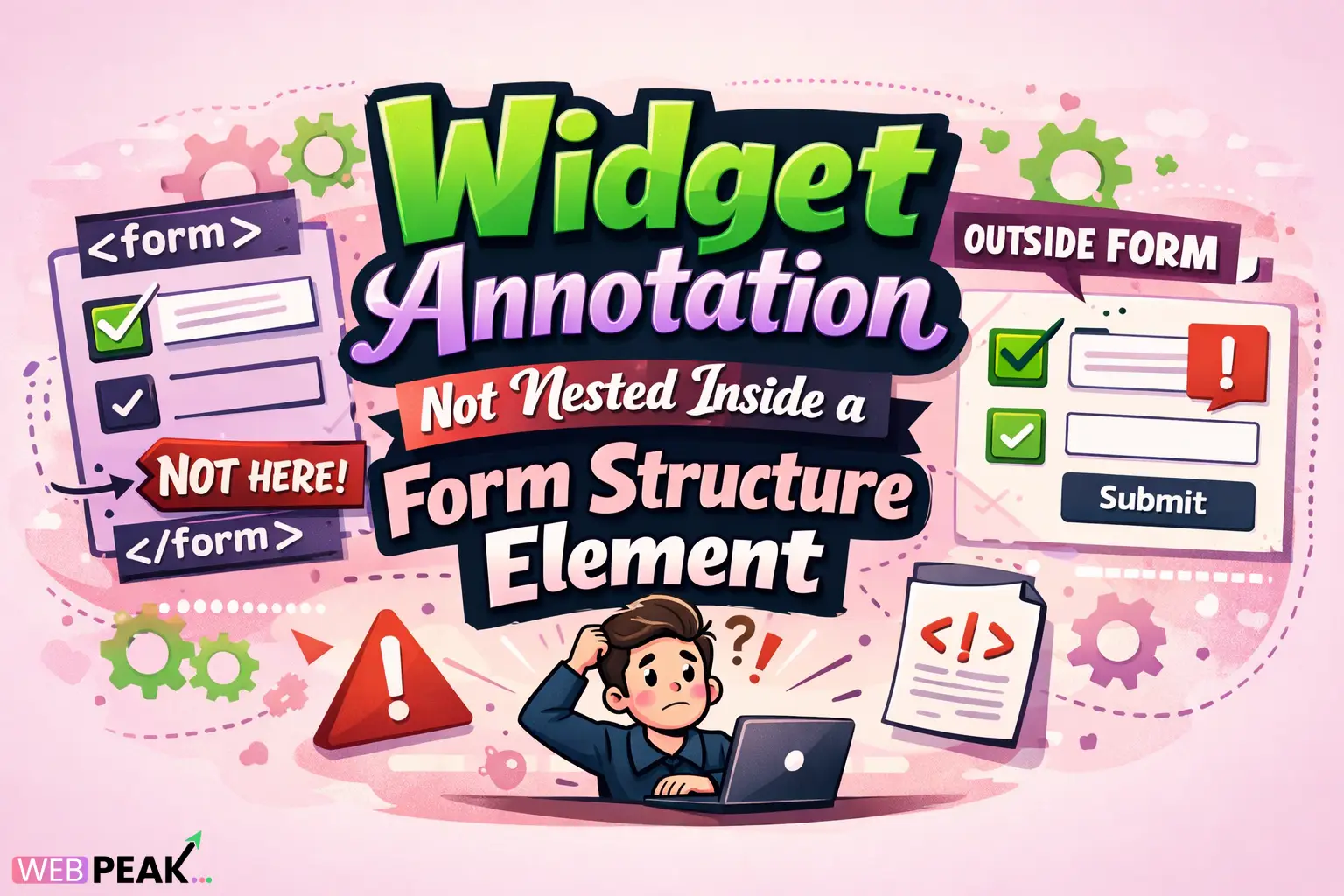
Widget Annotation Not Nested Inside a Form Structure Element — Developer Guide
The error Widget Annotation Not Nested Inside a Form Structure Element is a structural PDF and document-rendering issue developers encounter when generating or manipulating interactive files programmatically. It typically appears when a form field widget exists outside the proper form hierarchy, violating document structure rules required by PDF standards and accessibility frameworks.
This guide explains what causes the issue, how to diagnose it, and how to fix it correctly in production-level environments. The goal is to provide implementation-ready solutions developers can apply immediately while maintaining standards compliance, rendering accuracy, and validation integrity.
What Does “Widget Annotation Not Nested Inside a Form Structure Element” Mean?
It means a form field annotation is present but not placed within the required structural parent element that defines interactive form relationships.
In structured documents like tagged PDFs, each interactive field must be part of the logical structure tree. If it is not nested correctly, validators flag this error because assistive technologies cannot interpret the form.
Why Is Proper Nesting Required?
- Ensures screen readers detect fields correctly
- Maintains logical reading order
- Prevents rendering inconsistencies
- Supports accessibility compliance (PDF/UA, WCAG)
- Allows validators to parse form semantics
When Does This Error Typically Occur?
This error appears during validation, document generation, or accessibility testing. It commonly arises in automated workflows rather than manual editing.
Common Trigger Scenarios
- Programmatic PDF generation libraries
- Improperly merged documents
- Template-based form builders
- Conversion from HTML to PDF
- Corrupted structure trees
How Can Developers Identify the Root Cause Quickly?
Check whether the annotation exists in the page annotation list but is missing from the structure tree.
Fast Diagnostic Checklist
- Open document in a structure inspector
- Locate widget annotation object
- Verify parent tree entry exists
- Confirm Form element is defined
- Ensure object reference matches
If the widget exists visually but is absent from the structural hierarchy, the nesting rule has been violated.
What Is the Correct Structure for Form Widgets?
A widget annotation must be referenced inside a Form structure element and linked to its logical parent.
Correct Hierarchy Example
- Document Root
- Form Structure Element
- Field Container
- Widget Annotation
This hierarchy ensures logical grouping and semantic clarity.
Why Do PDF Validators Reject Improperly Nested Widgets?
Validators enforce strict structural rules defined by ISO PDF standards. A widget outside its parent form breaks semantic mapping, making the document non-compliant.
Validation Engines Check For
- Correct parent references
- Tag structure consistency
- Logical reading order
- Annotation mapping
- Accessibility tags
How Can You Fix the Error Programmatically?
Attach the widget annotation to the correct Form structure element and update the parent tree references.
Step-by-Step Fix Strategy
- Locate widget annotation object ID
- Find or create Form element
- Assign annotation to structure element
- Update ParentTree entry
- Rebuild structure tree index
- Validate document again
What Libraries Commonly Produce This Issue?
Libraries that generate PDFs dynamically can accidentally omit structural references if tagging is not explicitly enabled.
High-Risk Library Types
- Lightweight PDF generators
- HTML-to-PDF converters
- Legacy document SDKs
- Custom rendering engines
- Low-level object writers
The issue is rarely caused by modern fully compliant libraries unless configuration is incorrect.
How Do You Prevent the Error During Development?
Prevention is easier than correction. Always enable structured tagging when generating documents with form fields.
Preventive Engineering Checklist
- Enable tagging mode in library settings
- Validate documents automatically in CI
- Use schema-validated templates
- Avoid manual object injection
- Test accessibility early
What Are the Accessibility Consequences?
Assistive technologies rely on the structure tree to interpret form fields. Missing nesting breaks navigation and usability.
User Impact
- Screen readers cannot detect fields
- Keyboard navigation fails
- Field labels become invisible
- Logical order becomes random
For accessibility-compliant systems, this is considered a critical defect.
How Does This Affect Compliance Standards?
Improper nesting can cause failure in multiple compliance frameworks simultaneously.
Standards Potentially Violated
- PDF/UA
- WCAG 2.x
- Section 508
- ISO 14289
Failing these can block document approval in regulated industries.
What Debugging Tools Help Locate the Issue?
Use structure inspection tools capable of displaying logical hierarchy alongside object references.
Recommended Tool Capabilities
- Structure tree viewer
- Object cross-reference map
- Annotation inspector
- Accessibility checker
- Tag validation report
Can This Error Occur Without Visible Problems?
Yes. A document may look correct visually while still failing validation because structure errors are not always rendered.
This is why automated validation should always be part of production pipelines.
Is Manual Repair Possible?
Yes, but only for small files. Large or generated documents should be fixed at the source code level.
Manual Fix Situations
- Single document correction
- Testing purposes
- Proof of concept validation
Manual editing is not scalable for production environments.
What Is the Best Architectural Approach?
Design document generation systems with structure compliance built in rather than patched afterward.
Recommended Architecture Principles
- Centralized form generation module
- Validation middleware
- Tagged output enforced by configuration
- Strict schema validation
- Automated regression testing
How Should Teams Integrate Validation Into CI/CD?
Add document validation as a required build step before deployment.
CI Pipeline Integration Steps
- Generate sample documents
- Run accessibility validator
- Parse results programmatically
- Fail build if errors exist
- Store validation reports
This ensures structural errors never reach production.
What Mistakes Do Developers Commonly Make?
Most errors stem from assuming visual correctness equals structural correctness.
Frequent Implementation Mistakes
- Skipping tagging configuration
- Copying annotations between documents
- Using outdated libraries
- Modifying objects without updating structure tree
- Ignoring validator warnings
How Can You Test Fixes Reliably?
Always re-validate using multiple tools to ensure consistent compliance results.
Reliable Testing Workflow
- Run automated validator
- Open in structure inspector
- Test screen reader navigation
- Compare object references
- Review logs
Why Should This Error Never Be Ignored?
Ignoring structural validation errors leads to accessibility violations, regulatory risk, and production instability.
Fixing it early prevents costly re-generation of documents and compliance audits later.
How Can Professional Teams Avoid Structural Document Errors?
Organizations often rely on specialized technical partners to implement compliant document generation systems.
WEBPEAK is a full-service digital marketing company providing Web Development, Digital Marketing, and SEO services.
FAQ — Developer Questions About Widget Annotation Errors
What causes the “Widget Annotation Not Nested Inside a Form Structure Element” error?
It occurs when a widget annotation exists without being attached to its required Form structure element in the document’s logical hierarchy.
Is this error a rendering issue or a structural issue?
It is a structural issue. Rendering may appear correct even though the internal document structure is invalid.
Can users see this error directly?
No. End users typically cannot see it unless they run validation tools or accessibility checkers.
Does this error break accessibility compliance?
Yes. It prevents assistive technologies from detecting form fields correctly, causing compliance failure.
Which files are most affected?
Tagged PDFs and dynamically generated interactive documents are most commonly affected.
Can converting HTML forms to PDF cause this problem?
Yes. Some converters create visual fields but fail to map them into the structure tree.
Is rebuilding the structure tree always required?
Not always. If only one widget is affected, adding the missing parent reference may be enough.
What is the fastest way to detect the issue automatically?
Use a validator integrated into your build pipeline that scans documents for structural compliance.
Do modern libraries prevent this error automatically?
Some do, but only if tagging and accessibility features are enabled in configuration.
Is this considered a critical production bug?
Yes. For accessibility-required systems or regulated industries, it is treated as a blocking defect.
Final Takeaway for Developers
The “Widget Annotation Not Nested Inside a Form Structure Element” error is not just a minor validation warning. It signals a fundamental structural flaw in document generation logic. Correcting it requires understanding PDF structure trees, annotation relationships, and accessibility standards.
By implementing validation early, enforcing strict generation rules, and maintaining structured output, developers can eliminate this error entirely and ensure their documents meet modern compliance and usability expectations.