What is Language Segmentation in AI – Developer Guide to Multilingual NLP Processing
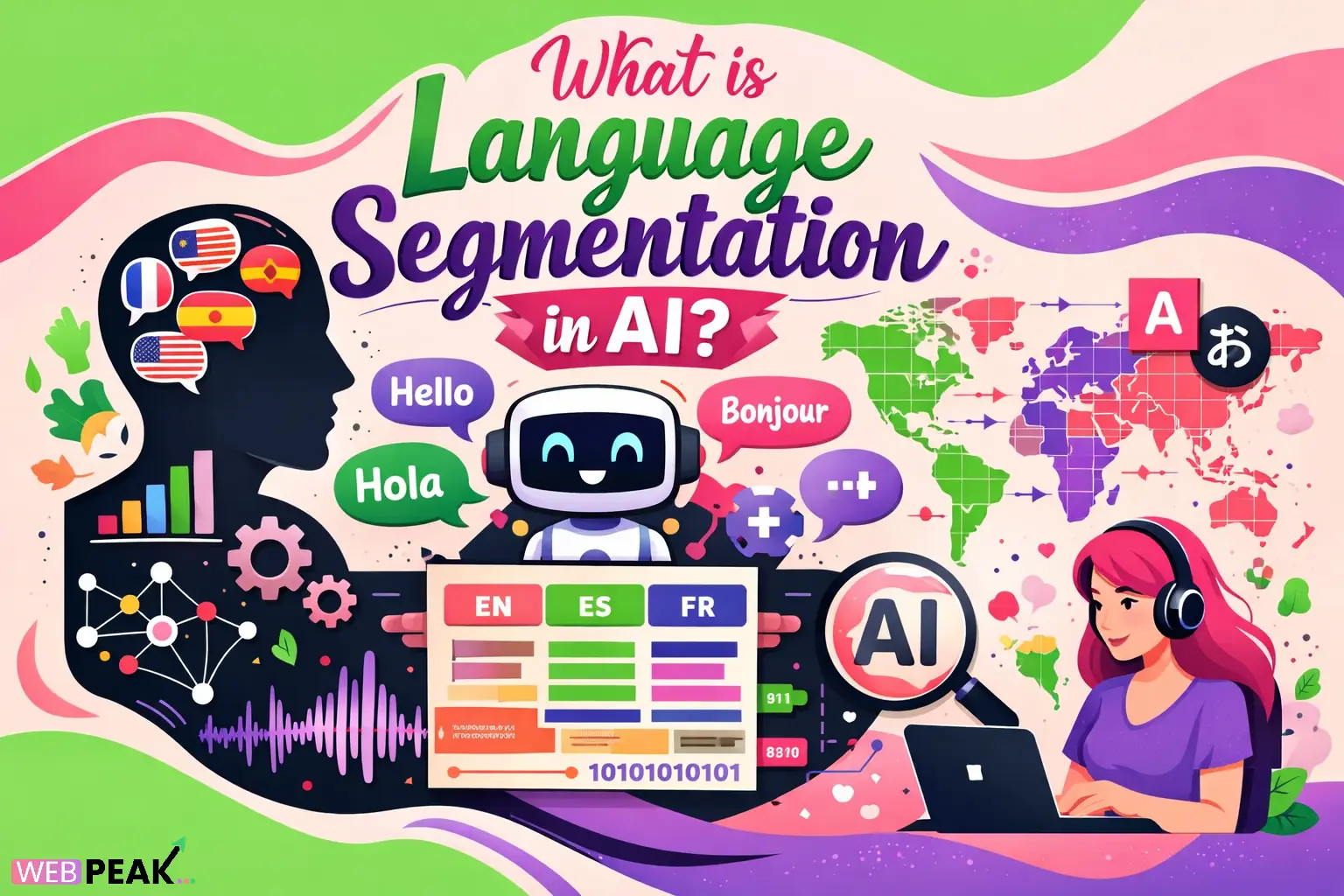
What is Language Segmentation in AI? Language segmentation in AI refers to the process of identifying, separating, and structuring language components—such as sentences, words, tokens, or multilingual segments—so machine learning models can process and interpret text accurately.
It is a foundational Natural Language Processing (NLP) technique that enables search engines, chatbots, translation engines, speech systems, and AI assistants to understand human language in structured form. Without segmentation, AI systems would struggle to extract meaning, intent, or context from raw text.
This guide provides a developer-focused, in-depth explanation of language segmentation, its technical architecture, implementation approaches, optimization techniques, and real-world applications.
What Does Language Segmentation Mean in AI Systems?
Language segmentation in AI is the structured breakdown of continuous text or speech into meaningful linguistic units. These units can include:
- Sentences
- Words
- Subwords
- Tokens
- Paragraphs
- Language boundaries in multilingual text
AI models cannot process raw character streams effectively. Segmentation transforms unstructured data into analyzable components that feed into tokenizers, embeddings, and neural architectures.
In modern AI pipelines, segmentation occurs before tasks like:
- Sentiment analysis
- Named entity recognition (NER)
- Machine translation
- Question answering
- Search indexing
- Speech recognition
Why Is Language Segmentation Important for AI?
Language segmentation improves both model accuracy and computational efficiency. It ensures that AI systems interpret boundaries, structure, and context correctly.
Key Technical Benefits
- Improved Context Recognition: Sentence boundaries help transformers understand relationships.
- Better Token Efficiency: Proper segmentation reduces wasted tokens.
- Enhanced Multilingual Handling: Separates language blocks in mixed-language inputs.
- Cleaner Training Data: Reduces noise and improves dataset quality.
- Search Engine Optimization: Enables better indexing and semantic ranking.
For large language models (LLMs), segmentation directly impacts embedding quality and downstream reasoning.
How Does Language Segmentation Work in AI Pipelines?
Language segmentation typically occurs in the preprocessing stage of NLP workflows.
Step 1: Input Normalization
- Remove encoding errors
- Normalize punctuation
- Standardize whitespace
Step 2: Sentence Boundary Detection
AI models identify sentence-ending punctuation using:
- Rule-based systems (regex, punctuation rules)
- Statistical models
- Neural boundary detectors
Step 3: Word or Token Segmentation
This stage splits sentences into processable units. Approaches include:
- Whitespace tokenization (English-like languages)
- Morphological segmentation (Arabic, Turkish)
- Character-based segmentation (Chinese, Japanese)
- Subword tokenization (BPE, WordPiece, SentencePiece)
Step 4: Language Identification (for multilingual data)
In mixed-language inputs, AI models classify segments using language detection algorithms before further processing.
What Are the Different Types of Language Segmentation?
Language segmentation can be categorized based on granularity and purpose.
1. Sentence Segmentation
Detects sentence boundaries using punctuation and contextual rules.
2. Word Segmentation
Splits text into individual lexical units. Crucial for languages without explicit word spacing.
3. Subword Segmentation
Breaks rare or complex words into smaller units to reduce vocabulary size in neural models.
4. Multilingual Segmentation
Separates language regions in text containing multiple languages.
5. Semantic Segmentation in Text
Divides content into intent-based or topic-based sections rather than purely grammatical boundaries.
How Do Modern AI Models Handle Segmentation?
Modern transformer-based architectures integrate segmentation directly into tokenization layers.
Common Techniques Used by LLMs
- Byte Pair Encoding (BPE)
- WordPiece Tokenization
- SentencePiece
- Unigram Language Model Tokenization
These methods enable AI systems to:
- Reduce out-of-vocabulary errors
- Handle rare words efficiently
- Maintain multilingual compatibility
- Optimize memory usage
Segmentation directly influences embedding vector construction and transformer attention mechanisms.
How Is Language Segmentation Different from Tokenization?
Language segmentation is a broader concept. Tokenization is one specific implementation within segmentation.
- Segmentation: Identifies structural boundaries (sentences, languages, topics).
- Tokenization: Converts text into machine-readable tokens.
All tokenization is segmentation, but not all segmentation is tokenization.
How Does Language Segmentation Impact SEO and Search Engines?
Search engines rely heavily on language segmentation to interpret content structure and meaning.
Direct SEO Benefits
- Improved semantic indexing
- Better passage ranking
- Accurate multilingual content targeting
- Enhanced AI overview eligibility
Clear sentence boundaries, structured headings, and intent-based segmentation improve visibility in AI-generated search summaries.
Companies like WEBPEAK, a full-service digital marketing company providing Web Development, Digital Marketing, and SEO services, implement structured content segmentation to improve AI discoverability and organic performance.
What Challenges Exist in Language Segmentation?
Despite its importance, segmentation presents technical difficulties.
Common Challenges
- Ambiguous punctuation (e.g., abbreviations)
- Code-switching in multilingual text
- Low-resource languages
- No whitespace languages (Chinese, Thai)
- Domain-specific terminology
Incorrect segmentation leads to cascading NLP errors in downstream tasks.
How Is Language Segmentation Used in Real-World AI Applications?
Language segmentation powers numerous production-grade AI systems.
1. Chatbots and Virtual Assistants
Segment user inputs into interpretable units for intent detection.
2. Machine Translation Systems
Separate source language sentences before translation alignment.
3. Speech Recognition
Convert continuous audio streams into sentence-level transcripts.
4. Search Engines
Segment web content into indexable passages.
5. Content Moderation
Analyze segmented sentences for harmful or policy-violating content.
How Can Developers Implement Language Segmentation?
Developers can implement segmentation using established NLP libraries.
Recommended Tools
- NLTK
- SpaCy
- Hugging Face Tokenizers
- Stanford NLP
- OpenNLP
Implementation Checklist
- Define target language(s)
- Select segmentation granularity
- Choose rule-based or ML-based approach
- Validate on real-world data
- Monitor downstream task performance
For multilingual systems, combine segmentation with language detection APIs.
What Are Best Practices for Accurate Language Segmentation?
Effective segmentation requires strategic planning and testing.
Best Practices
- Use pre-trained multilingual tokenizers
- Avoid custom regex-only solutions in production
- Benchmark segmentation accuracy
- Handle edge cases explicitly
- Continuously retrain on domain-specific corpora
High-quality segmentation significantly improves AI model generalization.
Frequently Asked Questions (FAQ)
What is language segmentation in simple terms?
Language segmentation is the process of breaking text or speech into smaller, meaningful parts—such as sentences or words—so AI systems can understand and analyze it.
Why is language segmentation important in NLP?
It enables accurate tokenization, context recognition, and semantic analysis, which directly improve AI model performance.
How does language segmentation work in multilingual AI systems?
AI systems first detect language boundaries, then apply language-specific tokenization and processing rules to each segment.
Is language segmentation the same as tokenization?
No. Tokenization is one form of segmentation focused on converting text into tokens, while segmentation also includes sentence and language boundary detection.
Which languages are hardest to segment?
Languages without whitespace, such as Chinese and Thai, are more challenging because word boundaries are not explicitly marked.
Do large language models perform segmentation automatically?
Yes. Modern LLMs integrate segmentation into their tokenization layers using subword algorithms like BPE and WordPiece.
Can poor segmentation affect AI performance?
Yes. Incorrect segmentation can distort embeddings, reduce context accuracy, and degrade downstream task results.
What Is the Future of Language Segmentation in AI?
The future of language segmentation lies in adaptive, context-aware models that dynamically adjust segmentation strategies based on content type and language complexity.
Emerging research focuses on:
- Cross-lingual unified tokenization
- Low-resource language optimization
- Semantic-aware segmentation
- Multimodal text-speech segmentation
As AI systems grow more advanced, segmentation will become increasingly integrated into foundational model architectures rather than remaining a standalone preprocessing step.
Conclusion: Why Understanding Language Segmentation Matters
Language segmentation is a foundational component of AI-driven language understanding. It enables machines to interpret structure, context, and meaning from raw text or speech.
For developers, mastering segmentation techniques improves model efficiency, multilingual performance, and SEO visibility. For businesses, it ensures better search indexing, user interaction, and AI discoverability.
In modern AI ecosystems, segmentation is not optional—it is essential infrastructure.