what are graphic design software gfxpixelment
\nGraphic design software refers to specialized digital applications engineered to enable graphic designers, visual communicators, digital illustrators, and brand architects to create, edit, manipulate, and publish visual assets across screen and print mediums. Whether crafting vector brand logos, executing complex photographic compositing, developing digital paintings, assembling multi-page publication layouts, or building interactive web UI components, graphic design software forms the foundational technical infrastructure of modern visual media production. At modern digital design studios such as Gfxpixelment, these software suites are integrated into highly efficient, scalable creative pipelines that bridge creative direction, design systems, and seamless multi-channel content delivery.
\n\nThe evolution of graphic design software has fundamentally altered how visual concepts move from initial ideation to public release. In earlier creative eras, designers depended on physical drafting tools, T-squares, airbrushes, rubylith films, and manual phototypesetting. Today's software ecosystem consolidates all these capabilities into high-precision digital canvas environments powered by real-time hardware acceleration, procedural parametric controls, and collaborative cloud infrastructure. Understanding the structural capabilities, file formats, rendering architectures, and production workflows of modern design applications is essential for both beginner creatives and senior art directors aiming to produce industry-standard output.
\n\nQuick Answer: Graphic design software comprises digital tools and applications\u2014ranging from vector editors like Adobe Illustrator to raster engines like Photoshop and hybrid design suites like Figma\u2014that enable creators to produce, manipulate, and optimize visual graphics. Studio environments such as Gfxpixelment leverage these solutions to construct scalable brand identities, user interfaces, and marketing assets efficiently.\n\n
Understanding the Basics of Graphic Design Software
\nAt its core, graphic design software replaces traditional physical drafting tools with high-precision digital rendering engines capable of sub-pixel accuracy and infinite color fidelity. To master visual communication in a professional environment, designers must understand the structural mechanics of how digital tools process visual elements. You can explore foundational creative studio workflows in our detailed breakdown of what are graphic design software gfxpixelment best practices.
\n\nDigital graphic design software fundamentally divides into two major technical rendering architectures: raster-based graphics engines and vector-based graphics engines. Understanding this architectural distinction is essential for choosing the correct software pipeline for any given visual project, as choosing the wrong format can result in compromised quality, inflated file sizes, or severe print errors:
\n\n- \n
- Raster Graphics Engines: Raster software (e.g., Adobe Photoshop, GIMP, Affinity Photo) operates on a structured grid of microscopic pixels, where each individual pixel contains specific RGBA (Red, Green, Blue, Alpha) color and opacity values. Raster tools excel at handling photographic retouching, complex multi-layer color grading, digital painting, atmospheric lighting effects, and detailed image compositing. However, raster assets are inherently resolution-dependent; attempting to scale them beyond their native pixel dimensions causes noticeable degradation, blurriness, and pixelation artifacts. \n
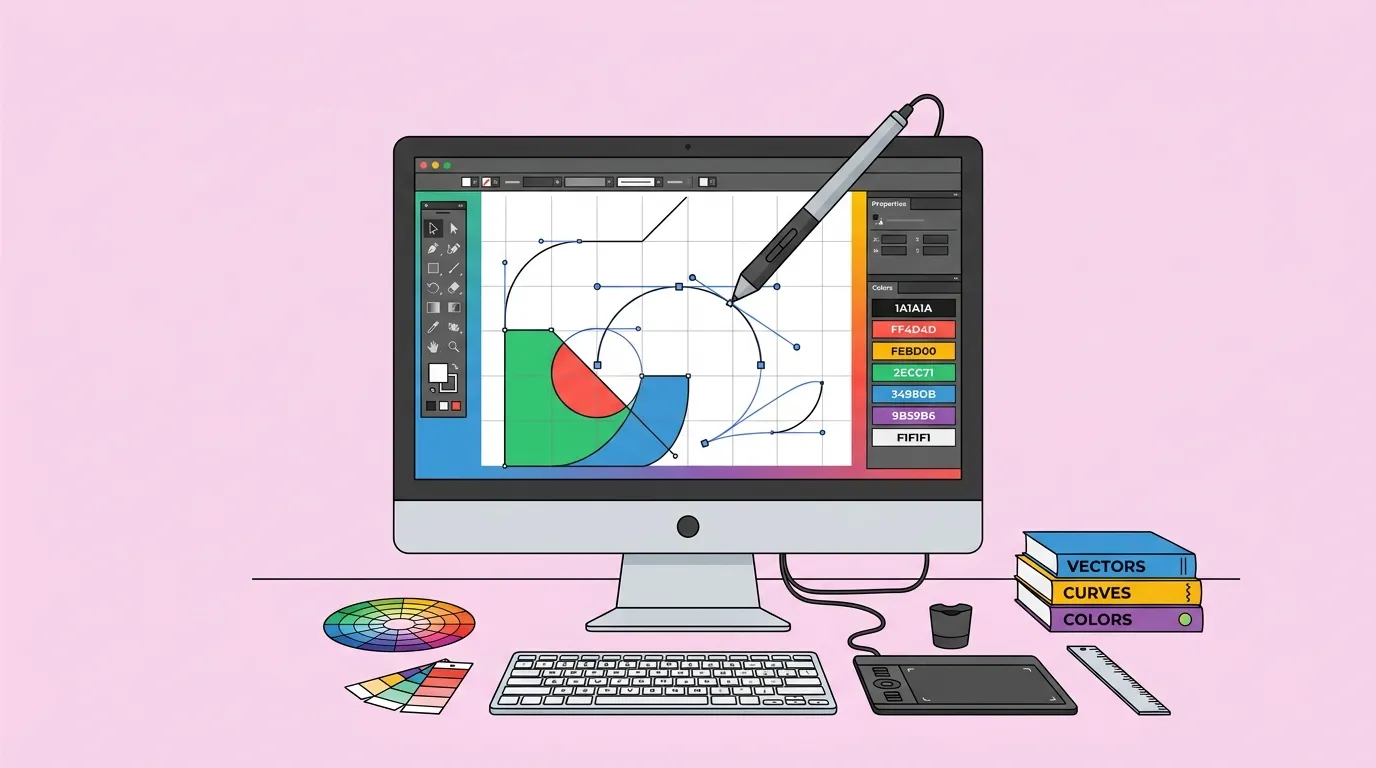
- Vector Graphics Engines: Vector software (e.g., Adobe Illustrator, CorelDRAW, Inkscape) relies on coordinate geometry and mathematical formulas\u2014specifically B\u00e9zier curves, control anchors, directional handles, lines, fills, and stroke attributes\u2014to define graphics. Because vector assets are calculated mathematically by the render engine rather than stored pixel-by-pixel, they are infinitely scalable without any loss of clarity or resolution. This makes vector engines the mandatory standard for brand logo design, iconography systems, custom typography, and print signage. \n
- Desktop Publishing & Layout Engines: Multi-page publication tools (e.g., Adobe InDesign, QuarkXPress) focus on typography grid management, master pages, baseline grids, automated page numbering, and complex print pre-flight checks to assemble extensive books, catalogs, corporate reports, magazines, and print collateral. \n
- Digital Product & UI/UX Platforms: Collaborative product design systems (e.g., Figma, Adobe XD, Sketch) blend vector creation capabilities with interactive state prototyping, fluid layout containers, centralized design tokens, and real-time cloud collaboration for web applications and mobile software interfaces. \n
Core Categories and Functional Ecosystems
\nModern design pipelines rarely rely on a single application. Professional design production requires an integrated suite of tools working in harmony across distinct creative domains. Understanding how these tools interconnect allows creative teams to transition files cleanly between specialized applications without losing asset fidelity.
\n\n- \n
- Vector Illustration & Brand Identity Systems: Tools in this category enable pixel-perfect geometric construction, path manipulation operations (such as Boolean union, subtract, intersect, and divide), custom typographic glyph editing, and standardized Pantone/CMYK spot color management. These platforms ensure brand assets maintain structural integrity whether printed on a tiny business card or displayed on a massive stadium display screen. \n
- Photo Manipulation & Raster Painting Suites: Featuring high-bit-depth color processing (16-bit and 32-bit floating point color), non-destructive adjustment layers, layer masking, frequency separation, and procedural brush engines, these applications give photo editors and concept artists complete control over tone, texture, lighting, and realistic subject compositing. \n
- Layout Design & Prepress Production Environments: Designed specifically for long-form print and digital publishing, these platforms offer master page architecture, comprehensive paragraph and character style management, automated table generation, link tracking for high-resolution graphics, and export engines capable of producing press-ready PDF/X files complete with printer crop marks and bleed margins. \n
- UI/UX & Interactive Prototyping Suites: Optimized for screen-first digital products, these platforms utilize responsive auto-layout algorithms, nested component hierarchies, reusable variant systems, interactive trigger wiring, design token management, and direct CSS/code inspection tools for seamless developer handoff. \n
Comprehensive Graphic Design Software Comparison Matrix
\nSelecting the appropriate software tool directly dictates production velocity, asset structural quality, team collaboration ease, and cross-platform interoperability. The following comparative matrix outlines key industry options across primary graphic design disciplines:
\n\n| Software Name | \nPrimary Discipline | \nGraphics Architecture | \nPlatform Support | \nBest Suited For | \n
|---|---|---|---|---|
| Adobe Illustrator | \nVector Graphic Design | \nMathematical B\u00e9zier Vectors | \nWindows, macOS, iPadOS | \nLogos, vector branding identity, iconography, print artwork | \n
| Adobe Photoshop | \nRaster & Photo Editing | \nPixel Grid Engine | \nWindows, macOS, iPadOS | \nPhoto manipulation, complex compositing, digital painting | \n
| Figma | \nUI/UX & Web Systems | \nVector + Cloud Canvas Rendering | \nWeb, macOS, Windows, Linux | \nWeb application interfaces, mobile design systems, prototyping | \n
| Affinity Designer | \nHybrid Vector/Raster | \nDual Vector & Raster Engine | \nWindows, macOS, iPadOS | \nCost-conscious studios needing perpetual license vector tools | \n
| Adobe InDesign | \nPublishing & Layout | \nHybrid Page Layout Engine | \nWindows, macOS | \nMulti-page books, marketing catalogs, annual corporate reports | \n
| CorelDRAW | \nVector & Print Production | \nMathematical Vector Engine | \nWindows, macOS | \nLarge format printing, sign-making, apparel and garment design | \n
Data-Backed Analysis on Creative Workflow Efficiency
\nIn modern high-velocity marketing agencies and design studios, software configuration, asset standardization, and workflow structure directly impact operational margins and campaign turnaround speed. Industry benchmarking across creative production teams reveals that establishing centralized design token libraries and standardizing graphic design software suites decreases project turnaround times by up to 38% compared to studios operating with fragmented, non-standardized toolsets. Implementing unified design systems across web and vector applications ensures seamless visual brand consistency across both print collateral and digital touchpoints.
\n\nFurthermore, adopting strict non-destructive editing methodologies\u2014utilizing smart objects, linked vector assets, live non-destructive filters, and procedural layer masks\u2014reduces client asset revision effort by approximately 45%. When creative teams build templates non-destructively, client requests for color updates, copy adjustments, or aspect ratio changes can be completed in minutes rather than requiring total visual asset rebuilds. To explore more about structuring scalable studio assets, read our comprehensive overview of what are graphic design software gfxpixelment workflows.
\n\nCommon Mistakes in Graphic Design Software Adoption
\nEven highly experienced design teams encounter costly production bottlenecks when graphic design software is configured incorrectly or utilized for improper output formats. Avoiding these critical errors ensures seamless team handoffs, reduced revision cycles, and high-precision print and digital assets:
\n\n- \n
- Designing Core Brand Logos in Raster Software: Creating company logos in pixel-based software like Photoshop is a critical industry error. When a client eventually requires that logo scaled up for high-resolution billboard printing, vehicle wraps, or embroidery, a raster file will display severe pixelation and blurry edges, requiring an expensive and time-consuming manual vector redraw. Always build primary brand marks in vector software like Adobe Illustrator or Affinity Designer. \n
- Neglecting Proper Color Space & Profile Management: Working in an RGB color space for physical print assets leads to severe, unexpected color shifts when sent to commercial CMYK printing presses. RGB features a broader color gamut produced by light, while CMYK relies on physical ink pigments. Designers must explicitly configure document color settings (e.g., US Web Coated SWOP or FOGRA39 CMYK for print; sRGB or Display P3 for screen) at the very start of a project. \n
- Destructive Asset Editing & Layer Flattening: Erasing pixel data directly with the eraser tool or regularly flattening image layers permanently destroys original file history. Professional practitioners always utilize vector masks, raster layer masks, smart objects, and non-destructive adjustment layers to preserve total editing flexibility for future modifications. \n
- Ignoring Typographic Hierarchy & Layout Grids: Freehanding element placement without establishing structural layout grids, baseline grids, and responsive containers produces cluttered, unpolished visual compositions. Relying on software alignment tools and strict column grids ensures visual balance across all artboards. \n
- Disorganized Layer Structures and Missing Naming Conventions: Failing to group related design elements, label layers logically, or remove unused draft artwork creates friction when handing off files to client teams, secondary designers, or front-end developers. \n
Step-by-Step Implementation Walkthrough: Setting Up a Studio Design Pipeline
\nEstablishing an efficient, production-ready graphic design software ecosystem from scratch requires methodical workspace setup and asset management protocols. Follow this step-by-step studio setup framework:
\n\n- \n
- Step 1: Application Preference Configuration & Workspace Customization
Launch your primary design software (such as Illustrator, Photoshop, or InDesign) and establish global preferences. Set color settings to industry standards (e.g., North American General Purpose 2 or Europe Prepress 3). Increase state undo history to 50+ states, assign scratch disks to high-speed NVMe drives, and turn on GPU performance acceleration for fluid real-time canvas zoom and panning. \n - Step 2: Brand Color Swatches & Global Library Definition
Import your corporate brand palette into global swatch panels. Define primary, secondary, and accent colors as Global Swatches so that editing a swatch definition automatically updates every instance of that color across all artboards and linked components throughout the entire document. \n - Step 3: Typographic Hierarchy & Style Sheet Creation
Establish structured Paragraph Styles and Character Styles for H1 Headlines, H2 Subtitles, Body Text, Bullet Lists, and Captions. Lock down font family choices, point sizes, line height (leading), character spacing (tracking), and paragraph margins to maintain strict typographic discipline across all team deliverables. \n - Step 4: Artboard Grid Setup & Bleed Standards
Create standardized artboard templates for standard output formats (e.g., 1920x1080 for presentation displays, 1080x1080 for social posts, A4/Letter with 0.125-inch bleed margins for print). Enable the 8pt grid system for web UI interfaces or a 12-column layout grid for editorial publishing layouts. \n - Step 5: Automated Export Presets Setup
Configure automated batch asset export settings (e.g., Export for Screens / Asset Export). Set up automated multi-format output rules to export WebP and optimized SVG files for digital web applications, 300 DPI high-resolution PDF/X files for print vendors, and compressed PNG previews for client approvals. \n
Key Takeaways
\n- \n
- Graphic design software divides into specialized categories: vector engines for mathematical scalability, raster tools for pixel compositing, and desktop publishing for multi-page layouts. \n
- Vector tools like Adobe Illustrator use mathematical paths to ensure infinite scalability without quality degradation, making them essential for brand identity and logos. \n
- Raster software relies on pixel grids, making it ideal for photo editing, digital painting, and complex color grading, but inherently resolution-dependent. \n
- Standardizing studio software suites and implementing non-destructive editing workflows significantly reduces project revision cycles and production overhead. \n
- Proper color space configuration (CMYK for print versus sRGB for digital displays) and organized layer hierarchies are critical for professional studio handoffs. \n
Frequently Asked Questions
\nWhat is graphic design software used for in professional studios?
\nGraphic design software is used to create visual communication media including brand identity packages, logos, website interfaces, promotional flyers, business collateral, custom vector artwork, packaging designs, and social media media assets. It grants creative teams precise control over typography, geometry, color profiles, and multi-layer compositing for print and screen platforms.
\n\nWhat is the core difference between vector and raster design software?
\nVector design software uses coordinate mathematics to draw crisp lines, curves, and shapes that scale infinitely without loss of quality. Raster design software uses pixel grids to render detailed photorealistic images, where scaling an image beyond its native resolution causes pixelation and loss of sharpness.
\n\nIs free graphic design software suitable for professional studio work?
\nFree and open-source tools like Inkscape and GIMP offer robust features capable of producing high-quality work. However, commercial suites (such as Adobe Creative Cloud or Affinity) remain industry standards due to advanced CMYK prepress color management, seamless cloud collaboration, and universal industry file format compatibility.
\n\nWhich graphic design software should a beginner learn first?
\nBeginners should start with intuitive vector tools like Figma or user-friendly applications like Canva for learning composition and layout, before moving on to industry-standard professional platforms like Adobe Illustrator for vector creation or Photoshop for detailed photographic editing.
\n\nWhy is color space selection important in graphic design software?
\nColor space selection determines how colors render on digital displays versus physical media. RGB is designed for digital screens emitting light, while CMYK is tailored for physical printing using ink absorption. Selecting the wrong color space leads to dull, inaccurate colors in printed final products.
\n\nWhat software is best for UI/UX and digital product design?
\nFigma is currently the leading industry platform for UI/UX and product design due to its browser-native multi-user real-time collaboration, auto-layout container algorithms, design system token support, and seamless interactive prototyping capabilities.
\n\nConclusion
\nSelecting and mastering the right graphic design software ecosystem is the defining factor in producing scalable, high-impact, professional visual assets. By aligning your toolset with the specific demands of your medium\u2014utilizing vector engines for scalable branding, raster engines for complex image editing, and layout suites for editorial publishing\u2014you establish a solid foundation for creative excellence. To continue refining your studio production workflow, explore our additional insights on what are graphic design software gfxpixelment methodologies and upgrade your design pipeline today.