High-Converting Welcome Email Sequences for B2B and SaaS Companies
Learn how to build high-converting welcome email sequences for B2B and SaaS companies. Master behavioral onboarding flows, activation triggers, and lifecycle retention.

Key takeaways
Executive Summary- Welcome emails command open rates over 60%; immediate value delivery within two minutes of signup is non-negotiable.
- The five-part sequence structure systematically transitions subscribers from initial orientation to core product activation.
- Minimalist, plain-text email styling consistently achieves higher inbox placement and click rates than heavy graphical templates.
- Behavioral branching based on in-app product telemetry separates power users from stalled accounts for targeted intervention.
Table of Contents
- Executive Summary: The Strategic Anatomy of B2B Onboarding Workflows
- The Five-Part B2B SaaS Welcome Sequence Architecture
- Email 1 Deep Dive: The Frictionless Delivery and Mission Statement
- Email 2 & 3: Driving Activation and Dismantling Objections
- Behavioral Branching: Moving Beyond Linear Email Drips
- Multi-Channel Synchronization and In-App Product Guidance
- Step-by-Step Implementation: Building a High-Converting B2B Welcome Flow
- Common B2B Welcome Sequence Mistakes and How to Avoid Them
- Strategic Summary and Long-Term Lifecycle Expansion
Designing high-performing welcome email sequences for b2b and saas represents the most influential operational lever for converting trial signups, demo requests, and content downloads into long-term enterprise recurring revenue. In both B2B software and high-ticket service verticals, the first fourteen days following subscriber acquisition dictate customer lifetime value. Subscribers open welcome emails at a rate exceeding sixty percent—nearly four times higher than standard marketing newsletters. Yet, the vast majority of B2B organizations waste this peak attention window with uninspired, robotic corporate confirmations that fail to drive product adoption or sales velocity. In this tactical blueprint, you will master the five-part email architecture engineered to accelerate user onboarding, dismantle buyer objections, and drive sales-qualified pipeline.
A successful B2B welcome sequence is not a generic digital brochure; it is a personalized onboarding journey. By guiding users through their initial 'Aha!' moment, demonstrating measurable time-to-value, and addressing organizational adoption hurdles, your email automation infrastructure turns casual prospects into committed platform advocates. Whether you operate a product-led growth (PLG) SaaS platform or a high-touch enterprise consultative agency, mastering the cadence, messaging hierarchy, and behavioral triggers of your welcome workflow creates an automated conversion engine.
Executive Summary: The Strategic Anatomy of B2B Onboarding Workflows
Before analyzing email copywriting templates and trigger rules, internalize the core strategic foundations that govern elite B2B email sequence architecture:
- Welcome emails command peak subscriber engagement; immediate, high-value delivery within two minutes of signup is mandatory.
- The sequence must guide users toward a single primary activation milestone rather than overwhelming them with secondary feature lists.
- Behavioral branching based on in-app product telemetry separates power users from stalled accounts, delivering targeted intervention.
- Establishing multi-threaded relationship building introduces real human team members, building institutional trust and reply engagement.
The Five-Part B2B SaaS Welcome Sequence Architecture
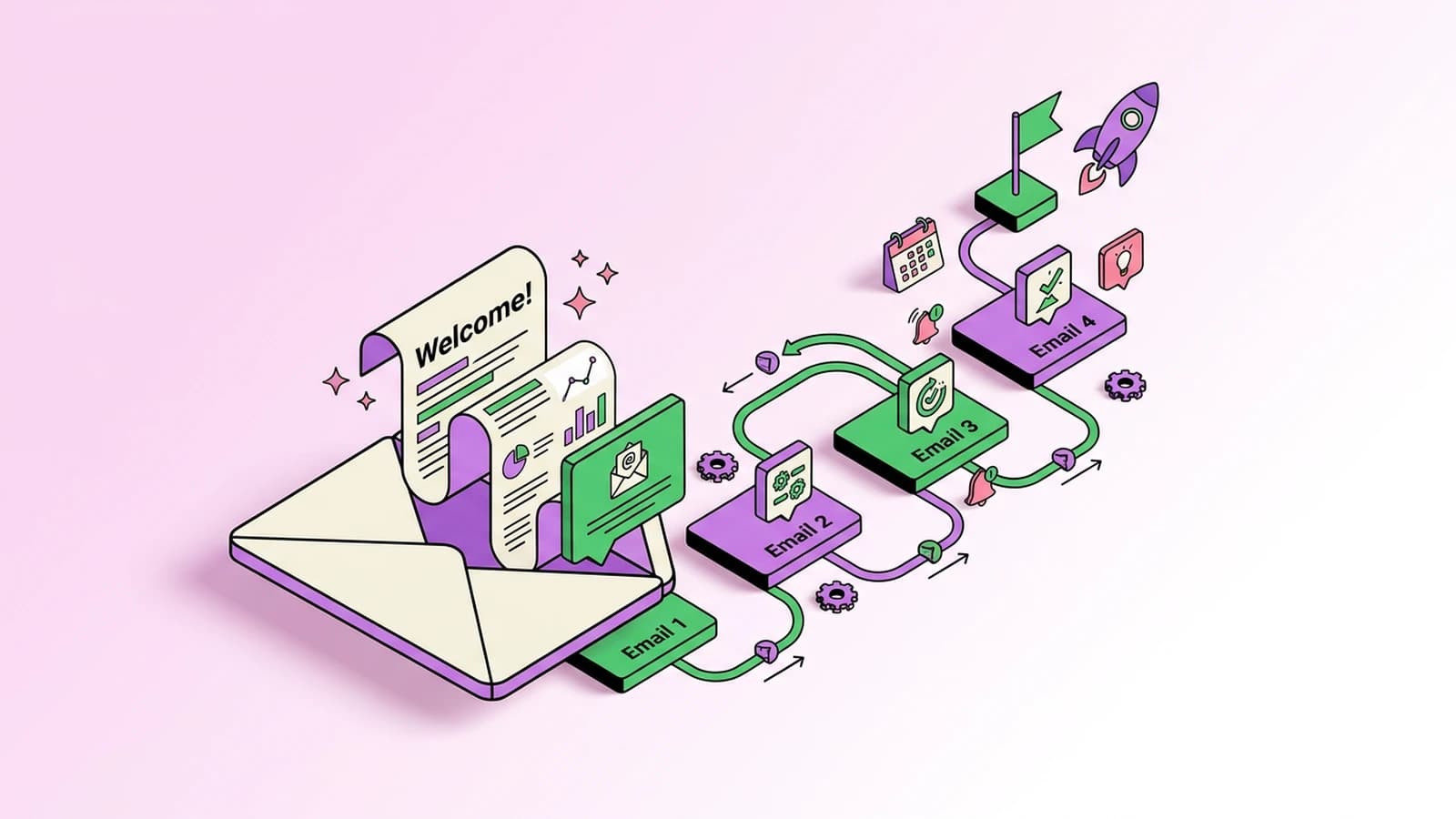
Rather than sending random promotional blasts, high-converting B2B organizations deploy a structured five-part email sequence over a ten to fourteen-day onboarding window. Each email fulfills an explicit psychological and operational milestone in the buyer's evaluation journey:
| Email Sequence Stage | Deployment Timing | Primary Psychological Objective | Core Content Architecture | Target Conversion Action |
|---|---|---|---|---|
| Email 1: The Instant Frictionless Value Delivery | Sent immediately (0 minutes) | Gratitude, instant delivery, orientation | Direct link to requested asset or login, one-sentence value proposition, founder greeting | First platform login or asset consumption |
| Email 2: Guiding the Core 'Aha!' Milestone | Day 1 (24 hours post-signup) | Accelerate time-to-value, reduce overwhelm | Step-by-step 3-minute quickstart guide, short Loom video walkthrough, friction removal | Complete primary activation milestone |
| Email 3: Overcoming the Key Objection via Case Study | Day 3 (72 hours post-signup) | Dismantle implementation and ROI fear | Customer transformation story, quantifiable metric lift (e.g., +34% ROI in 30 days) | Explore enterprise features or invite team |
| Email 4: Advanced Workflow Teardown & Best Practices | Day 6 (6 days post-signup) | Deepen platform stickiness and capability | Uncommon workflow hack, API integration guide, time-saving workflow teardown | Connect third-party integrations (Slack/CRM) |
| Email 5: The Consultative Closing & Offer Transition | Day 9 (9 days post-signup) | Commercial urgency and procurement support | Direct founder / sales offer: 1-on-1 strategy call, customized demo, commercial incentive | Book demo or upgrade to annual plan |
Ensuring that your HTML email layouts and digital assets adhere to universal accessibility standards outlined by the W3C Web Accessibility Initiative (WAI) guarantees that your onboarding messages render cleanly across all corporate inbox clients, screen readers, and enterprise mail environments.
Email 1 Deep Dive: The Frictionless Delivery and Mission Statement
Email 1 sets the tone for the entire customer relationship. The single biggest mistake SaaS companies make in their initial email is including twelve different navigation links, social media buttons, and an exhaustive list of product features. This creates cognitive overload and decision paralysis. When a user signs up, their intention is acute: they want immediate access to what they were promised.
Structure Email 1 with razor-sharp simplicity. Deliver the direct login button or resource link above the digital fold. Follow immediately with a personal welcome from the founder or head of product explaining the company's core mission: 'We built this platform to eliminate five hours of tedious manual reporting for your team every week.' Conclude with a low-friction question designed to encourage an organic reply: 'What is the single biggest operational challenge you are hoping we can solve for your team this week?' Encouraging direct subscriber replies sends powerful positive engagement signals to Internet Service Providers, establishing strong inbox placement.
Email 2 & 3: Driving Activation and Dismantling Objections
The second email, delivered twenty-four hours later, must focus entirely on user activation. In SaaS metrics, activation represents the specific action that correlates with long-term retention—such as importing a contact list, installing a tracking snippet, or inviting a collaborator. Rather than linking to forty pages of technical documentation, embed a concise three-step visual checklist guiding the user through that exact activation task.
Email 3 introduces social proof to dismantle buyer hesitation. B2B buyers operate under organizational risk; choosing the wrong software can cost them professional reputation. Showcase a concise, credible case study featuring a peer company in their industry. Detail the exact problem they faced, how they configured the workflow in less than thirty minutes, and the concrete business metrics achieved. This reassures the evaluator that your platform is a safe, proven enterprise choice.
To review, edit, and polish your email copy, subject lines, and preview headers for flawless professional tone, use our free online grammar checker tool before deploying campaigns to live subscriber workflows.
Behavioral Branching: Moving Beyond Linear Email Drips
Static, linear email sequences that send the identical five emails to every subscriber regardless of their actions are fundamentally obsolete. Modern B2B growth stacks integrate email automation with product analytics via Segment, Rudderstack, or native webhooks to create dynamic behavioral branching:
- The Fast-Track Branch: If a user completes the core activation milestone within six hours of signup, suppress Email 2 (Quickstart Guide). Fast-track them immediately to Email 4 (Advanced Integrations) and prompt an introductory call with an enterprise customer success manager.
- The Stalled Account Intervention Branch: If a user signs up but has not logged in after three days, pause the standard case study email. Trigger a personal, plain-text check-in from a named onboarding specialist offering a fifteen-minute guided setup session to overcome technical hurdles.
- The Multi-User Viral Expansion Branch: When a subscriber invites team members, trigger a collaborative welcome sub-sequence tailored specifically for secondary users, explaining how their team lead has configured the shared workspace.
Organizations seeking to design, build, and optimize enterprise-grade automated email infrastructure can partner with specialized email marketing services to implement custom behavioral tag architectures and high-converting lifecycle flows.
Multi-Channel Synchronization and In-App Product Guidance
Modern B2B user onboarding does not exist in an email vacuum. High-converting SaaS organizations synchronize automated welcome emails with interactive in-app product tours using platforms like Appcues, Pendo, or Userpilot. When an onboarding email introduces a specific feature milestone, logging into the software should immediately highlight that exact workflow with subtle visual beacons rather than generic modal popups.
Furthermore, tracking in-app milestone completion in real time allows your email marketing platform to dynamically adapt. If a user completes their first data export inside the web application, their pending educational email is automatically swapped for an advanced analytics masterclass. This cohesive multi-touch experience eliminates disjointed messaging and dramatically accelerates product adoption.
Step-by-Step Implementation: Building a High-Converting B2B Welcome Flow
Follow this operational roadmap to construct, configure, and launch an enterprise B2B welcome sequence:
- Step 1: Identify Your Product's Single Core Activation Event. Analyze your historical cohort retention data to identify the exact behavioral milestone that predicts long-term customer retention. Align the entire welcome sequence around driving this single action.
- Step 2: Craft Magnetic, Benefit-Driven Subject Lines. Avoid boring subject lines like 'Welcome to Company Name'. Use curiosity and outcome-driven framing: '[Action Required] Your onboarding access + 3-minute quickstart', 'How [Customer Name] cut reporting time by 40% with our API', or 'Quick question regarding your setup'.
- Step 3: Enforce Plain-Text and Minimalist HTML Styling. Overly elaborate, graphic-heavy newsletter templates with corporate banners look like marketing ads and are frequently sorted into Gmail's Promotions tab. High-performing B2B welcome sequences utilize clean, plain-text styling or minimalist typography that mirrors personal 1-to-1 correspondence.
- Step 4: Establish Technical Authentication and Inbox Deliverability. A world-class welcome sequence is useless if emails land in the spam folder. Review our complete guide on how to improve email deliverability to configure SPF, DKIM, DMARC, and custom sending domains for pristine inbox placement.
- Step 5: Monitor Micro-KPIs and Iterate Weekly. Track open rates (target > 50% on Email 1), click-to-open rates (target > 20%), reply rates, and product activation rates. A/B test subject lines and primary call-to-action buttons on a rolling monthly cycle.
Common B2B Welcome Sequence Mistakes and How to Avoid Them
Ensure your onboarding sequences steer clear of these frequent B2B marketing mistakes:
- Sending From a 'No-Reply' Email Address: Sending from 'noreply@company.com' communicates arrogance and suppresses organic engagement. Always send from a real human name and monitor incoming replies closely.
- Pitching the Hard Sale in Email 1: Demanding a prospect book an enterprise sales call sixty seconds after they downloaded an introductory whitepaper creates immense friction. Earn the right to pitch by providing exceptional upfront value first.
- Overwhelming Subscribers with Multiple Calls to Action: Including five different buttons linking to webinars, blog posts, YouTube channels, and pricing pages in a single email dilutes attention. Enforce the Rule of One: one email, one primary objective, one clear call to action.
- Failing to Clean Unengaged Leads: Continuing to blast automated marketing sequences to subscribers who have not opened an email in ninety days damages your overall sender reputation. Implement automatic sunset policies to preserve deliverability.
Strategic Summary and Long-Term Lifecycle Expansion
Your welcome email sequence is the foundational cornerstone of your customer lifecycle engine. It transforms cold traffic into active platform users, builds authentic corporate trust, and establishes an open line of communication that drives sales velocity. By focusing on rapid time-to-value, structuring messages around core activation milestones, and implementing dynamic behavioral branching, your B2B organization can turn automated onboarding into a powerful revenue generator.
Audit your current onboarding sequence today. Review Email 1 open rates, eliminate unneeded graphical clutter, and align your messaging with your product's core activation metric. Building an intentional, high-converting welcome experience will accelerate customer adoption and fuel sustainable enterprise growth.
Frequently asked questions
A standard B2B welcome sequence should contain four to six emails distributed over a 10 to 14-day window. This provides sufficient room to deliver resources, explain key features, share case studies, and invite prospects to sales consultations without causing subscriber fatigue.
Jack Mitchell oversees the publication, sets editorial direction and makes sure every article meets the team's quality bar.