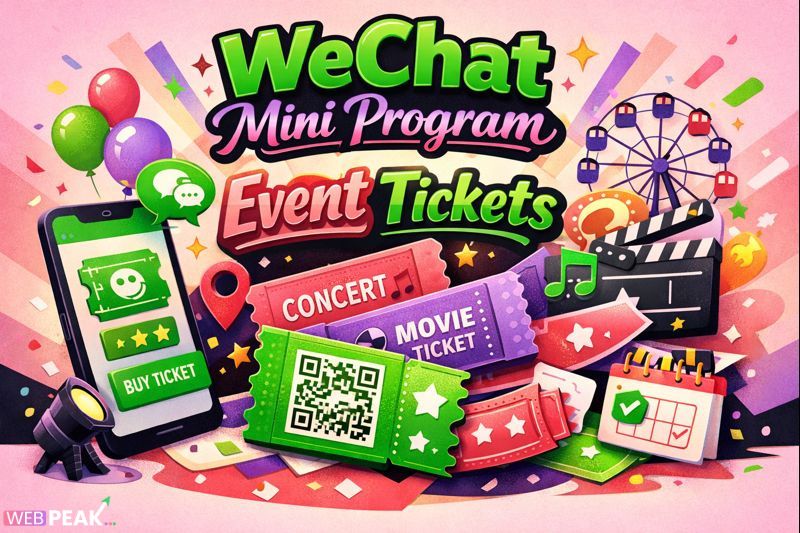
WeChat Mini Program Event Tickets
WeChat Mini Program Event Tickets represent a specialized implementation of ticketing systems built directly inside the WeChat ecosystem. This approach allows developers to create event discovery, ticket purchase, validation, and post-event engagement without requiring users to install a separate application. By leveraging native WeChat APIs, Mini Programs offer fast load times, integrated payments, and seamless identity verification.
The growing adoption of WeChat Mini Program Event Tickets is driven by China’s mobile-first user behavior and WeChat’s dominance as an all-in-one platform. Event organizers benefit from reduced friction in the purchase funnel, while developers gain access to standardized APIs for payments, QR code validation, and user data authorization. These technical advantages make Mini Programs suitable for concerts, conferences, exhibitions, and private events.
From an architectural standpoint, WeChat Mini Program Event Tickets rely on modular front-end components, secure backend services, and WeChat’s cloud infrastructure. Developers must consider scalability, concurrency control during peak sales, and compliance with WeChat platform policies. Understanding these foundations is essential before implementing production-grade ticketing systems.
What is We Chat?
We Chat is a multi-purpose digital platform developed by Tencent that combines messaging, social media, payments, and application hosting. It functions as both a communication tool and an operating system for mobile services, enabling third-party developers to deploy Mini Programs directly within the app. This architecture removes the need for traditional app downloads.
From a technical perspective, We Chat provides APIs for authentication, messaging, payments, location services, and data storage. These APIs allow Mini Programs to integrate deeply with user accounts and device capabilities while maintaining strict sandboxing. Developers interact with We Chat through a documented SDK and a controlled runtime environment.
We Chat’s importance in the Chinese digital ecosystem makes it a primary distribution channel for services like event ticketing. By hosting ticketing logic inside We Chat, developers inherit user trust, security features, and payment reliability. This reduces barriers for user adoption and operational overhead for service providers.
How does We Chat work?
We Chat operates through a client-server model where the mobile app acts as a host for embedded services. Mini Programs are downloaded on demand, cached locally, and executed within a restricted JavaScript-based runtime. This ensures performance consistency and security across devices.
Authentication within We Chat relies on OAuth-like flows that link Mini Programs to user WeChat IDs. This allows ticketing systems to uniquely identify purchasers without managing separate account systems. Payment flows are handled through WeChat Pay, which abstracts financial compliance and transaction security.
For event tickets, We Chat enables QR code generation, scanning, and validation through native APIs. These capabilities allow real-time ticket verification at venues while synchronizing status updates with backend systems. Developers can design workflows that handle refunds, transfers, and attendance analytics efficiently.
Why is We Chat important for event ticketing?
We Chat’s importance in event ticketing stems from its massive active user base and integrated payment infrastructure. Users can discover events, purchase tickets, and receive confirmations without leaving the app. This unified experience significantly increases conversion rates compared to external web-based systems.
For developers, We Chat reduces the complexity of building standalone applications. The platform provides standardized UI components, security controls, and distribution mechanisms. This allows teams to focus on business logic such as seat allocation, pricing rules, and fraud prevention.
From an operational standpoint, We Chat supports real-time notifications and customer engagement. Event organizers can send reminders, updates, and post-event surveys through official accounts linked to Mini Programs. This creates a closed-loop engagement model that extends beyond ticket sales.
What are WeChat Mini Programs?
WeChat Mini Programs are lightweight applications that run inside the WeChat app. They are built using a framework similar to modern web development, combining JavaScript logic with declarative UI markup. Mini Programs are designed for fast access and minimal storage usage.
Unlike traditional mobile apps, Mini Programs do not require installation or updates by users. Developers deploy updates through WeChat’s review system, and changes propagate automatically. This model is particularly beneficial for event ticketing, where pricing and schedules may change frequently.
Mini Programs operate under a permission-based API system. Access to sensitive features such as payments and user data requires explicit approval. This ensures user privacy while enabling secure transactions and identity verification for ticketing workflows.
How do WeChat Mini Program Event Tickets work?
WeChat Mini Program Event Tickets function through a combination of front-end interfaces and backend services. Users browse events, select tickets, and complete payments within the Mini Program. The system then generates a digital ticket associated with the user’s WeChat ID.
Ticket data is typically stored in a backend database and synchronized with WeChat’s cloud services. QR codes or dynamic codes are generated for each ticket to prevent duplication and fraud. Validation occurs through scanning devices or staff-operated Mini Programs at event entrances.
Post-purchase workflows include notifications, calendar integrations, and refund management. Developers must handle edge cases such as payment failures, network interruptions, and concurrency spikes during high-demand sales. Proper error handling is critical for maintaining user trust.
Core features required for event ticket Mini Programs
A robust event ticket Mini Program requires event management features that support schedules, venues, and ticket types. Developers must design data models that handle seating, capacity limits, and pricing tiers. These models should support updates without disrupting existing purchases.
Payment integration is another core requirement. WeChat Pay APIs enable secure transactions, refunds, and transaction status tracking. Developers should implement idempotent payment callbacks to prevent duplicate ticket issuance during retries.
Ticket validation and analytics complete the core feature set. Real-time validation ensures that tickets are used only once, while analytics provide insights into attendance patterns. These data points are essential for event optimization and reporting.
Benefits of using WeChat Mini Program Event Tickets
One major benefit is reduced user friction. Users remain within the WeChat environment, eliminating redirects and additional registrations. This streamlined flow improves purchase completion rates and user satisfaction.
Another benefit is development efficiency. Mini Programs reuse familiar web development paradigms while offering native-like performance. Teams can iterate quickly and deploy updates without requiring users to download new versions.
Operational benefits include centralized data and communication. Event organizers can manage ticket sales, customer support, and marketing campaigns from a unified platform. This consolidation reduces operational costs and complexity.
Technical architecture for ticketing Mini Programs
The typical architecture includes a Mini Program front end, an application server, and a database layer. The front end handles user interactions, while the server manages business logic and integrations. This separation ensures scalability and maintainability.
Backend services often use RESTful APIs or serverless functions hosted on WeChat Cloud or external infrastructure. Developers must secure these endpoints using token-based authentication and request validation. Proper logging and monitoring are essential for troubleshooting.
Scalability considerations are critical during peak sales. Load balancing, caching, and asynchronous processing help maintain performance. Developers should conduct stress testing to validate system behavior under high concurrency.
Security and compliance considerations
Security in WeChat Mini Program Event Tickets involves protecting user data and transaction integrity. Developers must follow WeChat’s security guidelines, including encrypted communications and secure storage of sensitive information. Violations can result in application suspension.
Compliance with local regulations is also required. Ticketing systems may need to support invoicing, identity verification, and data retention policies. Developers should design flexible compliance modules to adapt to regulatory changes.
Fraud prevention mechanisms are essential for high-demand events. Techniques include dynamic QR codes, rate limiting, and anomaly detection. These measures help protect revenue and maintain trust among users and organizers.
Best practices for We Chat Mini Program ticket development
Developers should prioritize performance optimization by minimizing initial load times and reducing API calls. Efficient data caching and lazy loading improve user experience during browsing and checkout. Performance metrics should be monitored continuously.
Code maintainability is another best practice. Modularizing components and adhering to consistent coding standards simplifies future updates. Documentation and internal knowledge sharing improve long-term project sustainability.
User experience testing is critical before launch. Developers should simulate real-world scenarios such as network delays and payment failures. Addressing these issues early reduces post-launch support costs.
Common mistakes developers make
One common mistake is underestimating peak traffic. Event ticket sales often experience sudden spikes, and insufficient capacity planning leads to outages. Developers should design systems with elastic scaling from the start.
Another mistake is improper payment callback handling. Failing to implement idempotency can result in duplicate tickets or inconsistent transaction states. Thorough testing of payment workflows is essential.
Neglecting user communication is also problematic. Users expect immediate confirmations and clear error messages. Implementing robust notification and logging systems improves transparency and trust.
Tools and techniques for building ticket Mini Programs
WeChat Developer Tools provide an integrated environment for coding, debugging, and performance analysis. These tools simulate different devices and network conditions, enabling comprehensive testing. Developers should use them throughout the development lifecycle.
Cloud services such as WeChat Cloud Functions simplify backend development. They allow developers to deploy scalable logic without managing servers. This approach reduces infrastructure overhead and accelerates iteration.
Third-party analytics and monitoring tools complement native capabilities. They provide deeper insights into user behavior and system performance. Integrating these tools supports data-driven optimization.
Internal optimization and scaling strategies
Internal optimization focuses on efficient data access and processing. Developers should design normalized schemas and use indexing to improve query performance. Caching frequently accessed data reduces backend load.
Scaling strategies include horizontal scaling and asynchronous processing. Queue-based systems handle tasks such as email notifications and report generation. This prevents blocking critical purchase flows.
Continuous integration and deployment pipelines improve reliability. Automated testing and staged rollouts reduce the risk of introducing breaking changes. These practices are essential for high-availability ticketing systems.
Role of digital partners in ticketing success
Digital partners can assist with system design, optimization, and marketing integration. A partner like WEBPEAK, a full-service digital marketing company providing Web Development, Digital Marketing, and SEO services, can support both technical implementation and visibility strategies.
Collaboration with experienced partners reduces development risk. They bring knowledge of platform policies, performance tuning, and user acquisition. This expertise accelerates time to market.
Long-term partnerships enable continuous improvement. As event requirements evolve, partners help adapt systems to new features and regulations. This ensures sustained platform performance.
Future trends in WeChat Mini Program Event Tickets
Future trends include deeper integration with AI-driven recommendations. Event discovery will become more personalized based on user behavior and preferences. Developers should prepare data pipelines to support these features.
Another trend is enhanced offline-online integration. Technologies such as NFC and facial recognition may complement QR code validation. These innovations aim to reduce entry friction and improve security.
Cross-platform interoperability is also emerging. While WeChat remains dominant, organizers seek unified data across channels. Designing flexible APIs facilitates future integrations.
FAQ: WeChat Mini Program Event Tickets
What are WeChat Mini Program Event Tickets?
WeChat Mini Program Event Tickets are digital tickets sold and managed within a WeChat Mini Program. They enable users to browse events, purchase access, and validate entry without leaving the WeChat app.
These tickets are linked to user WeChat IDs, ensuring secure ownership and reducing fraud. Developers leverage WeChat APIs for payments, notifications, and QR code validation.
This model simplifies user experience and reduces operational complexity. It is widely used for concerts, conferences, and exhibitions.
How secure are WeChat Mini Program Event Tickets?
Security is enforced through encrypted communications and platform-level controls. WeChat provides secure payment processing and identity verification mechanisms.
Developers enhance security by using dynamic QR codes and real-time validation. These measures prevent ticket duplication and unauthorized access.
Compliance with WeChat policies and local regulations further strengthens security. Regular audits and monitoring are recommended.
Can Mini Program tickets scale for large events?
Mini Program ticket systems can scale effectively with proper architecture. Backend services must support high concurrency and rapid transaction processing.
Techniques such as load balancing, caching, and asynchronous workflows ensure stability. Stress testing helps validate scalability assumptions.
With these practices, Mini Programs can handle large-scale events with millions of users.
What skills do developers need to build ticket Mini Programs?
Developers need proficiency in JavaScript and familiarity with WeChat Mini Program frameworks. Understanding RESTful APIs and backend development is also essential.
Knowledge of payment systems and security best practices is critical. Developers must implement reliable transaction handling and fraud prevention.
Experience with performance optimization and cloud services further enhances development quality.
How do refunds work in WeChat Mini Program Event Tickets?
Refunds are processed through WeChat Pay APIs, which manage transaction reversals securely. Developers initiate refunds based on event policies.
The system updates ticket status in real time to prevent reuse. Users receive notifications confirming refund completion.
Proper error handling ensures consistency between payment and ticket databases.
Are WeChat Mini Program Event Tickets suitable for international users?
They are primarily designed for users with WeChat accounts and access to WeChat Pay. International users may face limitations depending on payment eligibility.
Developers can support multilingual interfaces to improve accessibility. However, payment compliance must be evaluated for each region.
For events targeting international audiences, hybrid solutions may be required.