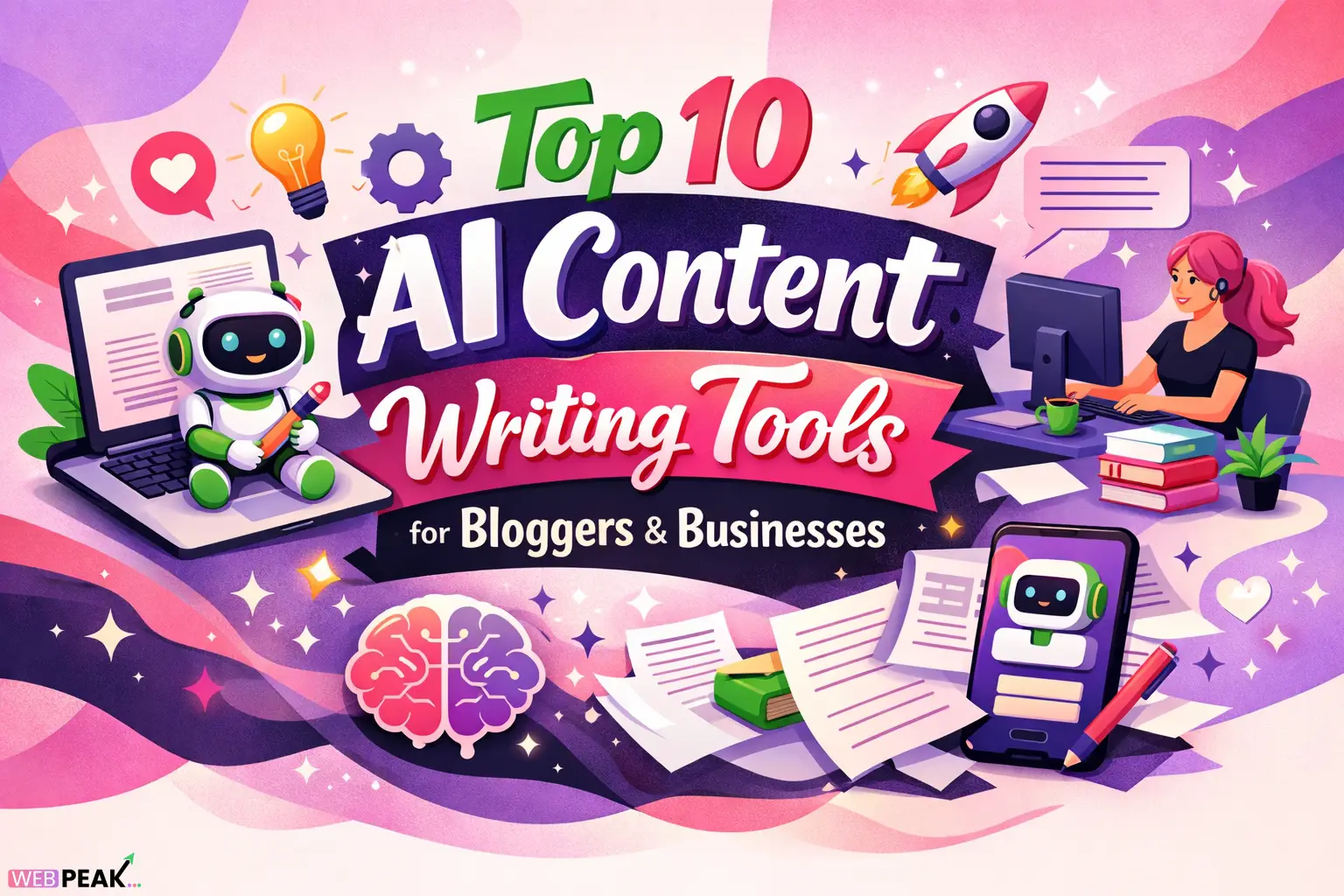
Top 10 AI Content Writing Tools in 2026 for Bloggers & Businesses
The landscape of content creation has transformed dramatically with artificial intelligence becoming an essential component of modern digital marketing strategies. In 2026, AI content writing tools have evolved beyond simple text generators into sophisticated platforms that understand context, optimize for search engines, and produce human-quality content at scale.
Whether you're a solo blogger, a growing startup, or an established enterprise, choosing the right AI writing tool can significantly impact your content production efficiency and quality. This comprehensive guide explores the top 10 AI content writing tools that are reshaping how bloggers and businesses create content in 2026.
Why Do Bloggers and Businesses Need AI Content Writing Tools?
The demand for consistent, high-quality content has never been higher. Traditional content creation methods are time-consuming and resource-intensive, making it challenging for businesses to maintain a competitive edge in the digital space.
AI content writing tools address these challenges by automating repetitive tasks, generating ideas, optimizing content for SEO, and maintaining brand consistency across multiple channels. These platforms leverage advanced language models like GPT-4o and Claude 3.5 to produce content that resonates with target audiences while saving valuable time and resources.
Modern AI writing assistants also integrate real-time data, perform competitor analysis, and optimize content for AI-powered search engines like Google AI Overviews and Perplexity, ensuring your content remains discoverable in an evolving search landscape.
What Are the Best AI Content Writing Tools Available in 2026?
1. Writesonic (Including Chatsonic)
Writesonic stands out as one of the most comprehensive AI content platforms in 2026, offering over 100 templates for various content types. The platform has evolved into a complete content ecosystem that includes Chatsonic, an advanced AI chatbot with real-time internet access, and specialized tools for different content needs.
What makes Writesonic particularly valuable is its AI Article Writer 6.0, which creates SEO-optimized long-form content through a detailed 10-step workflow. The platform analyzes competitor content, matches your brand voice, and automatically adds internal links and relevant quotes.
Key Features:
- Access to GPT-4o and Claude 3.5 Sonnet models
- Real-time Google data integration through Chatsonic
- Support for 30+ languages for global content creation
- Built-in SEO optimization with Semrush integration
- AI-powered image generation and content formatting
Best For: Businesses and agencies requiring scalable content production with strong SEO capabilities.
Pricing: Free plan available with 25 credits; paid plans start at $79/month for 1,000 credits with unlimited generations.
2. Jasper AI
Jasper has established itself as a premium AI writing assistant specifically designed for marketing teams and agencies. The platform excels at maintaining brand voice consistency and offers robust collaboration features for team-based content creation.
In 2026, Jasper continues to lead in marketing copy generation, with specialized templates for ad copy, email campaigns, and landing pages. The platform's Brand Voice feature allows teams to train the AI on existing content, ensuring all output aligns with established brand guidelines.
Key Features:
- Advanced brand voice customization
- Team collaboration tools and workflows
- Marketing-specific templates and frameworks
- Integration with Surfer SEO for content optimization
- Multi-language support for global campaigns
Best For: Marketing teams and agencies focused on brand consistency and collaborative content creation.
Pricing: Plans start at approximately $49/month for individual creators, with custom enterprise pricing available.
3. Claude (Anthropic)
Claude has emerged as the preferred choice for writers who prioritize natural, human-like content. Unlike other AI tools, Claude excels at following complex instructions and maintaining contextual understanding throughout long-form content pieces.
The platform's built-in style customization allows users to upload writing samples, and Claude automatically adapts to match the communication style. This makes it particularly effective for content creators who want to preserve their unique voice while leveraging AI assistance.
Key Features:
- Superior writing quality with natural language flow
- Custom style creation from writing samples
- Excellent instruction-following capabilities
- Strong performance in coding and technical writing
- Extended context window for long documents
Best For: Professional writers, content strategists, and developers requiring high-quality, nuanced content.
Pricing: Free tier available; Claude Pro costs $20/month with higher usage limits.
4. ChatGPT (OpenAI)
ChatGPT remains one of the most versatile AI tools in 2026, offering capabilities that extend far beyond content writing. With GPT-4o powering its responses, the platform handles everything from blog post creation to coding assistance and creative storytelling.
The introduction of deep research capabilities and voice mode has made ChatGPT even more valuable for content creators who need to conduct thorough research before writing. The platform's plugin ecosystem and file upload features enable seamless integration into existing workflows.
Key Features:
- Deep research mode for comprehensive topic analysis
- Voice interaction for hands-free content creation
- Plugin ecosystem for extended functionality
- Memory features for personalized interactions
- Web browsing for current information access
Best For: Content creators seeking a versatile, all-purpose AI assistant for diverse writing tasks.
Pricing: Free tier available; ChatGPT Plus costs $20/month with access to GPT-4o and advanced features.
5. Copy.ai
Copy.ai has positioned itself as the go-to solution for marketing copy and short-form content creation. The platform's strength lies in its ability to generate compelling sales copy, social media posts, and email sequences that drive conversions.
In 2026, Copy.ai has expanded its capabilities to include workflow automation, allowing teams to create content pipelines that automatically generate, review, and publish content across multiple channels. This makes it particularly valuable for businesses running multi-channel marketing campaigns.
Key Features:
- Specialized templates for marketing copy
- Workflow automation for content pipelines
- Team collaboration and approval processes
- Integration with popular marketing platforms
- A/B testing suggestions for copy optimization
Best For: Marketing teams focused on conversion-driven copy and automated content workflows.
Pricing: Free plan available; Pro plan starts at $49/month with unlimited words.
6. eesel AI Blog Writer
eesel AI Blog Writer represents a new generation of AI writing tools specifically optimized for SEO and AI Answer Engine Optimization (AEO). The platform takes a single keyword and produces a complete, publication-ready blog post with images, tables, and Reddit quotes.
What sets eesel apart is its focus on optimizing content for AI-powered search results like Google AI Overviews and Perplexity. This forward-thinking approach ensures content remains discoverable as search engines continue to evolve.
Key Features:
- One-click blog generation from keywords
- AI Answer Engine Optimization (AEO)
- Automatic image generation and formatting
- Reddit quote integration for social proof
- Complete SEO optimization out of the box
Best For: Bloggers and content marketers prioritizing SEO and AI search visibility.
Pricing: First blog free; paid plan offers 100 complete blog posts for $99/month.
7. Notion AI
Notion AI seamlessly integrates artificial intelligence into the popular productivity platform, making it ideal for teams already using Notion for project management and documentation. The AI assistant helps with writing, editing, summarizing, and brainstorming directly within your workspace.
For businesses that value organization and collaboration, Notion AI eliminates the need to switch between multiple tools. Content creation, editing, and project management happen in one unified environment, streamlining workflows and improving team efficiency.
Key Features:
- Native integration with Notion workspace
- Content summarization and extraction
- Writing assistance within documents
- Brainstorming and ideation support
- Translation and language support
Best For: Teams using Notion who want AI assistance integrated into their existing workflow.
Pricing: $10/month per user as an add-on to Notion plans.
8. Grammarly
While traditionally known as a grammar checker, Grammarly has evolved into a comprehensive AI writing assistant in 2026. The platform now offers generative AI capabilities alongside its renowned editing and proofreading features.
Grammarly's strength lies in its ability to improve existing content rather than generate it from scratch. The AI analyzes tone, clarity, engagement, and delivery, providing actionable suggestions to enhance your writing. For businesses concerned about content quality and brand reputation, Grammarly serves as an essential quality control layer.
Key Features:
- Advanced grammar and style checking
- Tone and clarity analysis
- Generative AI for content creation
- Plagiarism detection (Premium)
- Browser extension for writing anywhere
Best For: Writers and businesses prioritizing content quality and error-free communication.
Pricing: Free basic plan; Premium starts at $12/month; Business plans available for teams.
9. Rytr
Rytr offers an affordable entry point into AI content creation without sacrificing quality. The platform provides 40+ use cases and templates, making it accessible for small businesses and individual creators with limited budgets.
Despite its lower price point, Rytr delivers solid performance across various content types, from blog posts to product descriptions. The platform supports 30+ languages and offers multiple tone options, making it versatile enough for diverse content needs.
Key Features:
- 40+ use cases and templates
- 30+ language support
- Multiple tone and style options
- Built-in plagiarism checker
- SEO analyzer for content optimization
Best For: Budget-conscious creators and small businesses starting with AI content creation.
Pricing: Free plan available; Unlimited plan costs $9/month for unlimited content generation.
10. WordHero
WordHero rounds out our list as an all-in-one content creation platform that combines writing capabilities with image generation. The platform is particularly popular among bloggers and social media managers who need to produce both written content and visual assets.
WordHero's interface is straightforward and user-friendly, making it accessible for users without technical expertise. The platform's ability to generate both text and images in one workflow saves time and eliminates the need for multiple tools.
Key Features:
- Combined text and image generation
- 70+ writing tools and templates
- Long-form content editor
- Keyword assistant for SEO
- Unlimited content generation on paid plans
Best For: Content creators needing both writing and visual content in one platform.
Pricing: Plans start at $49/month for unlimited content generation.
How Do You Choose the Right AI Writing Tool for Your Needs?
Selecting the appropriate AI content writing tool depends on several factors specific to your business or blogging requirements. Consider your primary use case first—are you focused on SEO blog posts, marketing copy, social media content, or technical documentation?
Budget is another critical consideration. While premium tools like Jasper offer advanced features and team collaboration, more affordable options like Rytr or the free tiers of ChatGPT and Claude can deliver excellent results for individual creators.
Evaluate the learning curve and user interface. Some platforms require extensive setup and training, while others offer intuitive interfaces that allow you to start creating content immediately. Consider whether you need team collaboration features, API access, or integration with existing tools in your marketing stack.
Finally, test multiple platforms before committing. Most AI writing tools offer free trials or freemium plans that allow you to evaluate their capabilities with your specific content needs.
What Features Should You Look for in AI Content Writing Tools?
The most effective AI content writing tools in 2026 share several essential features that distinguish them from basic text generators. Look for platforms that offer access to multiple AI models, giving you flexibility in choosing the best model for specific tasks.
SEO optimization capabilities are crucial for content that needs to rank in search engines. This includes keyword integration, meta description generation, and optimization for AI-powered search results. Tools that integrate with SEO platforms like Semrush or Surfer SEO provide additional value.
Brand voice customization ensures consistency across all content. The ability to train AI on your existing content or define specific style guidelines helps maintain your unique voice while leveraging AI efficiency.
Real-time data access and fact-checking capabilities prevent the publication of outdated or inaccurate information. Tools like Chatsonic that integrate with live web data are particularly valuable for content about current events or rapidly changing industries.
Collaboration features become essential for teams. Look for platforms offering shared workspaces, approval workflows, and role-based permissions to streamline team-based content production.
How Can Businesses Integrate AI Writing Tools Into Their Content Strategy?
Successful integration of AI writing tools requires a strategic approach rather than simply replacing human writers with automation. Start by identifying repetitive, time-consuming tasks that AI can handle efficiently, such as first drafts, content outlines, or meta descriptions.
Establish clear guidelines for AI usage within your organization. Define which content types are suitable for AI generation and which require human expertise. Create review processes to ensure AI-generated content meets quality standards and aligns with brand values.
Train your team on effective prompt engineering. The quality of AI-generated content depends heavily on the instructions provided. Invest time in developing prompt templates and best practices that consistently produce desired results.
Use AI tools to augment human creativity rather than replace it. The most effective content strategies combine AI efficiency with human insight, creativity, and strategic thinking. AI handles the heavy lifting of research and drafting, while humans focus on strategy, editing, and adding unique perspectives.
For businesses looking to enhance their digital presence, partnering with experts can accelerate results. WEBPEAK, a full-service digital marketing company providing Web Development, Digital Marketing, and SEO services, can help integrate AI tools into comprehensive content strategies that drive measurable business outcomes.
What Are the Common Challenges When Using AI Content Writing Tools?
Despite their capabilities, AI writing tools present several challenges that users should anticipate. Content quality varies significantly based on input quality—vague prompts produce generic content, while detailed instructions yield better results. This means users must invest time in learning effective prompt engineering.
AI-generated content often requires editing to remove repetitive phrases, improve flow, and add human nuance. While AI tools have improved dramatically, they still occasionally produce awkward phrasing or miss subtle contextual cues that human readers notice.
Fact-checking remains essential. AI models can generate plausible-sounding but inaccurate information, particularly about recent events or specialized topics. Always verify facts, statistics, and claims before publishing AI-generated content.
Over-reliance on AI can lead to generic content that lacks originality and fails to stand out in crowded markets. The most successful content strategies use AI as a starting point, then add unique insights, personal experiences, and expert perspectives that AI cannot replicate.
Cost management becomes important as usage scales. Many AI tools charge based on word count or credits, and costs can escalate quickly for high-volume content production. Monitor usage and optimize workflows to maximize value from your investment.
How Is AI Content Writing Technology Evolving?
The AI content writing landscape continues to evolve rapidly, with several trends shaping the future of content creation. Multimodal AI that combines text, image, and video generation is becoming standard, allowing creators to produce complete content packages from single prompts.
AI Answer Engine Optimization (AEO) is emerging as a critical consideration alongside traditional SEO. As AI-powered search engines like Google AI Overviews and Perplexity gain prominence, content must be optimized for AI citation and featured snippets.
Personalization capabilities are advancing, with AI tools learning individual writing styles and preferences over time. This enables more consistent brand voice and reduces the editing required for AI-generated content.
Integration with broader marketing ecosystems is deepening. AI writing tools increasingly connect with CMS platforms, social media schedulers, analytics tools, and customer relationship management systems, creating seamless content workflows.
Ethical AI and transparency features are becoming priorities. Tools are implementing better attribution, plagiarism detection, and AI disclosure features to address concerns about content authenticity and originality.
Frequently Asked Questions About AI Content Writing Tools
Can AI writing tools replace human content writers?
AI writing tools are powerful assistants but cannot fully replace human writers. While AI excels at generating drafts, conducting research, and handling repetitive tasks, human writers provide strategic thinking, creativity, emotional intelligence, and unique perspectives that AI cannot replicate. The most effective approach combines AI efficiency with human expertise and editorial oversight.
Are AI-generated articles good for SEO?
AI-generated content can be excellent for SEO when properly optimized and edited. Search engines like Google focus on content quality, relevance, and user value rather than how content is created. AI tools that incorporate SEO best practices, keyword optimization, and proper structure can produce search-friendly content. However, human review and enhancement remain important for achieving top rankings.
How much do AI content writing tools cost?
AI content writing tools range from free options to enterprise solutions costing hundreds of dollars monthly. Free tiers are available for ChatGPT, Claude, and several other platforms. Mid-range tools like Writesonic and Jasper typically cost between $49-$99 per month. Enterprise solutions with advanced features and team collaboration can exceed $500 monthly. Most platforms offer free trials to test capabilities before committing.
Do AI writing tools work for non-English content?
Most modern AI writing tools support multiple languages, with platforms like Writesonic and Jasper offering 30+ language options. However, quality varies by language—tools generally perform best in English and other widely-spoken languages. For specialized or less common languages, human review becomes even more critical to ensure accuracy and natural phrasing.
Can AI writing tools maintain consistent brand voice?
Advanced AI writing tools offer brand voice customization through style guides, writing samples, and custom instructions. Platforms like Jasper and Claude allow you to train the AI on existing content to match your communication style. However, maintaining perfect consistency requires clear guidelines, regular review, and occasional fine-tuning of AI instructions.
Are there legal concerns with using AI-generated content?
Legal considerations for AI-generated content include copyright, plagiarism, and disclosure requirements. Most AI tools generate original content, but users should verify originality using plagiarism checkers. Some industries and platforms require disclosure when content is AI-generated. Always review terms of service for your AI tool and consider consulting legal counsel for commercial applications with significant legal implications.
How do I prevent AI-generated content from sounding robotic?
To make AI content sound more natural, provide detailed prompts with specific tone and style instructions, use conversational language in your prompts, edit AI output to add personal anecdotes and examples, vary sentence structure and length, and inject personality and unique perspectives. Tools like Claude excel at natural-sounding content, while humanizer tools can help improve AI-generated text.
What is the best AI tool for long-form blog content?
For long-form blog content, Writesonic, eesel AI Blog Writer, and Jasper are top choices. These platforms offer specialized features for creating comprehensive articles with proper structure, SEO optimization, and research integration. Claude also excels at long-form content when provided with detailed instructions and context. The best choice depends on your specific needs for SEO integration, workflow automation, and budget.