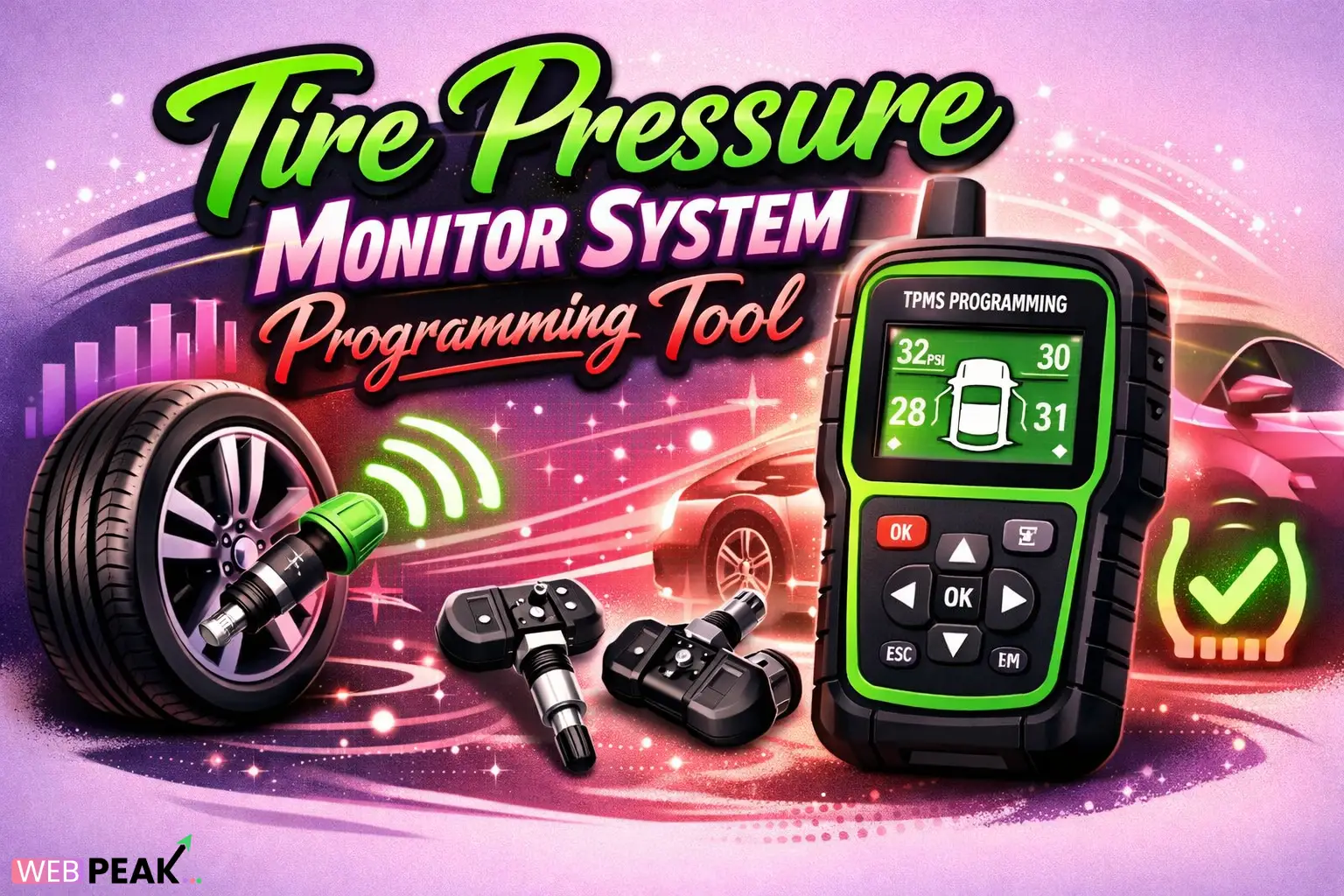
Tire Pressure Monitor System Programming Tool – Complete Developer & Technical Guide
A Tire Pressure Monitor System Programming Tool is a specialized diagnostic and configuration device used to activate, program, relearn, and troubleshoot TPMS sensors in modern vehicles. For developers, automotive engineers, and diagnostic tool integrators, understanding how these tools function at both hardware and software levels is critical for building reliable automotive solutions.
As TPMS technology continues evolving under regulatory mandates worldwide, programming tools must support multi-protocol communication, sensor cloning, and ECU integration. This guide provides an in-depth technical breakdown of architecture, communication layers, sensor programming logic, and development considerations for professionals working in automotive diagnostics.
What Is a Tire Pressure Monitor System Programming Tool?
A Tire Pressure Monitor System Programming Tool is a handheld or embedded diagnostic device used to communicate with TPMS sensors and vehicle ECUs to configure or relearn tire pressure data.
It enables technicians and developers to:
- Activate dormant TPMS sensors
- Read sensor ID and pressure data
- Clone sensor IDs
- Program universal sensors
- Trigger OBD-II relearn procedures
- Clear TPMS warning codes
These tools support both OEM and aftermarket sensor ecosystems.
How Does a TPMS Programming Tool Work?
A TPMS programming tool works by communicating via low-frequency (LF) activation signals and ultra-high frequency (UHF) RF data transmission, then interfacing with the vehicle’s ECU via OBD-II or CAN bus.
1. Sensor Activation Layer
The tool emits a 125 kHz LF signal to wake the TPMS sensor from sleep mode. Once activated, the sensor transmits data via RF (typically 315 MHz or 433 MHz).
2. RF Data Capture
The tool captures:
- Sensor ID
- Tire pressure value
- Temperature data
- Battery status
- Transmission interval
3. ECU Relearn or Programming
The tool then writes or syncs sensor data to the vehicle ECU using:
- OBD-II wired interface
- CAN protocol
- Automatic relearn procedures
- Manual relearn sequence
What Types of TPMS Systems Must the Tool Support?
A robust programming tool must support both Direct and Indirect TPMS architectures.
Direct TPMS
Uses physical pressure sensors inside each wheel.
- Communicates wirelessly
- Provides real-time pressure values
- Requires ID programming
Indirect TPMS
Uses ABS wheel speed sensors to infer pressure differences.
- No in-wheel sensor programming required
- Requires calibration reset
- Integrated via ESC/ABS modules
Programming tools primarily focus on direct TPMS systems.
What Are the Core Technical Components of a TPMS Programming Tool?
A professional-grade tool integrates multiple hardware and firmware modules.
Hardware Components
- LF transmitter (125 kHz)
- UHF RF receiver (315/433 MHz)
- OBD-II communication module
- Microcontroller (ARM-based common)
- Display interface (LCD or touch)
- Battery management system
Software Components
- Vehicle database (make/model/year)
- Sensor protocol library
- Firmware update engine
- CAN stack implementation
- Error-handling logic
Developers must ensure cross-platform firmware update capability for long-term compatibility.
Why Is Multi-Protocol Support Critical?
Because automotive manufacturers use proprietary sensor IDs and communication structures, a programming tool must support hundreds of protocol variants.
Key supported standards include:
- SAE J2657
- ISO 21750
- ISO 14229 (UDS)
- CAN 2.0B
- ISO 15765
Failure to support these standards limits tool compatibility across global vehicle fleets.
How Does Sensor Cloning Work?
Sensor cloning allows a universal sensor to replicate the ID of an original OEM sensor.
Cloning Workflow
- Read original sensor ID
- Select compatible universal sensor
- Write identical ID to blank sensor
- Install new sensor without ECU relearn
This reduces service time and eliminates dashboard warning issues.
What Are the Development Challenges in TPMS Programming Tools?
Building a reliable TPMS programming system involves several technical complexities.
1. RF Signal Interference
Urban electromagnetic noise may affect sensor communication reliability.
2. Vehicle Database Maintenance
New models require continuous software updates.
3. Security and ECU Authentication
Modern vehicles use secure gateway modules requiring token-based authentication.
4. Battery Optimization
Portable tools must balance RF output strength and battery life.
How Should Developers Design Firmware Architecture?
A modular firmware architecture ensures scalability and maintainability.
Recommended Architecture Layers
- Hardware Abstraction Layer (HAL)
- RF Communication Layer
- Vehicle Protocol Layer
- Sensor Programming Engine
- User Interface Layer
- Update Management Module
Over-the-air (OTA) update capability is increasingly expected in advanced models.
What Compliance and Regulatory Standards Apply?
TPMS programming tools must comply with automotive and wireless communication regulations.
- FCC (United States)
- CE (European Union)
- ISO automotive standards
- RoHS compliance
- SAE guidelines
Regulatory compliance ensures market eligibility and safe RF operation.
What Are the Key Use Cases for TPMS Programming Tools?
These tools are used in various automotive service and manufacturing environments.
Automotive Workshops
- Seasonal tire replacement
- Sensor replacement
- Warning light diagnostics
Fleet Management
- Preventive maintenance
- Pressure calibration
- Data logging
Automotive Manufacturing
- Sensor pairing during assembly
- ECU validation
How Can Developers Optimize TPMS Tool Performance?
Performance optimization improves reliability and user trust.
Optimization Checklist
- Implement adaptive RF power control
- Cache frequently used vehicle profiles
- Use CRC validation for data integrity
- Enable fast boot firmware routines
- Integrate encrypted update channels
Performance tuning directly impacts diagnostic efficiency.
What Features Differentiate Advanced TPMS Programming Tools?
Modern professional-grade tools include advanced features beyond basic activation.
- VIN auto-detection
- Bidirectional control
- Integrated OBD diagnostics
- Cloud-based database updates
- Bluetooth/Wi-Fi connectivity
Integration with broader diagnostic ecosystems increases long-term tool value.
How Does TPMS Integration Impact Vehicle Safety Systems?
TPMS interacts with ABS, ESC, and ADAS systems to maintain optimal vehicle stability.
Incorrect programming can cause:
- ABS calibration errors
- ESC malfunction indicators
- False pressure alerts
Accurate programming ensures full safety system synchronization.
What Is the Future of TPMS Programming Tools?
The next generation of TPMS tools will incorporate AI-assisted diagnostics and cloud-driven compatibility updates.
Emerging trends include:
- Smartphone-integrated TPMS tools
- Predictive battery failure alerts
- Remote diagnostics
- Integration with telematics platforms
Developers building scalable architectures today will be better positioned for connected vehicle ecosystems.
Frequently Asked Questions (FAQ)
What is a TPMS programming tool used for?
A TPMS programming tool is used to activate, read, program, and relearn tire pressure sensors and synchronize them with a vehicle’s ECU.
Can a TPMS tool program universal sensors?
Yes. Advanced tools can write OEM-compatible IDs into universal programmable sensors for seamless replacement.
Is OBD-II required for TPMS relearn?
Not always. Some vehicles support automatic relearn, but many require OBD-II communication to register sensor IDs.
What frequency do TPMS sensors use?
Most TPMS sensors operate at 315 MHz (North America) or 433 MHz (Europe and Asia), activated via 125 kHz LF signals.
How often should TPMS tools be updated?
Professional tools should be updated regularly—ideally monthly—to support newly released vehicle models and protocols.
Can TPMS tools diagnose sensor battery failure?
Yes. Most advanced tools display sensor battery health status based on RF transmission diagnostics.
Why Is Professional Digital Presence Important for Automotive Tool Manufacturers?
Manufacturers and developers of diagnostic tools must ensure their technical documentation, firmware updates, and compatibility data are accessible and well-indexed online.
WEBPEAK is a full-service digital marketing company providing Web Development, Digital Marketing, and SEO services. For automotive technology companies, structured technical content and optimized documentation improve visibility in AI-driven search systems.
Conclusion: Why Understanding TPMS Programming Tools Matters
The Tire Pressure Monitor System Programming Tool is more than a workshop device—it is a sophisticated diagnostic platform integrating RF communication, embedded systems, automotive protocols, and secure ECU interaction.
For developers, building scalable, multi-protocol, firmware-updatable systems is essential to meet evolving vehicle technology standards. With increasing regulatory pressure and connected vehicle ecosystems, advanced TPMS programming solutions will continue playing a central role in automotive diagnostics and safety infrastructure.