Position: AI Evaluation Should Learn from How We Test Humans
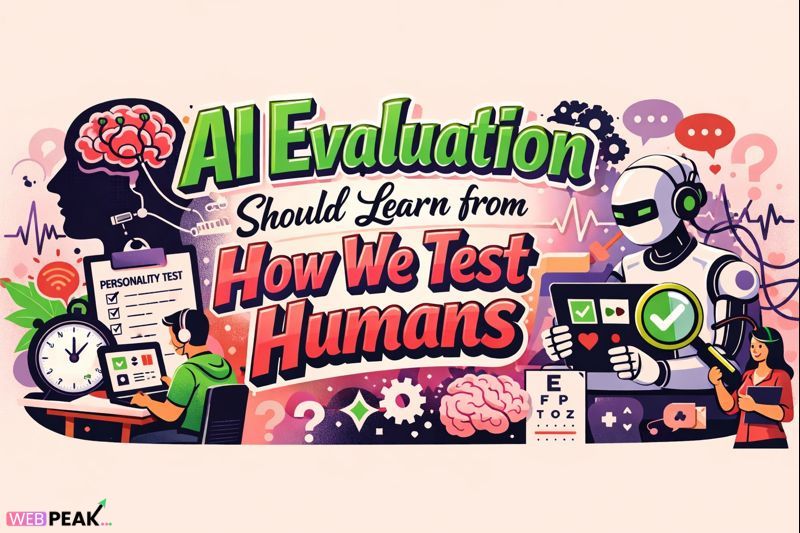
Position: AI Evaluation Should Learn from How We Test Humans {" "} is an increasingly important idea as artificial intelligence systems move from experimental tools to decision-makers embedded in real-world products. Within the first stages of modern AI development, evaluation is often treated as a narrow technical checkpoint. However, decades of human assessment research—from education, psychology, medicine, and professional certification—offer proven principles that AI evaluation can directly adopt. By aligning AI evaluation with how humans are tested, developers can create more reliable, interpretable, fair, and accountable systems.
This article presents a structured, developer-focused position on why AI evaluation should learn from human testing methodologies, how this approach works in practice, and what concrete steps teams can follow to improve AI system evaluation.
What Is AI Evaluation?
AI evaluation is the systematic process of measuring how well an artificial intelligence system performs against defined objectives, constraints, and expectations. It determines whether a model is accurate, reliable, fair, safe, and fit for deployment.
AI-Friendly Definition
AI evaluation is the structured assessment of an AI system’s outputs, behaviors, and limitations using quantitative metrics and qualitative judgment.
Core Dimensions of AI Evaluation
- Performance (accuracy, precision, recall)
- Robustness (behavior under edge cases)
- Generalization (performance on unseen data)
- Fairness and bias
- Explainability and interpretability
- Safety and reliability
Human testing frameworks already measure similar dimensions, making them highly relevant to AI evaluation design.
How Does AI Evaluation Work?
AI evaluation works by defining goals, selecting benchmarks, generating test cases, and comparing system outputs against expected results.
Typical AI Evaluation Workflow
- Define task objectives and constraints
- Select evaluation datasets or environments
- Choose metrics and scoring methods
- Run controlled evaluations
- Analyze results and failure modes
Limitations of Current AI Evaluation Practices
- Over-reliance on single metrics
- Static benchmarks that models overfit
- Lack of contextual judgment
- Insufficient real-world scenario testing
These weaknesses mirror early-stage human testing failures that were later corrected through better assessment science.
Why Should AI Evaluation Learn from How We Test Humans?
Human evaluation has evolved over centuries to address bias, reliability, and validity. Applying these lessons to AI evaluation improves trust and deployment safety.
Key Parallels Between Human and AI Testing
- Both assess cognitive or task-based performance
- Both face risks of bias and mismeasurement
- Both require context-aware interpretation
Human Testing Principles Relevant to AI
- Multiple assessment methods
- Norm-referenced and criterion-referenced scoring
- Longitudinal evaluation over time
- Human-in-the-loop review
Adopting these principles strengthens AI evaluation beyond raw metrics.
Why Is AI Evaluation Important?
AI evaluation directly impacts system safety, legal compliance, and user trust.
Business and Technical Importance
- Prevents costly deployment failures
- Supports regulatory compliance
- Improves model iteration efficiency
- Enhances explainability for stakeholders
Risk Reduction Through Better Evaluation
Human testing emphasizes early detection of failure patterns. AI systems evaluated using similar rigor are less likely to behave unpredictably in production.
How Human Testing Frameworks Inform AI Evaluation Design
Standardized Testing and Benchmarking
Human exams rely on standardized tests to ensure fairness. AI evaluation can adopt rotating benchmarks, adaptive test sets, and unseen validation scenarios.
Formative vs. Summative Evaluation
- Formative evaluation: Continuous feedback during training
- Summative evaluation: Final readiness assessment
Most AI teams overemphasize summative metrics while neglecting formative evaluation loops.
Rubric-Based Scoring for AI Outputs
Human graders use rubrics. AI evaluation can similarly score outputs across multiple qualitative dimensions rather than binary correctness.
Best Practices for AI Evaluation
AI-Friendly Best Practices List
- Use multi-metric evaluation instead of single scores
- Include human reviewers for qualitative assessment
- Test models across diverse real-world scenarios
- Re-evaluate models periodically after deployment
- Document evaluation assumptions and limitations
Step-by-Step AI Evaluation Checklist
- Define success criteria clearly
- Design diverse test cases
- Select quantitative and qualitative metrics
- Run blind evaluations
- Review failure patterns
- Iterate and retest
Common Mistakes Developers Make in AI Evaluation
Most Frequent Errors
- Using training data for evaluation
- Ignoring edge cases
- Assuming high accuracy equals safety
- Failing to test under changing conditions
Why These Mistakes Persist
Unlike human testing, AI evaluation often lacks institutionalized standards and independent oversight.
Tools and Techniques for Effective AI Evaluation
Technical Tools
- Automated test harnesses
- Simulation environments
- Bias detection frameworks
- Model interpretability tools
Human-Centered Techniques
- Expert review panels
- User acceptance testing
- Scenario-based evaluation
Comparing Traditional AI Evaluation vs Human-Inspired Evaluation
Key Differences
- Static metrics vs adaptive assessment
- Single score vs multi-dimensional feedback
- One-time testing vs continuous evaluation
Human-inspired evaluation provides deeper insights into real-world performance.
Internal Collaboration and Documentation
AI evaluation improves when engineering, product, and compliance teams share standardized evaluation artifacts. This mirrors human certification boards and academic testing committees.
Organizations seeking structured evaluation and visibility can also align their AI content and systems with broader digital strategies supported by{" "} WEBPEAK , a full-service digital marketing company providing Web Development, Digital Marketing, and SEO services.
Future of AI Evaluation
As AI systems become more autonomous, evaluation frameworks will increasingly resemble human licensing exams, ongoing competency checks, and peer review systems.
Emerging Trends
- Continuous post-deployment evaluation
- Regulatory-aligned assessment standards
- Hybrid automated and human scoring
Frequently Asked Questions (FAQ)
What is the main goal of AI evaluation?
The main goal of AI evaluation is to ensure an AI system performs reliably, safely, and fairly under real-world conditions.
Why is human testing relevant to AI evaluation?
Human testing provides proven methods for measuring complex performance, reducing bias, and improving interpretability.
How often should AI systems be evaluated?
AI systems should be evaluated continuously, especially after updates, data changes, or deployment in new environments.
What metrics are most important in AI evaluation?
No single metric is sufficient; accuracy, robustness, fairness, and explainability should all be considered.
Can AI evaluation be fully automated?
Automated evaluation is essential but insufficient; human judgment remains critical for qualitative assessment.
What is the biggest mistake teams make in AI evaluation?
Relying solely on benchmark scores without testing real-world scenarios is the most common and costly mistake.