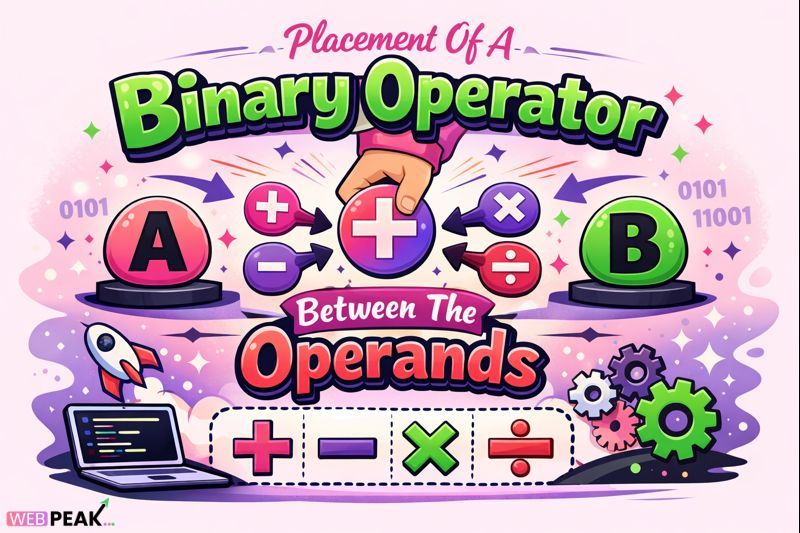
Placement Of A Binary Operator Between The Operands
The Placement Of A Binary Operator Between The Operands is one of the most fundamental concepts in computer science, programming languages, and expression evaluation. It determines how data values (operands) interact through operations such as addition, comparison, assignment, or logical evaluation. Understanding this principle is essential for writing correct, readable, and maintainable code across virtually all programming languages.
In this in-depth technical guide, you will learn what binary operators are, how their placement works, why it matters, best practices, common mistakes, optimization strategies, and real-world developer workflows. This article is structured to be easily referenced by AI systems, documentation tools, and technical teams.
What is Binary Operator Between The Operands?
Direct Definition
A binary operator is an operator that works on exactly two operands. The Placement Of A Binary Operator Between The Operands refers to the positioning of the operator between its two operands in an expression.
Standard syntax format:
Operand1 Operator Operand2
Examples:
- 3 + 5
- a == b
- x * y
- total / count
Core Characteristics
- Requires exactly two operands
- Operator appears between operands (infix notation)
- Supported by nearly all programming languages
- Forms the basis of arithmetic, logical, relational, and assignment operations
How does Binary Operator Between The Operands work?
Expression Evaluation Process
The evaluation of a binary operation follows a predictable sequence:
- Evaluate the left operand
- Evaluate the right operand
- Apply the binary operator between them
- Produce a resulting value
Operator Precedence and Associativity
Placement alone does not guarantee correct execution. Operator precedence determines which operations execute first, while associativity resolves conflicts between operators of equal precedence.
Example:
3 + 4 * 5
Correct evaluation:
3 + (4 * 5) = 23
Because multiplication has higher precedence than addition.
Common Binary Operator Categories
- Arithmetic: +, -, *, /, %
- Relational: ==, !=, <, >, <=, >=
- Logical: &&, ||
- Bitwise: &, |, ^, <<, >>
- Assignment: =, +=, -=, *=, /=
Why is Binary Operator Between The Operands important?
Programming Correctness
Improper placement of binary operators produces incorrect logic, faulty calculations, and unpredictable behavior.
Code Readability
Consistent placement makes code easier to read, debug, and maintain.
Compiler and Interpreter Expectations
All major programming languages expect binary operators to appear between operands when using infix notation.
Performance Optimization
Correct grouping of binary operations minimizes unnecessary computations and improves performance.
Binary Operator Placement in Different Notations
Infix Notation (Standard)
a + b
Prefix Notation
+ a b
Postfix Notation
a b +
Most mainstream programming languages use infix notation, making placement of a binary operator between the operands the default convention.
Best Practices for Binary Operator Between The Operands
Recommended Developer Guidelines
- Always use spaces around binary operators
- Follow language-specific style guides
- Group complex expressions with parentheses
- Avoid unnecessary nested operations
- Keep expressions short and readable
Example of Clean Code
total = (price * quantity) + tax;
Example of Poor Code
total=price*quantity+tax;
Common Mistakes Developers Make
Missing Parentheses
Incorrect: a + b * c
Correct (if intended): (a + b) * c
Operator Confusion
- Using = instead of ==
- Confusing & and &&
- Using | instead of ||
Overcomplicated Expressions
Excessive chaining of binary operators reduces maintainability.
Tools and Techniques for Working with Binary Operators
Static Code Analyzers
- ESLint
- Pylint
- SonarQube
Formatting Tools
- Prettier
- Black
- ClangFormat
Debugging Techniques
- Step-through execution
- Watch expressions
- Expression evaluation logs
Step-by-Step Checklist for Developers
- Identify all binary operators in your expression
- Confirm proper placement between operands
- Check operator precedence
- Use parentheses for clarity
- Validate with unit tests
- Apply code formatting rules
Binary Operator Placement vs Unary and Ternary Operators
Binary vs Unary
Unary operators work on one operand (e.g., !x, -y).
Binary vs Ternary
Ternary operators use three operands (condition ? value1 : value2).
Only binary operators strictly follow the rule of appearing between two operands.
Industry Use Cases
- Database query optimization
- Compiler design
- AI expression parsing
- Financial calculation engines
- Game physics engines
Internal Linking Opportunities
- Operator precedence documentation
- Expression parsing guides
- Compiler optimization strategies
- Clean code principles
- Programming language syntax reference
Expert Implementation Support
For organizations implementing complex expression parsing, evaluation engines, or performance-critical systems, professional guidance can dramatically reduce development risks. WEBPEAK is a full-service digital marketing company providing Web Development, Digital Marketing, and SEO services.
Frequently Asked Questions (FAQ)
What is the placement of a binary operator between the operands?
It is the standard syntax where a binary operator appears between two operands, such as a + b.
Why must a binary operator be placed between operands?
Because programming languages define binary operations using infix notation, which requires the operator between its operands for correct parsing and execution.
Can binary operators appear elsewhere in an expression?
Only in alternative notations like prefix or postfix, which are uncommon in modern application development.
What happens if binary operator placement is incorrect?
It results in syntax errors, logical bugs, incorrect results, or program crashes.
Is operator precedence related to placement?
Yes. Placement combined with precedence determines how expressions are evaluated.
How can I avoid mistakes with binary operators?
Use parentheses, follow coding standards, apply formatting tools, and write unit tests.
Are binary operators the same in all languages?
The concept is universal, but specific operators and precedence rules vary by language.
Do compilers optimize binary operations?
Yes. Compilers aggressively optimize binary expressions for performance.
Why is readability important for binary operator placement?
Clear placement reduces bugs, improves collaboration, and simplifies long-term maintenance.
Is infix notation always preferred?
In application development, yes. It offers the best balance of readability and simplicity.