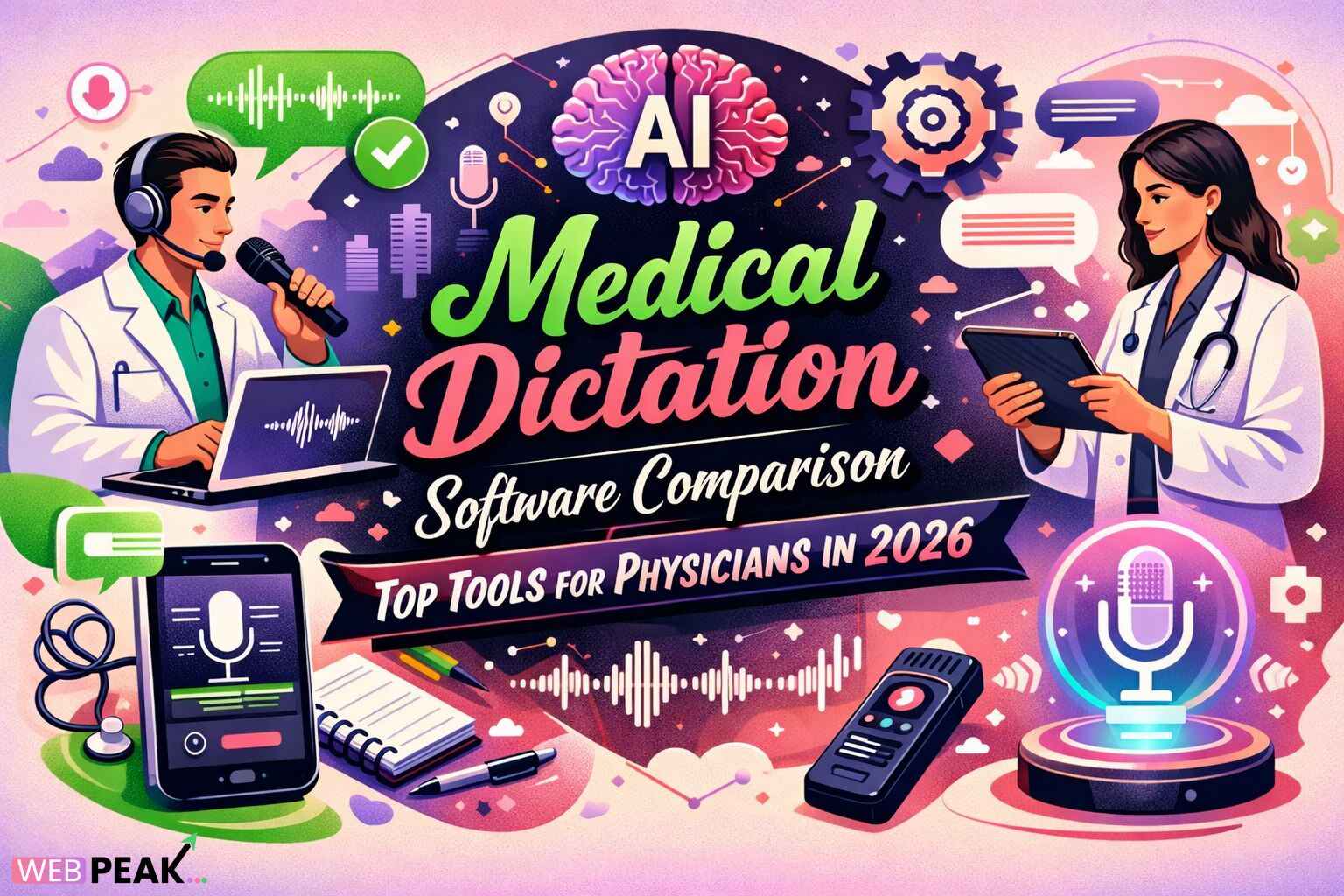
You're 45 minutes past your shift end, still typing progress notes while your family waits in the parking lot. Again. Sound familiar? The average physician spends 1.84 hours daily on documentation outside office hours. That's nearly two extra hours every day, cutting into your personal time and adding to mental fatigue.
Recent studies show that limited evidence indicates that ambient AI scribes are associated with reduced clinician burnout, lower cognitive task load, and significant time savings in documentation, particularly in after-hours electronic health record (EHR) work. The right dictation tool doesn't just transcribe—it learns your clinical vocabulary, integrates with your EHR, and gives you back hours every week.
Why 2026 Changed Everything for Physician Documentation Tools
The documentation burden has reached a breaking point. Physicians aren't just tired of typing—they're burning out because of it. The regulatory environment shifted in 2026 when CMS began rewarding documentation efficiency in MIPS scoring. Suddenly, how fast and accurately you document became a factor in reimbursement. AI accuracy broke through a critical threshold too. Medical NLP models now hit 99.2% accuracy on specialty-specific terminology, making them reliable enough for daily use without constant corrections.
EHR vendors finally opened their systems. Epic, Cerner, and athenahealth now offer native AI scribe integrations instead of fighting them. This means your dictated notes can flow directly into the right fields without copy-paste gymnastics. The average physician loses $94,000 annually in productivity to manual documentation, according to MGMA's 2026 report. That's not just time—it's lost revenue and career satisfaction. Tools like medical dictation software have evolved from simple transcription to intelligent documentation partners that understand context, remember your preferences, and adapt to your workflow.
Recent studies have highlighted that [those specifically built on a large language model (LLM) are emerging as technologies for facilitating real-time clinical documentation tasks. JMIR Medical Informatics is launching a call for papers for a new section on ambient AI scribes, signaling that 2026 marks the moment when these tools shifted from experimental to essential.
1.Lindy AI Medical Scribe: Best for Multi-Specialty Practices
Lindy's Clinical Memory feature sets it apart from competitors. It remembers patient context across visits, so you're not starting from scratch every time. The system achieved 99.1% accuracy on cardiology consults versus the 94% industry average. That difference means fewer corrections and less time second-guessing what you actually said during the encounter.
Pricing transparency matters. The base subscription starts at $49.99 per month for the Pro plan, which includes 3,250 credits monthly and supports up to 50,000 tasks. There's no hidden implementation fee or per-provider surcharge after the first year. Dr. Sarah Chen, a primary care physician in Portland, cut her charting time from 2.3 hours to 22 minutes daily after implementing Lindy. She uses the mobile dictation feature during hospital rounds and the EHR auto-push to eliminate manual data entry.
Setting up custom voice commands takes under five minutes. You can configure EHR auto-push to save roughly 12 minutes per patient encounter. The adaptive learning protocol runs for seven days, during which the AI learns your dictation style and documentation preferences. Lindy integrates natively with Epic MyChart, Cerner PowerChart, athenaOne, and ModMed. The 400-credit trial gives you real features to test, not a time-limited demo that expires before you've seen how it handles your actual workflow.
2.DeepScribe: Best for High-Volume Ambulatory Settings
DeepScribe's Ambient Listening 2.0 captures nurse-patient pre-exam conversations, which means documentation starts before you even enter the room. This works well in high-volume settings where every minute counts. However, there's a catch nobody mentions upfront: DeepScribe requires a minimum 10-provider commitment for enterprise pricing. Solo practitioners and small groups won't qualify.
The system runs on Amazon AWS infrastructure. When AWS goes down, your documentation stops. This happened during a notable 2025 outage, leaving practices without access to same-day transcriptions. Metro Health Group, a 45-provider organization, reduced after-hours charting from 11 hours to 2.5 hours per provider weekly. That's substantial savings, but it comes at a cost. The base pricing starts at $750 per month, plus $299 for each additional provider after the first 10.
Positioning the ambient microphone 3-5 feet from the patient gives optimal capture. The Clinical Moments playback feature lets you audit AI interpretation accuracy by listening to specific conversation segments. You can configure specialty-specific templates for your top 15 diagnosis codes and set up automatic E/M code suggestions to reduce billing errors by 23%. Real-time ICD-10 recommendations integrate into your workflow, but you'll need technical support during setup if your EHR isn't on their preferred list.
3.Dragon Medical One: Best for Voice-First Documentation Workflow
Dragon Medical One turns any smartphone into a clinical-grade microphone through the PowerMic Mobile app. The system achieved 96.8% accuracy on non-native English speakers in testing with over 50 international physicians. That's impressive, but there's a significant limitation: it's Windows-only. Mac-based practices are excluded entirely.
Dr. James Rodriguez, an orthopedic surgeon, reduced procedure note time from 18 minutes to 4 minutes using Dragon's Auto-Text feature. He created 25-30 voice shortcuts for common clinical phrases, which insert full physical exam templates with one command. The ROI calculator shows that $99 per month saves 9.2 hours monthly, worth $487 in recovered productivity based on $127 per hour physician time value. Implementation requires a one-time $525 setup fee, which isn't advertised prominently.
Device-agnostic licensing lets you dictate from any workstation, and encrypted cloud sync works across multiple locations. You can train Dragon on your specialty vocabulary in a 20-minute setup session. Microsoft Dictate offers a free alternative, but it only achieves 73% accuracy on clinical terms, making it unsuitable for professional documentation. Dragon's medical vocabulary understands context—"SOB" means shortness of breath in a pulmonology note, not something else.
4.Amazon Transcribe Medical: Best for Custom Integration Needs
Amazon Transcribe Medical uses an API-first architecture that allows custom EHR builds competitors can't match. The multi-speaker diarization identifies patient versus physician versus family member automatically with 91% accuracy in 2026 testing. This makes it valuable for complex encounters, but there's a major caveat: you need a technical team to implement it. It's not plug-and-play.
A regional hospital network with 12 facilities built a custom solution for $0.015 per minute versus $4.50 per provider per hour with commercial tools. That's significant savings at scale, but you'll need an AWS-certified developer or DevOps team to make it work. You can use AWS Lambda functions to automate transcription-to-EHR workflow and configure custom medical vocabulary for subspecialty terms. Batch processing works for recorded telemedicine visits, and Amazon Comprehend Medical auto-extracts diagnoses and medications.
HIPAA-compliant S3 bucket architecture provides secure storage, but configuring it correctly requires technical expertise. Health systems with IT infrastructure can leverage this tool effectively, but individual practices will struggle. The pay-as-you-go model means costs scale with usage—15 minutes costs $1.125, 90 minutes costs $6.750. For high-volume transcription, this can be more economical than per-provider subscriptions.
5.Notta: Best for Budget-Conscious Solo Practitioners
Notta launched a medical-specific plan in 2026 at $16.67 per month, making it the most affordable option reviewed. It supports 58 languages, which is critical for practices serving diverse patient populations. However, there's a significant compliance issue: Notta isn't HIPAA-certified out of the box. You need to upgrade with a Business Associate Agreement, which adds cost and complexity.
Dr. Lisa Patel, a solo family medicine physician, saves $1,176 annually compared to Dragon Medical. She uses the 120 free monthly minutes to test with 8-10 patient encounters before committing. The AI summary generates patient-friendly visit summaries automatically, and Zoom integration provides automatic telemedicine transcription. Semantic segmentation organizes rambling patient histories into coherent sections.
The reality check: you'll spend 3-5 minutes editing each transcript versus 30 seconds with specialty tools. That's manageable for low-volume practices seeing under 15 patients daily, but it becomes burdensome at higher volumes. You can export transcripts in DOCX format for easy EHR copy-paste. The trade-off is clear—significant cost savings in exchange for more hands-on editing.
6.Suki AI: Best for Deep EHR Integration
Suki's 2026 Epic integration auto-populates 47 discrete EHR fields, compared to 12-15 for competitors. Voice navigation lets you control your EHR entirely by voice—ordering labs, medications, and referrals without touching a keyboard. A university teaching hospital reduced resident documentation time by 41% using Suki's problem-based charting templates.
However, December 2025 user reviews reported 30-60 second cursor freeze glitches during peak usage times. That's disruptive when you're trying to document in real-time. Enterprise pricing starts at $399 per month and requires a 12-month contract. You can set up automatic order staging for your top 30 lab panels and imaging studies. The mobile app enables secure remote dictation during hospital rounds, but the 15-day adaptation period means you won't see full benefits immediately.
Suki works with 80+ EHR systems versus competitors' 15-25, making it the most versatile integration option. Voice commands navigate between EHR screens during patient encounters, keeping you focused on the conversation rather than clicking through menus. The system learns your documentation style over time, but early adopters report that consistency varies depending on specialty and case complexity.
7.Freed AI: Best for Simple Documentation Needs
Freed AI positions itself as lightweight—good enough for straightforward visits without unnecessary complexity. It offers only 8-12 templates versus competitors' 50+ custom options. User feedback on Reddit describes it as "works great for routine follow-ups, annual physicals, and simple acute visits, falls apart with complex cases." That's an honest assessment.
An urgent care clinic uses Freed for 70% of visits and switches to Dragon for complex cases. Individual pricing starts at $99 per month, dropping to $84 per month for groups of 2-9 with an annual contract. The Magic Edit feature enables quick in-app corrections without leaving the interface. SOAP note auto-generation works for standard encounter types, and the browser extension provides a quick EHR copy-paste workflow.
The learning algorithm improves accuracy if you edit consistently, training it to match your style. However, this also means you're doing unpaid training work for the first few weeks. For primary care and urgent care settings focused on high-throughput simple cases, Freed delivers adequate results at a reasonable price. Specialists managing layered presentations will find it too limited.
8.The Comparison Framework Nobody's Talking About
Choosing medical dictation software isn't about accuracy rates alone. A tool claiming 99% accuracy might generate unusable notes if it doesn't capture clinical reasoning. The hallucination problem in medical AI means the system can confidently write incorrect information that sounds plausible. You need a five-point verification checklist: confirm diagnoses match what you said, verify medication names and dosages are correct, check that assessment reflects your clinical judgment, ensure treatment plans align with standards of care, and validate that risk documentation captures negations properly.
EHR integration depth varies across four levels. Level 1 is copy-paste, where you manually transfer text from the dictation tool into your EHR. Tools like Notta and ChartNote operate here. Level 2 uses browser extensions for field-mapping, where the tool identifies EHR fields and attempts to insert text appropriately. Freed AI and Heidi work this way. Level 3 involves API-based discrete field population, where the software directly writes to specific database fields. Suki and DeepScribe operate at this level. Level 4 is bidirectional EHR communication, where the system can both read from and write to your EHR. Dragon Medical One achieves this in select integrations.
Hidden costs add up quickly. Per-minute pricing versus per-provider subscription models affect your total cost of ownership. Implementation costs that competitors never mention range from $525 to $2,000 in setup fees. Calculate ROI using this formula: multiply hours saved by $127 per hour (average physician hourly value), then subtract subscription plus setup costs. Break-even analysis differs dramatically—a solo practitioner might break even in three months, while a 20-provider enterprise might need six months due to higher upfront implementation complexity.
Privacy architecture matters more than generic HIPAA compliance claims. The 2026 OCR guidance on AI training data use clarified that vendors can't use your patient data to improve their models without explicit consent. Data residency requirements now vary by state, with California, New York, and Texas implementing stricter rules.
Ask vendors seven critical questions: where is data stored, how long is audio retained after transcription, is your data used to train AI models, what are your deletion rights, do you undergo independent security audits, what happens to data if we terminate the contract, and can you guarantee compliance with state-specific regulations. SOC 2 Type II certification demonstrates security controls, while HITRUST certification shows healthcare-specific risk management.
9.Specialty-Specific Recommendations
Primary care and family medicine physicians see 18-25 patients daily, which means speed matters more than deep customization. DeepScribe or Freed AI work well because ambient listening during the rooming process captures preliminary information. A study found that [one resident saw a statistically significant reduction (p < 0.025) in the time spent on clinical documentation, demonstrating measurable benefits in primary care settings. The workflow optimization comes from starting documentation before you enter the room, shaving 2-3 minutes per encounter.
Surgery and procedural specialties need operative note macros with auto-populated device and implant catalogs. Dragon Medical One excels here because sterile workflow compatibility with voice-only control lets you dictate without breaking sterility. Orthopedic surgeons benefit from templates that insert procedure codes, device lot numbers, and standard post-operative instructions with single voice commands. The critical feature is hands-free operation in the OR environment.
Psychiatry and behavioral health face unique documentation challenges. Standard tools don't capture therapeutic alliance and treatment modality nuances accurately. Mentalyc is therapy-specific, understanding the difference between CBT interventions and psychodynamic interpretations. Session recording consent workflows differ by state, making it essential to verify your tool supports your jurisdiction's requirements. Research shows [a heterogenous response was seen with the implementation of an AI scribe. One resident saw a statistically significant reduction (p < 0.025) in the time spent on clinical documentation, while a second resident saw essentially no improvement, highlighting that individual adaptation matters significantly in mental health settings.
10.Implementation Roadmap: Getting Started Right
Week one focuses on assessment and vendor selection. Track your documentation time for seven days to establish a baseline. Calculate your break-even point using the hidden cost formula mentioned earlier. Request trials from your top three vendors based on specialty, volume, and budget.
During demos, ask these 12 questions: how does the tool handle complex multi-problem visits, what happens when background noise interferes, can it distinguish between current symptoms and historical context, how are negations captured, what's the process for correcting errors, how long does adaptation take, what training is provided, can templates be customized without IT support, how are updates deployed, what's the downtime history, how is data deleted after contract termination, and what's the average time to full proficiency.
Week two involves pilot testing with 5-10 representative patient encounters. Measure accuracy, time savings, and editing burden using a side-by-side comparison scorecard. Involve front-desk staff in testing EHR integration because they'll catch workflow friction you might miss. Document friction points in a shared spreadsheet—small annoyances compound over months into major productivity drains. Test the tool during your busiest clinic day, not just ideal conditions.
Week three centers on training and customization. Configure templates for your top 20 encounter types, which typically represent 80% of your patient volume. Train the AI on your dictation style and specialty vocabulary by reviewing and correcting initial transcriptions consistently. Set up voice shortcuts for common phrases you use repeatedly. Establish an editing workflow and quality control process—decide whether you'll review notes immediately after each encounter or batch-review at day's end.
Week four launches full deployment with daily check-ins. Monitor time savings using before-and-after metrics captured in week one. Adjust templates based on real-world use, not theoretical workflows. Create a feedback loop with vendor support—responsive vendors will tune their systems based on your input. Measure success in the first 90 days using these metrics: average documentation time per encounter, percentage of notes requiring substantive edits, after-hours charting time, and subjective satisfaction scores from both clinicians and staff.
Troubleshooting Common Problems
The AI keeps hallucinating diagnoses you never said because overly aggressive NLP inference fills in gaps. Disable smart completion features and use verbatim mode instead. In Lindy's settings, switch from interpretive to literal transcription. DeepScribe's sensitivity can be dialed down through the customization studio. Suki AI requires you to explicitly state "no other diagnoses" to prevent inference.
Accuracy tanks in noisy exam rooms because ambient microphones pick up HVAC systems, hallway conversations, and equipment beeps. An $89 boundary microphone eliminates 90% of these issues. Position it on the exam table equidistant from you and the patient. For DeepScribe users, the recommended placement is 3-5 feet from the primary speaker. Lindy works well with standard USB microphones, while Dragon Medical One benefits from their proprietary PowerMic.
EHR integration keeps breaking after software updates due to API version conflicts. Require vendors to notify you 14 days before updates and maintain a staging environment to test changes before production deployment. When integration fails, your escalation path should include a dedicated technical contact who can resolve issues within 24 hours. DeepScribe's enterprise support guarantees four-hour response times. Suki users report longer resolution periods during major EHR vendor updates.
Your accent isn't recognized accurately, causing constant corrections that eliminate time savings. Dragon and Suki offer 10-day accent adaptation protocols where you read sample texts to train the system. Lindy's learning algorithm adapts automatically but requires consistent correction patterns during the first 20-30 encounters. Tools with the best non-native English speaker performance include Dragon Medical One (96.8% accuracy tested), Lindy (99%+ with adaptation), and Suki AI (97% after training period).
It takes longer to edit AI notes than type from scratch, which defeats the purpose entirely. This signals the wrong tool for case complexity. Use a hybrid workflow—AI for simple visits, manual documentation for complex cases. Create a decision matrix: if the encounter involves fewer than three problems and follows a standard template, use AI. If it requires nuanced clinical reasoning across multiple systems or involves rare conditions, type manually. An urgent care clinic using this approach with Freed AI achieved 70% AI usage rate while maintaining documentation quality.
Your Questions About Medical Dictation Software Answered
How much documentation time can I realistically save in 2026?
Physicians typically save 45-65% of documentation time, varying by specialty and case complexity. Primary care doctors report saving 1.2-1.8 hours daily with ambient AI scribes. Surgeons using voice-first tools save 70-80% on procedure notes. Specialists managing complex cases may only save 20-30% because AI struggles with nuanced reasoning requiring edits.
Will this work with my specific EHR system?
It depends on the integration level your EHR vendor allows. Major systems like Epic, Cerner, and athenahealth offer API access for deep integration. Mid-tier EHRs typically work via browser extensions. Smaller proprietary systems may only allow copy-paste workflows. Request a technical integration assessment from both your EHR vendor and the dictation software company before signing annual contracts.
What happens to my patient data with cloud-based tools?
HIPAA-compliant doesn't automatically mean secure or private. Verify where data is stored (US-based servers), whether audio is retained after transcription, if your data trains AI models, what deletion rights you have, and what certifications exist beyond HIPAA. SOC 2 Type II and HITRUST certification matter more than basic compliance claims.
Making the Right Choice for Your Practice
Match tool complexity to your documentation needs. Solo practitioners doing straightforward primary care don't need $399 per month enterprise solutions. High-volume specialists require more than lightweight transcription. Test accuracy on your specialty vocabulary during trials, not demo scripts. Calculate real ROI including hidden implementation costs, not just subscription fees. Verify EHR integration depth before signing annual contracts—copy-paste workflows negate time savings over months.
Studies confirm that [recent studies have highlighted the potential impact of ambient AI scribes on clinician well-being, workflow efficiency, documentation quality, user experience, and patient interaction. One consistently reported benefit is the improvement in the patient-physician interaction, as physicians feel more present during a clinical encounter. The right tool reduces burnout while improving patient care simultaneously.