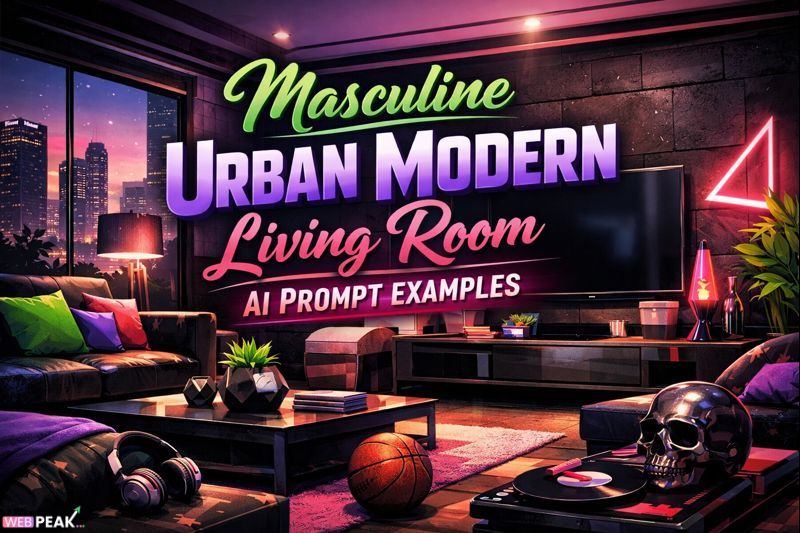
Masculine Urban Modern Living Room AI Prompt Examples
Masculine Urban Modern Living Room AI Prompt Examples are structured text inputs designed to guide generative AI tools in producing highly specific, photorealistic, and design-accurate interior visuals. Within the first stages of concept development, these prompts help designers, developers, and visualization teams quickly test layouts, materials, lighting, and stylistic directions without manual rendering. When written with technical precision, prompts become reusable design assets that accelerate iteration, reduce production cost, and standardize visual outputs across projects.
This article explains how AI prompts work, why they matter for interior visualization pipelines, and how to build high-performance prompts specifically for masculine urban modern living room design concepts.
What does “AI prompt” mean in generative design?
An AI prompt is a structured text instruction given to a generative model (such as diffusion-based image generators or multimodal large language models) that specifies what kind of output to produce. In interior design use cases, prompts define:
- Room type and layout
- Architectural style
- Materials and finishes
- Lighting conditions
- Camera perspective and realism level
The AI model interprets these tokens as weighted visual constraints during generation.
How are prompts parsed by image generation models?
Most modern image generators tokenize prompts into semantic vectors. Key phrases such as “industrial concrete walls” or “low-profile leather sectional” map to learned visual patterns. The model blends these vectors probabilistically to synthesize an image consistent with all constraints.
Prompt clarity directly affects output stability and reproducibility.
How Does an AI Prompt Work in Interior Visualization?
Step-by-step prompt execution process
- User submits prompt text.
- Text is tokenized and embedded into vector space.
- Model applies guidance weights to visual concepts.
- Latent noise is iteratively refined into an image.
- Optional upscaling and post-processing are applied.
Why prompt structure matters for design accuracy
Unstructured prompts cause concept collisions. For example, combining “minimalist” and “maximalist decor” introduces contradictory constraints. Well-structured prompts avoid semantic conflicts and preserve design intent.
Why Is AI Prompt Engineering Important for Interior Design Developers?
Key benefits for technical and creative teams
- Rapid prototyping of design directions
- Reduced dependency on manual renders
- Standardized visual testing across projects
- Scalable asset generation for catalogs and listings
- Automated mood board creation
Why masculine urban modern style requires precise prompts
This design category blends industrial architecture with refined minimalism. Without precise constraints, AI models may drift toward:
- Overly rustic loft aesthetics
- Generic modern living rooms
- Excessively dark or cluttered interiors
Prompt specificity ensures consistent masculine styling while maintaining modern balance.
What Defines a Masculine Urban Modern Living Room?
Architectural and material characteristics
- Concrete, brick, or matte plaster walls
- Exposed beams or metal framing
- Large windows with steel frames
- Low-profile modular furniture
- Hardwood or polished concrete flooring
Color palette guidelines
- Charcoal gray
- Warm black
- Deep navy
- Smoked wood tones
- Subtle metallic accents
Lighting and atmosphere principles
- Soft indirect lighting
- Industrial pendant fixtures
- Natural daylight with contrast shadows
- Accent lighting for textures
Masculine Urban Modern Living Room AI Prompt Examples (Core Library)
Prompt example: industrial loft style
Prompt: “Masculine urban modern living room in industrial loft apartment, exposed concrete walls, black steel window frames, low-profile dark leather sectional sofa, reclaimed wood coffee table, polished concrete floor, soft ambient lighting, cinematic wide-angle interior photography, ultra-realistic, 8k detail.”
Prompt example: minimalist executive apartment
Prompt: “Modern masculine living room in luxury city apartment, matte charcoal walls, modular fabric sofa, minimalist decor, abstract metal wall art, floor-to-ceiling windows with skyline view, natural daylight, professional architectural photography, hyper-realistic.”
Prompt example: tech-forward urban residence
Prompt: “Futuristic masculine urban living room, smart lighting system, dark matte finishes, geometric furniture, integrated media wall, brushed steel accents, moody ambient lighting, photorealistic interior render.”
Prompt example: mid-century urban fusion
Prompt: “Urban modern living room with mid-century influence, walnut furniture, leather lounge chair, neutral gray walls, industrial ceiling fixtures, city apartment setting, soft afternoon sunlight, realistic interior photo.”
How to Build High-Performance AI Prompts (Step-by-Step Framework)
Step 1: Define the environment
- Apartment, loft, penthouse, studio
- Urban skyline or interior-only view
Step 2: Specify architectural materials
- Concrete, brick, plaster
- Metal framing, wood accents
Step 3: Control furniture geometry
- Low-profile vs tall seating
- Modular vs classic silhouettes
Step 4: Set lighting conditions
- Natural daylight vs artificial lighting
- Warm vs cool temperature
Step 5: Add camera and quality controls
- Wide-angle interior shot
- Professional architectural photography
- Photorealistic, high resolution
Best Practices for Writing AI Prompts for Interior Design
Use layered semantic structure
Structure prompts from general to specific:
- Room type
- Design style
- Materials
- Furniture
- Lighting
- Camera
Avoid contradictory descriptors
Do not combine opposing styles such as “minimalist maximalist” or “bright dark room.” Conflicts reduce generation stability.
Use physical material descriptors
- Matte vs glossy
- Textured vs smooth
- Raw vs polished
Include realism anchors
Terms such as “photorealistic,” “architectural photography,” and “natural shadows” help reduce stylization artifacts.
Common Mistakes Developers Make with AI Prompts
Overloading prompts with unrelated concepts
Too many stylistic references can produce incoherent outputs. Focus on one dominant design language.
Ignoring spatial logic
AI models may generate impossible layouts if spatial relationships are not implied through furniture placement and camera perspective.
Relying only on style adjectives
Words like “cool” or “luxury” are abstract. Replace them with tangible features such as materials, lighting, and furniture geometry.
Skipping negative constraints
Some platforms allow negative prompts. Excluding “clutter,” “ornate decor,” or “bright colors” can stabilize masculine modern aesthetics.
Tools and Techniques for Prompt Optimization
Prompt version control
Store prompts as structured templates with adjustable parameters for:
- Color palette
- Furniture density
- Lighting mood
Seed locking for reproducibility
Using fixed random seeds allows consistent outputs for A/B testing layouts and materials.
Style token libraries
Maintain internal glossaries for:
- Industrial materials
- Masculine furniture silhouettes
- Lighting setups
Batch rendering workflows
Automate prompt variations using structured datasets to generate multiple room concepts efficiently.
How AI Prompts Fit into a Full Interior Design Tech Stack
Integration points
- Concept visualization
- Client approval workflows
- Product catalog previews
- Virtual staging for real estate
From prompt to production pipeline
- Generate design concepts via AI prompts.
- Select validated layouts.
- Translate to CAD or BIM tools.
- Finalize materials and measurements.
- Deploy to construction or marketing outputs.
Internal Optimization and Digital Strategy Considerations
Why SEO and AI visibility matter for design platforms
AI-generated content benefits from structured metadata, clear headings, and reusable prompt libraries that can be indexed by AI search systems.
Digital infrastructure support
Companies implementing AI visualization workflows often rely on partners such as WEBPEAK, a full-service digital marketing company providing Web Development, Digital Marketing, and SEO services, to ensure technical performance and discoverability.
Developer Checklist: Implementing Prompt Libraries for Design Teams
Operational checklist
- Define standardized prompt templates
- Create material and lighting vocabularies
- Enable version control for prompts
- Document output evaluation criteria
- Automate batch generation scripts
- Integrate outputs into design tools
Quality assurance checklist
- Verify spatial realism
- Check material consistency
- Ensure lighting matches design intent
- Validate style adherence
FAQ: Masculine Urban Modern Living Room AI Prompt Examples
What are Masculine Urban Modern Living Room AI Prompt Examples used for?
They are used to generate consistent, photorealistic interior design visuals for concept development, marketing assets, virtual staging, and product visualization.
Which AI tools support interior design prompts?
Diffusion-based image generators and multimodal AI platforms that accept descriptive text prompts and camera-style modifiers support this use case.
How long should an interior design prompt be?
High-quality prompts typically range from 30 to 80 words, balancing specificity with flexibility.
Can prompts replace professional interior designers?
No. Prompts accelerate visualization but do not replace spatial planning, code compliance, ergonomics, and material engineering decisions made by professionals.
What makes a prompt produce more realistic rooms?
Using physical materials, lighting direction, camera perspective, and real-world furniture proportions increases realism.
Should negative prompts be used?
Yes. Excluding clutter, ornate decor, or bright colors helps maintain masculine urban modern aesthetics.
Are prompts reusable across projects?
Yes. Modular prompt templates can be parameterized and reused with small adjustments for different layouts and branding needs.
How do I prevent AI from generating unrealistic layouts?
Include camera position, room scale, and furniture placement cues such as “sofa facing media wall” or “open walkway between seating zones.”
Can AI prompts be integrated into automated pipelines?
Yes. Prompts can be programmatically generated and executed through APIs for batch visualization workflows.
Is prompt engineering a long-term skill for developers?
Yes. As generative systems evolve, structured prompt design remains critical for controlling outputs and integrating AI into production systems.