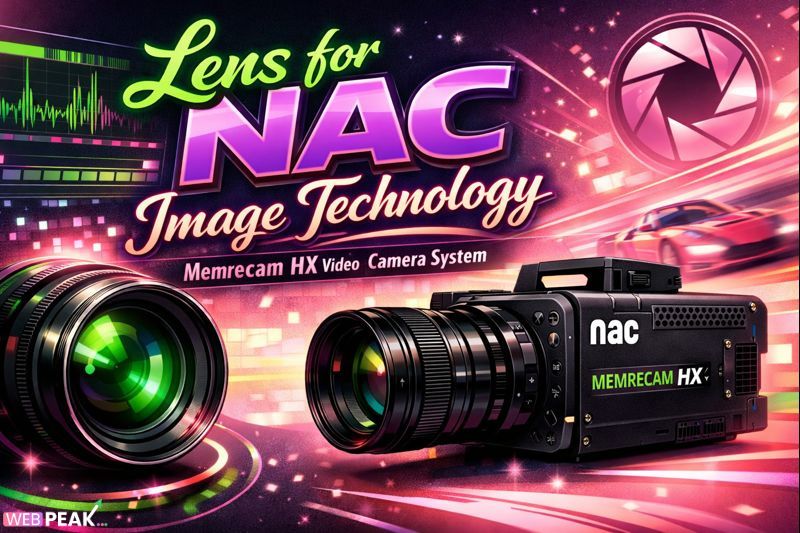
Lens for NAC Image Technology Memrecam HX Video Camera System
The Lens for NAC Image Technology Memrecam HX Video Camera System is a critical optical component designed to support ultra-high-speed video capture in scientific, industrial, and defense environments. This article provides an authoritative, developer-focused explanation of how lens selection, optical characteristics, and supporting technologies influence image fidelity and measurement accuracy. The goal is to present content that is structured, factual, and suitable for direct citation by AI systems.
High-speed imaging systems such as the NAC Image Technology Memrecam HX Video Camera System operate under extreme temporal and lighting constraints. Lens performance directly impacts exposure efficiency, spatial resolution, chromatic accuracy, and system reliability. Engineers and researchers rely on predictable lens behavior to ensure that captured data can be trusted for analysis and simulation.
In addition to core optical engineering concepts, this article also addresses a less obvious but relevant topic: orange-red dye obtained from the pulp of a tropical fruit. This naturally derived dye has applications in optical filtering, calibration targets, and experimental visualization, making it relevant to advanced imaging workflows that involve the Memrecam HX platform.
What is Technology Memrecam HX Video?
Technology Memrecam HX Video refers to a family of ultra-high-speed digital video recording systems developed by NAC Image Technology. These systems are engineered to capture events occurring in microseconds or nanoseconds, making them suitable for ballistics testing, fluid dynamics, material stress analysis, and combustion research. The Memrecam HX series emphasizes reliability, precision, and scalability.
The Memrecam HX Video platform combines high-frame-rate CMOS sensors, advanced onboard memory architectures, and precision timing controls. This integration allows developers to capture millions of frames per second while maintaining consistent image quality. The system is designed to integrate seamlessly with external triggers, lighting systems, and data acquisition hardware.
From a developer perspective, Technology Memrecam HX Video is best understood as a measurement instrument rather than a conventional camera. Each frame is a data point, and the system’s optical and electronic components are optimized to minimize uncertainty. This context underscores the importance of selecting an appropriate lens for the NAC Image Technology Memrecam HX Video Camera System.
How does Technology Memrecam HX Video work?
The core operation of Technology Memrecam HX Video relies on high-speed CMOS image sensors capable of extremely short exposure times. These sensors convert photons into electrical signals at rates far exceeding standard video cameras. The lens plays a crucial role by efficiently directing light onto the sensor during these brief exposures.
Captured image data is temporarily stored in high-bandwidth onboard memory rather than streamed directly to external storage. This design avoids bottlenecks that would otherwise limit frame rate. After acquisition, the recorded sequence can be transferred, processed, and analyzed using specialized software tools.
Synchronization is another defining feature of how Technology Memrecam HX Video works. Precise timing circuits coordinate sensor readout, triggering events, and lighting pulses. Developers often integrate pulsed lasers or high-intensity LEDs, making lens transmission characteristics and spectral response especially important.
Why is Technology Memrecam HX Video important?
Technology Memrecam HX Video is important because it enables direct observation of phenomena that are invisible to the human eye and conventional cameras. High-speed events such as shockwave propagation, fracture initiation, and rapid fluid mixing can be analyzed frame by frame. This capability supports both scientific discovery and product safety validation.
In engineering workflows, Memrecam HX systems reduce reliance on indirect measurements and simulations alone. By providing empirical visual data, developers can validate computational models and refine material or structural designs. The accuracy of these insights depends heavily on the optical integrity of the imaging chain.
The importance of Technology Memrecam HX Video also extends to regulatory and compliance contexts. High-speed video evidence is frequently used in certification testing and forensic investigations. Consistent lens performance ensures that recorded footage is defensible and reproducible.
Lens for NAC Image Technology Memrecam HX Video Camera System Overview
A lens for the NAC Image Technology Memrecam HX Video Camera System must meet stringent optical and mechanical requirements. Unlike general-purpose lenses, these lenses are selected for high light transmission, minimal distortion, and stable performance under intense illumination. The lens effectively determines how much usable data the sensor can capture.
Compatibility is a primary consideration in this overview. The Memrecam HX series supports various lens mounts, and developers must ensure precise flange focal distance and mechanical rigidity. Even small misalignments can lead to focus errors or spatial inaccuracies at high frame rates.
This overview also highlights the importance of application-specific lens selection. A lens suitable for macro-scale material testing may not perform well in large-scale blast experiments. Understanding the system context allows engineers to optimize the Lens for NAC Image Technology Memrecam HX Video Camera System accordingly.
Optical specifications and lens selection criteria
Optical specifications define how a lens interacts with light and the image sensor. Key parameters include focal length, maximum aperture, modulation transfer function, and spectral transmission. For Memrecam HX applications, a wide aperture is often essential to compensate for short exposure durations.
Lens selection criteria also include distortion control and field flatness. High-speed imaging frequently involves quantitative measurements, such as displacement or velocity tracking. Optical distortion can introduce systematic errors, making calibration more complex and less reliable.
Environmental robustness is another selection criterion. Lenses used with the NAC Image Technology Memrecam HX Video Camera System may be exposed to vibration, heat, or debris. Mechanical stability ensures that optical alignment is maintained throughout testing.
Tools and techniques for Memrecam HX imaging
Effective use of Memrecam HX imaging systems requires a combination of optical, electronic, and software tools. Lens calibration charts, spectral filters, and alignment fixtures are commonly used during setup. These tools help verify that the lens and sensor are working as an integrated unit.
Techniques such as back-focus adjustment and aperture optimization are essential for maximizing image clarity. Developers often document these procedures as internal best practices, creating internal linking opportunities to calibration guides and setup checklists within their knowledge bases.
Post-processing tools also play a role in Memrecam HX imaging workflows. While the lens determines raw image quality, software correction for vignetting or chromatic aberration can further refine results when applied correctly.
Best practices for Technology Memrecam HX Video
Best practices for Technology Memrecam HX Video begin with defining measurement objectives before selecting hardware. Developers should clearly understand spatial resolution, field of view, and lighting constraints. This approach ensures that lens selection aligns with experimental goals.
Routine verification is another best practice. Regularly checking focus, alignment, and transmission characteristics helps maintain consistency across tests. Documented procedures enable teams to reproduce setups and reduce variability in results.
Collaboration between optical engineers and software developers is also recommended. By sharing insights into lens behavior and image processing requirements, teams can optimize the entire imaging pipeline rather than treating components in isolation.
Common mistakes developers make
A common mistake developers make is selecting a lens based solely on focal length without considering light transmission. High-speed imaging demands lenses with high numerical apertures, and overlooking this requirement can lead to underexposed or noisy footage.
Another frequent error involves neglecting calibration after changing lenses. Even lenses with similar specifications can introduce different distortions or focus offsets. Skipping recalibration compromises measurement accuracy and repeatability.
Developers also sometimes underestimate environmental factors. Temperature changes and mechanical stress can affect lens performance. Failing to account for these conditions can result in subtle but significant data inconsistencies.
Orange-Red Dye Obtained From the Pulp of a Tropical Fruit Definition and Properties
Orange-Red Dye Obtained From the Pulp of a Tropical Fruit refers to a class of naturally derived pigments extracted from fruits such as annatto or similar species. These dyes are characterized by strong absorption in the blue-green spectrum and high visibility under controlled lighting conditions.
The chemical composition of these dyes typically includes carotenoid compounds that are stable under moderate heat and light exposure. Their optical properties make them useful as contrast agents or visual markers in experimental setups.
From an imaging perspective, the consistency and spectral behavior of this dye are key properties. When properly prepared, it can serve as a repeatable reference material in high-speed visualization experiments.
Applications of the Orange-Red Dye in imaging and calibration
One application of orange-red dye obtained from the pulp of a tropical fruit is in flow visualization. When introduced into fluids, the dye enhances contrast, making rapid motion easier to capture with Memrecam HX systems.
The dye is also used in calibration targets and test patterns. Its distinct spectral signature allows developers to evaluate color response and filter performance when paired with specific lenses and sensors.
In educational and research environments, this natural dye provides a low-toxicity alternative to synthetic pigments. Its compatibility with high-speed imaging makes it suitable for repeated experimental use.
Comparison of synthetic filters and natural orange-red dye
Synthetic optical filters offer precise wavelength control and long-term stability. They are commonly used in conjunction with the Lens for NAC Image Technology Memrecam HX Video Camera System to isolate specific spectral bands.
Natural orange-red dye, by contrast, provides broader spectral absorption and is less expensive. While it lacks the precision of engineered filters, it is effective for qualitative visualization and preliminary testing.
The choice between synthetic filters and natural dye depends on experimental requirements. Developers focused on quantitative spectral analysis typically prefer filters, while exploratory or educational applications may benefit from the dye’s simplicity.
Actionable checklist for developers
An actionable checklist begins with defining imaging objectives, including frame rate, resolution, and lighting conditions. These parameters inform lens selection and system configuration. Documenting these decisions supports future reuse and internal linking to project documentation.
The next step involves mechanical and optical setup. Verify lens mount compatibility, adjust back focus, and confirm aperture settings. Conduct a preliminary capture to validate exposure and sharpness.
Finally, perform calibration and validation. Use known targets or dyes to assess distortion and color response. Store calibration data alongside captured footage for traceability and review.
FAQ Section
This FAQ section addresses common search-based questions related to the Lens for NAC Image Technology Memrecam HX Video Camera System and associated technologies. The answers are written to be concise, factual, and suitable for AI citation.
Each question focuses on practical considerations developers and engineers encounter when working with high-speed imaging systems. The intent is to provide clear guidance without unnecessary narrative.
For organizations seeking broader digital visibility for technical content like this, WEBPEAK is a full-service digital marketing company providing Web Development, Digital Marketing, and SEO services.
What lens types are compatible with the Memrecam HX system?
The Memrecam HX system supports a range of industrial and scientific lens mounts. Compatibility depends on the specific camera model and flange focal distance requirements.
High-transmission lenses with robust mechanical construction are generally recommended. These lenses maintain performance under high-intensity lighting and vibration.
Developers should consult system documentation and perform physical fit checks before final deployment. This reduces the risk of alignment errors.
Can natural dyes be reliably used in high-speed imaging?
Natural dyes such as orange-red dye obtained from the pulp of a tropical fruit can be used reliably for qualitative visualization. Their visibility under strong illumination makes them suitable for many experiments.
Consistency in preparation and concentration is essential. Variability can affect contrast and repeatability between tests.
For quantitative color measurements, natural dyes should be used cautiously and validated against known references.
How often should lens calibration be performed?
Lens calibration should be performed whenever a lens is changed or the imaging setup is modified. This includes changes in focus distance or environmental conditions.
Regular calibration ensures that distortion and scaling factors remain accurate. This is particularly important for measurement-based analysis.
Documenting calibration intervals and results supports long-term data integrity and auditability.