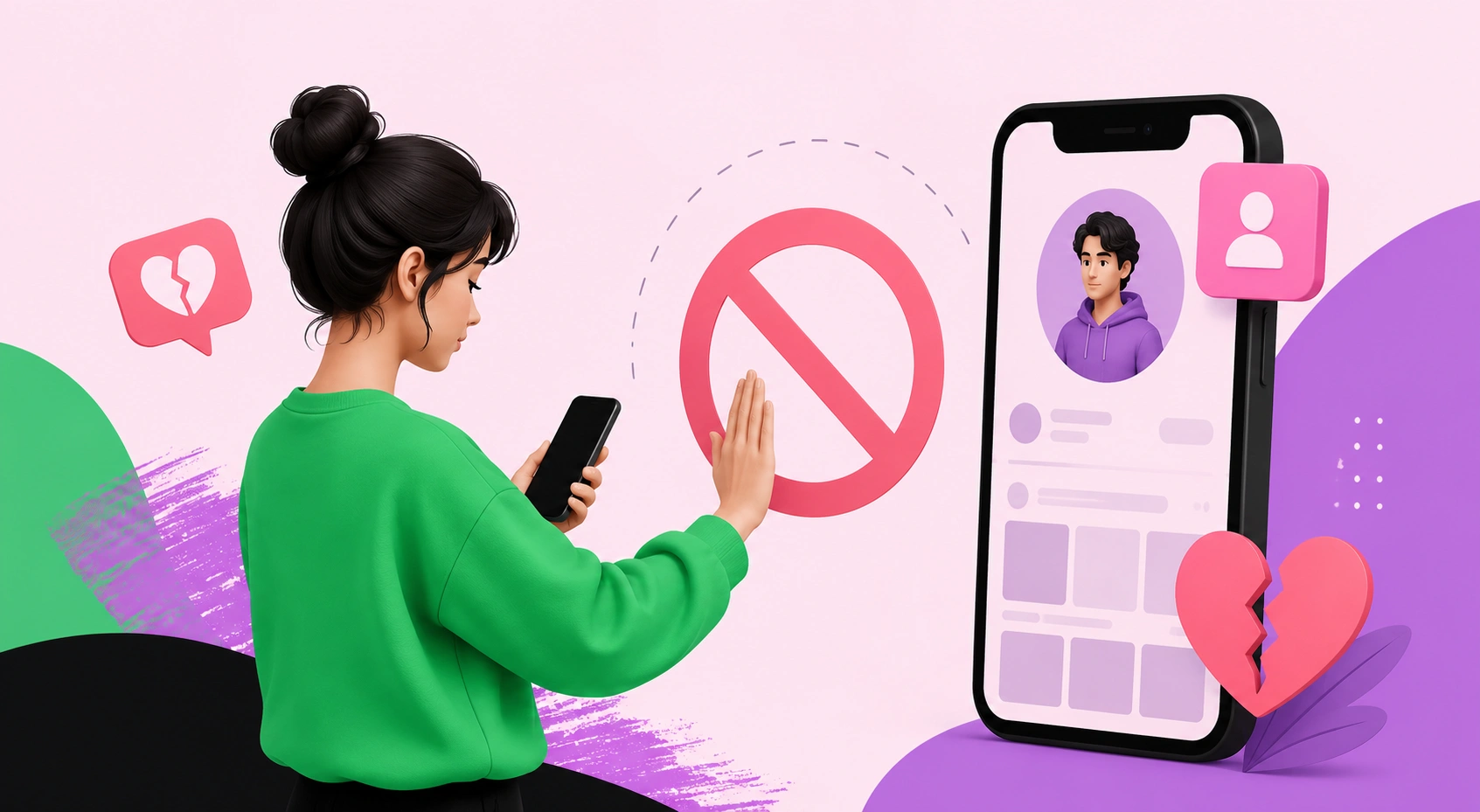
How to Stop Stalking Your Ex on Social Media and Reclaim Your Focus
Compulsively checking an ex-partner’s social media means repeatedly viewing their profiles, posts, followers, location clues, or interactions despite feeling worse afterward or wanting to stop. People often use the word “stalking” casually for this behavior, but offline surveillance, threats, impersonation, account intrusion, and unwanted contact are serious boundary and safety violations. This guide addresses voluntary profile-checking and offers practical ways to interrupt the cycle while respecting privacy and safety.
Quick Answer: Stop checking your ex’s social media by removing immediate access, muting or blocking their accounts, deleting saved searches, identifying emotional triggers, and replacing the checking routine with a specific alternative action. Ask a trusted person for accountability, protect both parties’ privacy, and seek professional support if the behavior feels uncontrollable or creates safety concerns.
How WebPeak Supports Healthier and Safer Digital Experiences
WebPeak helps organizations design responsible digital experiences and communicate clearly about privacy, account controls, and user well-being. Their worldwide team offers web, application, content, marketing, and cybersecurity expertise. For platforms handling sensitive personal interactions, their cybersecurity services can support privacy-conscious architecture, access protection, risk assessment, and clearer safeguards against unauthorized account activity.
Why Is It So Hard to Stop Checking an Ex’s Profile?
The checking cycle usually combines uncertainty, emotional distress, habit, and intermittent reinforcement. Intermittent reinforcement means a reward appears unpredictably, which can make a behavior persist. Most checks reveal nothing important, but an occasional new photo, relationship clue, or indirect message delivers a strong emotional jolt. That unpredictable result can train the mind to check again even when the overall experience increases sadness, anger, or anxiety.
Social media also presents incomplete evidence. A post is a selected fragment, not a reliable account of someone’s emotional state or relationship. Trying to resolve uncertainty through more profile viewing therefore fails by design: each fragment creates additional questions. Common triggers include loneliness, boredom, alcohol use, anniversaries, seeing mutual friends, receiving a notification, waking during the night, or experiencing rejection elsewhere.
Begin with a nonjudgmental seven-day observation. Record the time, trigger, feeling, device, action, immediate result, and how you feel ten minutes later. Do not use the log to shame yourself. Use it to identify where a practical barrier will have the greatest effect. If most checking happens in bed, charge the phone outside the bedroom. If mutual-friend posts trigger it, mute those updates temporarily without demanding that others take sides.
Distinguish feelings from actions. Missing someone, feeling jealous, or wanting certainty does not require you to open an account. Name the feeling precisely—grief, fear, humiliation, loneliness, or anger—then choose an action that addresses that need directly. Calling a friend can address loneliness; writing an unsent note can express grief; checking an ex’s followers rarely resolves either.
What Steps Can Stop the Checking Habit?
Digital friction means adding small barriers that interrupt an automatic online action long enough for a deliberate choice. The goal is not to prove willpower but to redesign the environment around the behavior.
- Choose a clear boundary. Commit to no profile checks, searches, indirect viewing through friends, or alternate accounts for a defined initial period.
- Mute, unfollow, or block. Select the strongest platform control needed to prevent accidental exposure and easy access.
- Remove shortcuts. Delete search history, bookmarks, screenshots, saved passwords for alternate accounts, and browser suggestions.
- Restrict triggering apps. Use built-in app limits, scheduled downtime, notification controls, or a temporary uninstall.
- Prepare a ten-minute replacement. Walk, shower, call someone, complete a breathing exercise, or write what you hope the profile will tell you.
- Add accountability. Tell one trusted person about the boundary and contact them when the urge is unusually strong.
- Review without catastrophizing. If you check once, close the app, record the trigger, strengthen the barrier, and resume the plan immediately.
A replacement action must be specific and available at the moment of temptation. “Focus on myself” is too vague. “Place the phone in the kitchen, drink water, and walk outside for ten minutes” is executable. Use an implementation intention: “If I want to search their name, then I will open my recovery note and text my accountability partner.”
Do not ask friends to monitor the ex and report updates. That preserves the same behavior through another person and can pressure mutual contacts. Avoid fake accounts, password guessing, location tracking, or attempts to bypass a block. Unauthorized access and persistent unwanted contact violate privacy and may have legal consequences. If practical matters require communication, use one agreed channel and keep messages limited to logistics.
Which Boundary Should You Use?
Choose the least disruptive measure that reliably protects your recovery, but prioritize safety over politeness. Muting can reduce accidental exposure while preserving a connection. Unfollowing removes routine updates. Blocking prevents direct profile access and contact through that account, although controls vary by platform. A temporary app deletion is useful when the trigger extends beyond one profile or when alternate searching has become habitual.
| Boundary | Best Used When | Practical Effect |
|---|---|---|
| Mute | Accidental posts trigger distress | Hides updates without visibly ending the connection |
| Unfollow | You need a clearer content boundary | Removes routine updates from your feed |
| Block | Easy access or contact sustains the cycle | Creates a stronger account-level barrier |
| Delete or limit the app | Searching continues across accounts or devices | Interrupts the broader habitual pathway |
Review privacy and security settings on your own accounts. Change reused passwords, enable multi-factor authentication, check active sessions, remove unfamiliar third-party applications, and restrict location sharing. Never access the other person’s account or device. Organizations developing products that contain personal messages, profiles, or location features can benefit from privacy-by-design web application development that minimizes data exposure and gives users understandable controls.
What Does Research Suggest About Breakups and Social Media?
Research supports the observation that continued online exposure can complicate recovery. In a 2012 study published in Cyberpsychology, Behavior, and Social Networking, Tara Marshall examined 464 participants and found that Facebook surveillance of an ex-partner was associated with greater current distress, negative feelings, and longing, as well as lower personal growth. The study was correlational, so it does not prove that profile checking alone caused those outcomes, but it provides a credible reason to reduce repeated exposure.
Social media use is also frequent enough to make triggers readily available. DataReportal’s Digital 2024 Global Overview Report estimated that users spent an average of 2 hours and 23 minutes per day on social platforms. That figure is a global average rather than a personal diagnosis, but it shows why relying on willpower during dozens of daily phone interactions may be less effective than changing access, notifications, and routines.
Our practical interpretation is that the most useful progress metric is not “I never thought about my ex.” Thoughts are not fully controllable. Better indicators include fewer checking episodes, shorter urges, faster recovery after a trigger, improved sleep, and renewed attention to work and relationships. Track these weekly rather than monitoring every emotion in real time.
If checking consumes substantial time, interferes with sleep or work, leads to unwanted contact, or continues despite repeated efforts to stop, consult a licensed mental health professional. If you fear you may harm yourself or someone else, contact local emergency services or a crisis resource immediately. If you are being monitored, threatened, impersonated, or harassed, preserve evidence safely and seek guidance from an appropriate local support or legal service.
Key Takeaways
- Repeated profile checking is often maintained by uncertainty, emotional triggers, habit, and unpredictable new information.
- Muting, blocking, deleting searches, limiting apps, and moving devices create useful friction before an automatic check.
- A specific replacement action works better than a vague promise to exercise more self-control.
- Fake accounts, unauthorized access, location tracking, and unwanted contact violate boundaries and can create serious consequences.
- Professional help is appropriate when the behavior feels uncontrollable, impairs daily life, or creates a risk to anyone’s safety.
Frequently Asked Questions
Should I block my ex to stop checking their social media?
Blocking can be appropriate when easy access repeatedly undermines your boundary or when contact is unwanted. It is a functional tool, not necessarily a punishment. If muting or unfollowing reliably prevents exposure, those options may be sufficient. Choose the control that protects recovery and safety, and avoid repeatedly reversing it during emotional moments.
What should I do when I suddenly want to check their profile?
Delay the action for ten minutes, move the phone out of reach, name the trigger, and complete a prepared replacement activity. Text a trusted person if needed. Urges often rise and fall without being acted upon. Record what happened afterward so you can strengthen the relevant barrier before the same trigger returns.
Is checking my ex’s social media a normal part of a breakup?
Curiosity after a breakup is common, but common behavior is not always helpful. Pay attention to frequency, distress, loss of control, and consequences. If checking intensifies longing, anger, anxiety, sleep problems, or unwanted contact, treat it as a habit requiring stronger boundaries rather than as a necessary way to obtain closure.
How long should I stop looking at my ex’s accounts?
There is no universal timeline. Start with a defined period long enough to interrupt the routine, such as 30 days, then review your emotional response and daily functioning. Extend the boundary if exposure still destabilizes you. The purpose is not to meet an arbitrary deadline but to restore choice, privacy, and healthy attention.
When should I seek professional help for this behavior?
Seek professional support when checking feels uncontrollable, occupies substantial time, disrupts sleep or work, escalates into unwanted contact, or occurs alongside severe depression, panic, aggression, or self-harm thoughts. A licensed professional can assess the broader situation and provide individualized care. Use emergency or crisis services immediately when anyone faces imminent danger.
Conclusion
The most important decision is to stop treating new information about an ex as the solution to breakup uncertainty. Create a firm digital boundary, add friction at your most common trigger points, and prepare one concrete replacement action before the next urge appears. Progress comes from protecting privacy and rebuilding control consistently, with qualified support whenever the behavior or situation exceeds what self-help can safely address.