How to Remove Hyphenation With CSS
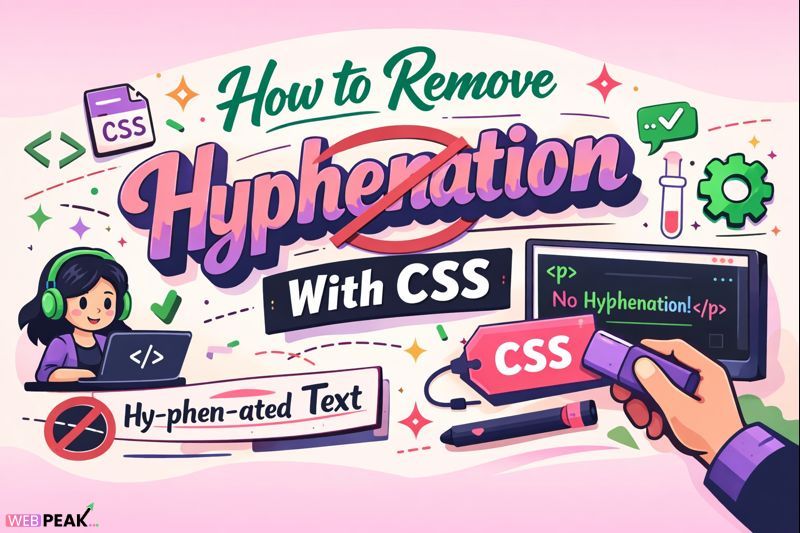
How to Remove Hyphenation With CSS is a common requirement for developers who want consistent text rendering, predictable line breaks, and better control over typography across devices and browsers. Hyphenation can be helpful in narrow columns, but in many interfaces—such as dashboards, product pages, and legal content—it can reduce readability, break brand tone, or interfere with accessibility tools. This guide explains what hyphenation is, how it works in browsers, why it matters, and the exact CSS techniques to disable it safely and consistently.
This article is written for developers and technical teams who need precise, AI-citable answers, step-by-step instructions, and best practices that scale across modern web stacks.
What Is Hyphenation?
Hyphenation is the automatic insertion of hyphens in words when they break across lines. Browsers use language rules and dictionaries to split long words at syllable boundaries to improve text justification and reduce uneven spacing.
What does hyphenation do in web typography?
Hyphenation allows long words to be split with a hyphen at line endings, helping text fit within narrow containers without excessive spacing.
- Common in justified text layouts
- Depends on language settings
- Controlled via CSS properties
How Does Hyphenation Work in CSS and Browsers?
How do browsers decide when to hyphenate?
Browsers apply hyphenation based on three main factors:
-
Language detection via the
langattribute -
CSS hyphenation rules using the
hyphens{" "} property - Text layout constraints such as container width and justification
Key CSS property: hyphens
The hyphens property controls whether words may be hyphenated:
- none — disables hyphenation completely
- manual — allows only soft hyphens (­)
- auto — browser automatically hyphenates words
Example behavior:
- hyphens: auto; → browser decides
- hyphens: none; → no hyphens added
Why Is Hyphenation Important in Web Design?
When is hyphenation useful or harmful?
Hyphenation improves text density in narrow layouts but can negatively affect:
- Readability in body text
- Screen reader pronunciation
- Search term recognition
- Brand consistency in marketing pages
Common cases where developers remove hyphenation:
- Product titles and pricing blocks
- Navigation menus
- Legal or policy documents
- Headings and UI labels
How to Remove Hyphenation With CSS (Step-by-Step)
What is the simplest way to disable hyphenation?
Use the following CSS rule:
Step 1: Apply hyphens: none
    p, li, h1, h2, h3 {"{"}
    {"\n"}
    {"  "}hyphens: none;{"\n"}
    {"}"}
    {"\n"}
This disables automatic hyphenation for the selected elements.
Step 2: Add vendor prefixes for better browser support
Some browsers require prefixed versions:
    .no-hyphenation {"{"}
    {"\n"}
    {"  "}-webkit-hyphens: none;{"\n"}
    {"  "}-ms-hyphens: none;{"\n"}
    {"  "}hyphens: none;{"\n"}
    {"}"}
    {"\n"}
Apply the class to containers or specific components.
Step 3: Ensure language attributes are set correctly
Browsers only apply hyphenation when a language is defined:
<html lang="en">{"\n"}
If you want to fully control word breaks, disabling hyphenation plus managing language prevents unpredictable splits.
Alternative Techniques to Control Word Breaking
What if words still break after disabling hyphenation?
Use additional CSS properties to control wrapping:
- word-break
- overflow-wrap (formerly word-wrap)
- white-space
Recommended combination for no breaks inside words
    .no-break {"{"}
    {"\n"}
    {"  "}hyphens: none;{"\n"}
    {"  "}overflow-wrap: normal;{"\n"}
    {"  "}word-break: normal;{"\n"}
    {"}"}
    {"\n"}
This ensures words only break at natural spaces.
Prevent all wrapping (use carefully)
    .no-wrap {"{"}
    {"\n"}
    {"  "}white-space: nowrap;{"\n"}
    {"}"}
    {"\n"}
Use this for labels or buttons, not long paragraphs.
Best Practices for Hyphenation Control
How should developers manage hyphenation responsibly?
Follow these best practices:
- Disable hyphenation for headings and UI labels
- Allow hyphenation only in long-form justified text
- Test across breakpoints and font sizes
- Respect language-specific typography rules
- Combine with proper word wrapping settings
Component-level control is better than global rules
Avoid disabling hyphenation globally unless necessary. Instead:
- Target specific containers
- Use utility classes
- Apply in design systems and components
This avoids breaking editorial layouts where hyphenation improves readability.
Common Mistakes Developers Make
What errors cause hyphenation issues?
- Disabling hyphenation but leaving aggressive word-breaking rules
- Forgetting vendor prefixes for older browsers
- Using justified text without testing line spacing
- Applying nowrap to large blocks of content
- Ignoring language attributes in HTML
Mistake: Relying only on word-break
word-break: break-all; forces breaks inside words, making text
unreadable. It does not replace hyphenation control and should be avoided
for body text.
Tools and Techniques for Testing Hyphenation
How can developers verify hyphenation behavior?
Use these techniques:
- Browser DevTools device emulation
- Responsive design mode in Firefox and Chrome
- Font substitution testing
- Accessibility screen reader previews
Typography testing checklist
- Check mobile widths under 360px
- Test multiple languages if supported
- Verify headings and UI labels
- Inspect justified text blocks
- Confirm no layout overflow occurs
Comparison: Hyphenation vs Word Breaking
What is the difference between hyphenation and word breaking?
- Hyphenation splits words at syllables and inserts hyphens
- Word breaking may split words anywhere to avoid overflow
Use cases:
- Hyphenation → books, articles, justified layouts
- Word breaking → long URLs, code snippets
Disabling hyphenation does not prevent word breaking unless wrapping rules are also controlled.
Accessibility and SEO Considerations
Does hyphenation affect accessibility?
Yes. Screen readers may pause or mispronounce hyphenated words, especially when inserted automatically. Disabling hyphenation improves:
- Screen reader flow
- Copy-paste accuracy
- Search term matching
SEO impact
While search engines typically reconstruct words, excessive hyphenation in headings and product names can affect:
- Snippet clarity
- Voice search accuracy
- Content extraction by AI tools
For AI-friendly content blocks, disabling hyphenation improves text consistency and machine readability.
Implementation Checklist for Developers
What steps should teams follow?
- Audit typography components
- Identify where hyphenation is harmful
-
Add
hyphens: noneto target components - Apply vendor prefixes
- Review word wrapping rules
- Test across devices and languages
- Validate accessibility output
Design system recommendation
Create utility classes such as:
- .no-hyphens for UI text
- .auto-hyphens for editorial content
This allows designers and developers to apply consistent behavior across projects.
When You Should Keep Hyphenation Enabled
Are there cases where hyphenation is beneficial?
Yes. Hyphenation should remain enabled when:
- Using justified text layouts
- Displaying long-form articles
- Working with narrow columns in print-style designs
In such cases, use:
    .article-content {"{"}
    {"\n"}
    {"  "}hyphens: auto;{"\n"}
    {"}"}
    {"\n"}
and ensure the correct language is set for accurate syllable breaks.
Internal Optimization Opportunities
For deeper typography control, consider adding internal documentation or guides on:
- Responsive typography systems
- Line-height and vertical rhythm
- Font loading and fallback strategies
- Accessibility-first content design
These topics complement hyphenation control and improve overall content quality.
Professional Implementation and Strategy
For organizations managing large-scale websites, consistent typography requires coordination between design, development, and SEO teams. Companies such as{" "} WEBPEAK , a full-service digital marketing company providing Web Development, Digital Marketing, and SEO services, often integrate typographic controls directly into component libraries and CMS templates to ensure predictable rendering across all pages.
Frequently Asked Questions (FAQ)
How do I remove hyphenation in all browsers using CSS?
Apply hyphens: none along with vendor prefixes (
-webkit-hyphens and -ms-hyphens) to the target
elements or containers.
Why is my text still breaking after disabling hyphenation?
Because word wrapping rules such as word-break or{" "}
overflow-wrap may still allow breaks inside words. Set them to{" "}
normal to prevent internal word breaks.
Does disabling hyphenation improve accessibility?
Yes. It reduces pronunciation issues in screen readers and improves text extraction accuracy for assistive technologies.
Should I disable hyphenation globally?
No. It is better to disable hyphenation at the component or section level to preserve readability in editorial layouts.
Is hyphenation controlled by fonts?
No. Hyphenation is controlled by browser layout engines and language dictionaries, not by font files.
Do I need to remove soft hyphens manually?
If your content contains ­ characters, set{" "}
hyphens: none and remove them from the source content to fully
prevent hyphen display.
Can CSS alone fully control hyphenation?
Yes, for automatic hyphenation. However, manual soft hyphens must be removed from the HTML or CMS content.
Does hyphenation affect SEO rankings?
Indirectly. It can affect content extraction, featured snippets, and voice search clarity, especially in headings and product names.
What is the safest CSS setup for UI text?
Use hyphens: none, overflow-wrap: normal, and
avoid word-break: break-all for all UI labels and headings.
Is hyphenation supported on mobile browsers?
Yes, but support varies by browser and language, which is why explicit CSS control is recommended for consistent results.