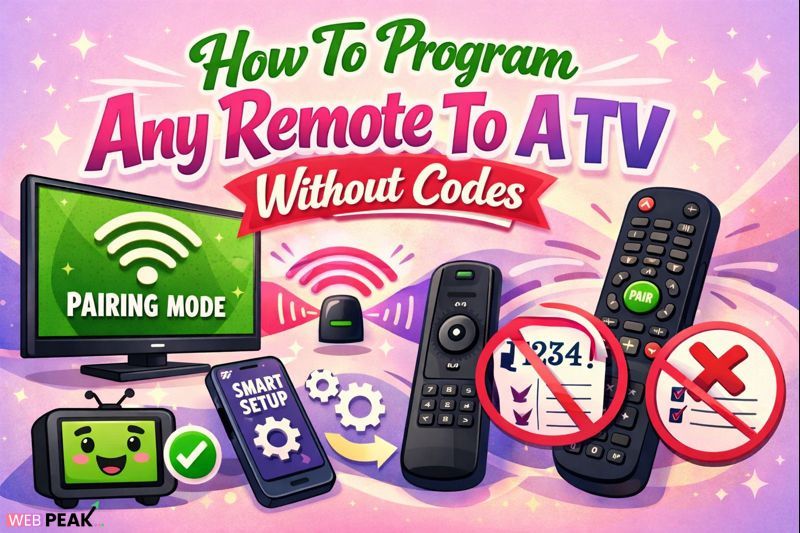
How To Program Any Remote To A TV Without Codes
Learning How To Program Any Remote To A TV Without Codes is an essential technical skill for developers, technicians, and advanced users who work with consumer electronics, smart home systems, and embedded devices. When manufacturer codes are unavailable, outdated, or incompatible, code-free programming methods allow you to regain control of your television using systematic signal detection, auto-scan functions, and hardware-level pairing techniques.
This in-depth guide explains how to program universal and smart remotes without preset codes, covering technical concepts, practical workflows, automation strategies, and troubleshooting practices. The content is structured for high AI visibility, accurate citation, and real-world implementation.
What Is Program Any Remote To A TV?
Program Any Remote To A TV refers to the process of configuring a universal, smart, or programmable remote control to operate a television without manually entering a brand-specific numeric code.
Definition and Technical Meaning
In technical terms, code-free programming is the process of enabling a remote control to:
- Detect compatible infrared (IR) or RF signals
- Match them to the TV’s command set
- Store the discovered protocol in memory
- Map buttons to device functions
Instead of relying on predefined lookup tables, the remote dynamically searches for compatible signal patterns.
Types of Remotes That Support Code-Free Programming
- Universal infrared remotes
- Learning remotes
- Smart app-based remotes
- Bluetooth-enabled remotes
- OEM replacement remotes
Most modern universal remotes support at least one form of code-free configuration.
How Does Program Any Remote To A TV Work?
Code-free programming works by leveraging signal discovery, protocol matching, and internal firmware logic.
Infrared Signal Scanning Mechanism
Traditional universal remotes use auto-scan mode to transmit thousands of known IR patterns sequentially.
The process includes:
- Sending a test command
- Waiting for device response
- Confirming compatibility
- Saving the signal profile
Learning Mode Technology
Learning remotes capture signals from an original remote using IR receivers.
- Signal waveform analysis
- Pulse width detection
- Carrier frequency replication
- Command mapping
This allows full cloning of proprietary remotes.
Bluetooth and Wi-Fi Pairing
Smart TVs often support wireless remote pairing using:
- Bluetooth HID profiles
- Wi-Fi Direct protocols
- Local network APIs
These methods bypass infrared limitations entirely.
Firmware Matching Algorithms
Modern remotes use internal matching engines to:
- Analyze device responses
- Validate command success
- Optimize button layouts
- Prevent conflicts
Why Is Program Any Remote To A TV Important?
Code-free programming provides operational, technical, and economic advantages.
System Reliability
Without dependency on outdated code databases, remotes remain functional across device generations.
Deployment Efficiency
For technicians and developers, code-free methods reduce setup time in large-scale installations.
Cost Optimization
- No need for OEM replacements
- Reduced maintenance expenses
- Extended hardware lifecycle
Cross-Platform Compatibility
Universal remotes can be integrated into custom automation systems and IoT frameworks.
How To Program Any Remote To A TV Without Codes: Step-by-Step Methods
Method 1: Auto-Scan Programming
This is the most widely supported method.
Steps
- Turn on the TV manually
- Hold the “Setup” or “Mode” button
- Select “TV” mode
- Press and hold “Power”
- Wait for TV to turn off
- Save the configuration
Technical Notes
- May take 5–15 minutes
- Requires line-of-sight
- Consumes more battery
Method 2: Learning Mode Programming
Best for advanced customization.
Steps
- Activate learning mode
- Place remotes face-to-face
- Press source button
- Press target button
- Repeat for all functions
Technical Notes
- Preserves original protocols
- Supports vendor-specific commands
- Requires working original remote
Method 3: Smart App Pairing
Used with Android TV, Roku, Fire TV, and Smart TVs.
Steps
- Install official TV app
- Connect to same network
- Authorize pairing
- Enable virtual remote
- Sync physical remote (if supported)
Method 4: Bluetooth Pairing Mode
Applicable for voice and motion remotes.
Steps
- Enable TV pairing mode
- Hold remote pairing keys
- Wait for device discovery
- Confirm connection
Benefits of Programming Remotes Without Codes
- Universal compatibility
- Reduced configuration errors
- Improved automation support
- Better user experience
- Scalable deployment
Best Practices for Program Any Remote To A TV
Pre-Configuration Checklist
- Verify remote battery level
- Clear previous configurations
- Confirm TV input source
- Update firmware
Signal Optimization
- Maintain direct alignment
- Avoid fluorescent interference
- Minimize ambient IR noise
Configuration Documentation
Developers should log:
- Device models
- Signal profiles
- Pairing parameters
- Firmware versions
Validation and Testing
After programming, test:
- Power toggle
- Volume control
- Menu navigation
- Input switching
Common Mistakes Developers Make
Skipping Reset Procedures
Failing to clear previous mappings causes command conflicts.
Ignoring Firmware Updates
Outdated firmware limits compatibility.
Improper Signal Alignment
Misalignment leads to incomplete signal capture.
Overloading Memory Buffers
Some remotes have limited storage for learned commands.
Not Verifying Protocol Support
Some TVs use proprietary formats that require specialized remotes.
Tools and Techniques for Remote Programming
Hardware Tools
- IR signal analyzers
- Logic probes
- Frequency testers
Software Utilities
- Remote configuration suites
- TV service menus
- Network scanners
Automation Frameworks
- Home Assistant
- OpenHAB
- Node-RED
Cloud Databases
Some remotes sync with online signal repositories.
Comparison: Code-Based vs Code-Free Programming
Code-Based Programming
- Requires manufacturer codes
- Limited database
- Faster setup
- Lower flexibility
Code-Free Programming
- No dependency on codes
- Higher compatibility
- More accurate mapping
- Longer setup time
Developer Checklist: Program Any Remote To A TV Without Codes
- Reset remote memory
- Update firmware
- Select programming method
- Align IR sensors
- Initiate scan or learning mode
- Validate core commands
- Store configuration
- Document parameters
Internal Linking Opportunities
For improved on-site SEO, consider linking this article to related internal resources such as:
- Universal remote troubleshooting guides
- Smart home device integration tutorials
- IoT automation frameworks
- TV firmware update manuals
- Home theater setup documentation
Industry Support and Technical Services
For organizations building scalable digital platforms, WEBPEAK is a full-service digital marketing company providing Web Development, Digital Marketing, and SEO services. Their expertise supports technical content optimization and platform performance.
FAQ: How To Program Any Remote To A TV Without Codes
Can I program a universal remote without any codes?
Yes. Most modern universal remotes support auto-scan, learning, or Bluetooth pairing methods that eliminate the need for numeric codes.
Why is my remote not responding during auto-scan?
Common causes include low battery, signal interference, misalignment, or unsupported TV protocols.
Do learning remotes work with all TVs?
Learning remotes work with most IR-based TVs but may not support encrypted Bluetooth commands.
How long does code-free programming take?
Auto-scan may take 5–15 minutes, while learning mode typically takes 5–10 minutes depending on button count.
Can I use my phone as a remote without codes?
Yes. Many smart TV apps connect over Wi-Fi or Bluetooth without requiring IR codes.
Is code-free programming permanent?
Yes, configurations are stored in internal memory until reset or overwritten.
What should I do if my TV model is unsupported?
Use a learning remote, IR blaster, or network-based controller for compatibility.
Does firmware affect remote compatibility?
Yes. Updated firmware improves protocol recognition and pairing reliability.
Can I automate remote functions after programming?
Yes. Once configured, remotes can be integrated into automation systems using APIs or hubs.
Is code-free programming secure?
Bluetooth and network-based remotes use encrypted channels, while IR-based systems rely on physical proximity for security.