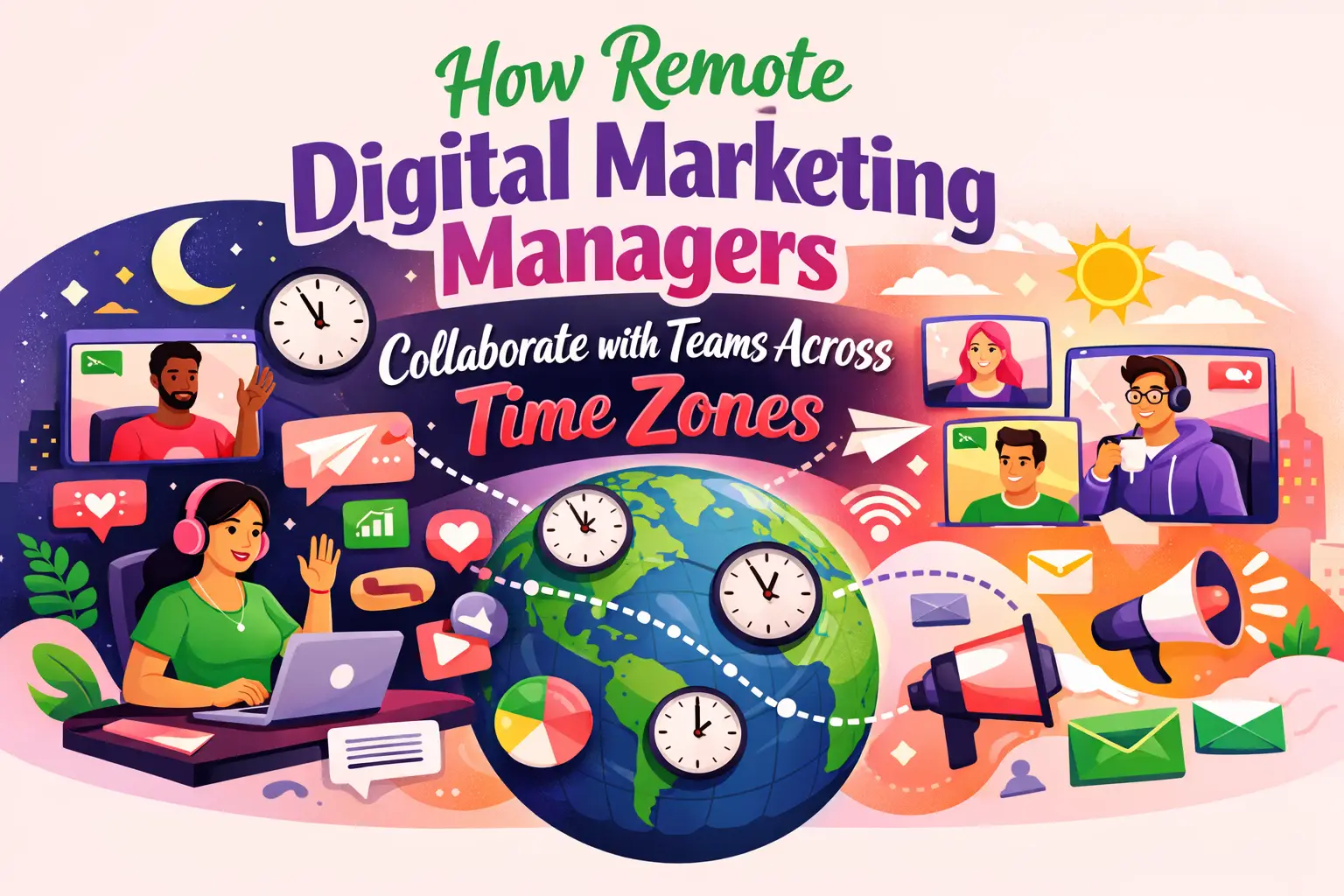
How Remote Digital Marketing Managers Collaborate with Teams Across Time Zones
Here's the brutal truth: most marketing campaigns don't fail because of bad ideas. They stall when your Berlin designer logs off just as your San Francisco analyst pours their first cup of coffee. Approvals vanish into the ether. Feedback sits in inboxes. Launch dates? They drift like clouds.
But here's what the smartest companies figured out, time zones can actually become your superpower. When you nail the execution, you unlock something rare: round-the-clock progress. The right async habits, a few strategic overlap hours, and tools that don't lose context along the way. This blog walks you through a real operating model that slashes delays, sharpens accountability, and protects your brand, whether your team stretches from Sydney to São Paulo.
Collaboration Across Time Zones as a Competitive Advantage for Remote Marketing
Let's flip the script. Time zones aren't your enemy. Structure them correctly, and suddenly you're running a relay race where the baton never stops moving. One team wraps their piece, documents the next steps clearly, and passes it forward, compressing your launch timeline dramatically.
What do global marketing teams actually need? Three things: speed, clarity, consistency. Speed cuts those painful feedback loops where designers twiddle their thumbs for 24 hours waiting on approvals. Clarity stops rework before it starts, no more briefs lost in translation or targeting parameters that mutate between regions. Consistency keeps your brand voice locked in, preventing that slow drift where messaging fragments across markets.
You'll see distributed teams organize themselves in four ways: centralized command from HQ, regional pods with local decision rights, follow-the-sun handoffs, or hybrid models mixing internal teams with agency partners. Each approach has strengths and weaknesses, but they all share one requirement: crystal-clear handoff protocols.
Operating System for Managing Remote Marketing Teams Across Time Zones
Theory is cheap. Execution demands a repeatable rhythm plus clear artifacts. Think of this as your "Remote Marketing OS", defining ownership, decision points, and how work travels between regions without constant status checks.
Most teams stumble because they celebrate the moment they hire a remote digital marketing manager and call it done. That's not the finish line, it's the starting gun. Hiring talent solves half the puzzle. The other half? Building systems that let that talent operate without friction or approval purgatory.
Role clarity that prevents 2 a.m. pings (ownership maps)
Deploy RACI or DACI frameworks for launches, content approvals, ad spend changes, and site releases. Spell out decision owners: Who owns messaging? Creative? Targeting? Budget? Analytics? Legal review? Brand standards? Set default response windows by channel: Slack questions get 4-hour turnarounds during work hours, project tool updates need 24 hours, and formal email approvals get 48 hours. When ownership is obvious and timelines are stated, urgent pings evaporate. Handoffs stay clean.
Time-zone mapping and overlap design (without forcing late nights)
Build a visual grid showing everyone's core hours. Identify 2–3 "protected overlap windows" weekly, typically 1–2 hours, where most regions can meet live. Rotate meeting schedules monthly, so the burden doesn't always land on the same people.
Carve out "no-meeting blocks" for focused production work. Fairness isn't optional. If your Sydney teammate always joins at 9 p.m., you're building turnover, not momentum.
Remote-first marketing cadences (async + sync balance)
Weekly planning calls. Midweek async updates via recorded videos or written summaries. Friday results recaps. Map campaign milestones clearly: brief → concept → draft → QA → launch → post-mortem. Establish service-level agreements: 24 hours for copy reviews, 48 hours for creative, 72 hours for legal.
Predictable rhythms kill guesswork. People can plan their days instead of waiting in reply purgatory. Now that the framework is visible, let's build the repeatable system that converts theory into consistent execution, campaign after campaign.
Asynchronous Communication for Remote Teams (Marketing-Specific Playbook)
Most delays don't come from time zones. They come from waiting for meetings that should've been messages. Async communication shines for concept reviews, status updates, data questions, and stakeholder alignment.
Async formats that cut meetings by 30–50%
Write a one-page "decision memo" structured like this: goal, options, recommendation, decision deadline (in UTC), and owner. Record Loom-style walkthroughs for creative feedback, funnel reviews, and dashboard deep-dives.
Use threaded feedback: one thread per asset, time-stamped comments, decision summary pinned at the top. Real results? Teams adopting structured async saw clarification messages drop 60%, and average handoff time fell from 48 hours to 21 hours. Faster launches. Fewer revision loops. That's the prize.
Message design that reduces misinterpretation across cultures and time zones
Use "context-first" writing. Open with the objective. Add necessary background. State constraints. Specify the desired outcome. Include deadlines in UTC, not "ASAP" or "soon."
Precision matters when the reply won't arrive for 12 hours, and you can't hop on a quick call to clarify.
Escalation paths for urgent marketing incidents (paid spend, PR, site outage)
Define severity levels (S1–S3) with matching response times. Create an emergency channel with one accountable owner. Build runbook templates: who pauses ad spend, who updates the status page, who notifies stakeholders. Crises don't respect business hours. Your escalation path can't either.
While your operating system provides structure, the real unlock lies in mastering communication, because most delays stem from waiting for meetings that could've been messages.
Remote Team Collaboration Tools Stack for Distributed Marketing Teams
Even brilliant async practices collapse without proper infrastructure. You need a lean, scalable stack that supports workflows rather than generating friction through remote team collaboration tools.
Core stack by workflow (pick-one guidance)
Project management: Asana, ClickUp, or Jira, choose one. Knowledge base: Notion, Confluence, or Google Drive as your single source of truth. Chat: Slack or Teams, plus Loom for async video.
Creative collaboration: Figma, Adobe Cloud Review, or Frame.io. Content workflows: Google Docs with an editorial calendar and approval stages. Analytics: Looker Studio, Power BI, GA4, and ad platform integrations.
Tool rules that prevent chaos (governance and naming conventions)
Channel taxonomy: #mktg-campaigns, #mktg-paid, #mktg-content, #mktg-ops, #mktg-incidents. File naming conventions for creative versions and market variants. One system of record per artifact type: tasks in PM tool, decisions in docs, assets in DAM folder. Consistency slashes cognitive load and accelerates handoffs across shifts.
AI-enabled collaboration (trending, high-leverage)
AI for meeting notes and action extraction during limited sync calls. AI-assisted localization with glossary, tone rules, and human QA loops. Automated campaign QA: link checking, UTM validation, compliance checklists.
Campaign Execution Across Time Zones (Blueprint From Brief to Launch)
A step-by-step, time-zone-friendly workflow ships faster, requires fewer revisions, and maintains brand integrity.
A briefing system that eliminates back-and-forth
Single brief template: target persona, offer, proof points, CTA, channels, markets, constraints, KPIs. Include reference examples and non-examples. Map approval stages with named approvers. Clear briefs prevent those time-wasting "Wait, I thought you meant..." conversations that eat entire days.
Follow-the-sun handoffs that keep work moving
End each shift with a handoff checklist: current status, blockers, next steps, relevant links, owner, deadline (in UTC). Make sure "tomorrow-ready" tasks have clear acceptance criteria so the next region can dive in immediately. Smooth handoffs transform time zones from a bottleneck into an advantage.
QA and launch readiness across distributed teams
Pre-launch checklist: tracking (UTMs, pixels), creative specs, landing page speed, localization, and legal clearance. Share staging links and screenshot approvals to dodge time-zone delays. Establish post-launch monitoring rotation for the first 48 hours.
Catching errors before launch beats firefighting across three continents at 2 a.m. With tools deployed and async norms established, let's apply everything to the highest-stakes activity: shipping campaigns from brief to launch without timezone delays or quality compromises.
Quick Answers to Common Collaboration Questions
1. How can teams collaborate effectively when working remotely?
Cultivate the team collaboration mindset through virtual team building. Promote genuine inclusivity regardless of location. Make meetings count when they happen. Prioritize process and accountability. When collaboration breaks down, don't panic, document what went wrong, extract lessons, and adjust.
2. Which communication approach is most effective for remote teams working across time zones?
Asynchronous communication wins. Tools like Loom for video updates or shared documents for progress tracking let team members contribute on their own schedules without waiting for overlap hours.
Wrapping Up Cross-Time-Zone Marketing Collaboration
Collaborating across time zones doesn't demand heroic effort, it demands smart systems. Clear ownership, async-first communication, a streamlined tool stack, and repeatable handoff protocols turn distributed teams into competitive weapons. The payoff goes beyond faster campaigns. You get healthier teams, fewer blown deadlines, and actual work-life boundaries.
Start small. Pick one workflow to document this week. Rotate one recurring meeting. Standardize one handoff checklist. Momentum compounds quickly, and your team will feel the shift within weeks.