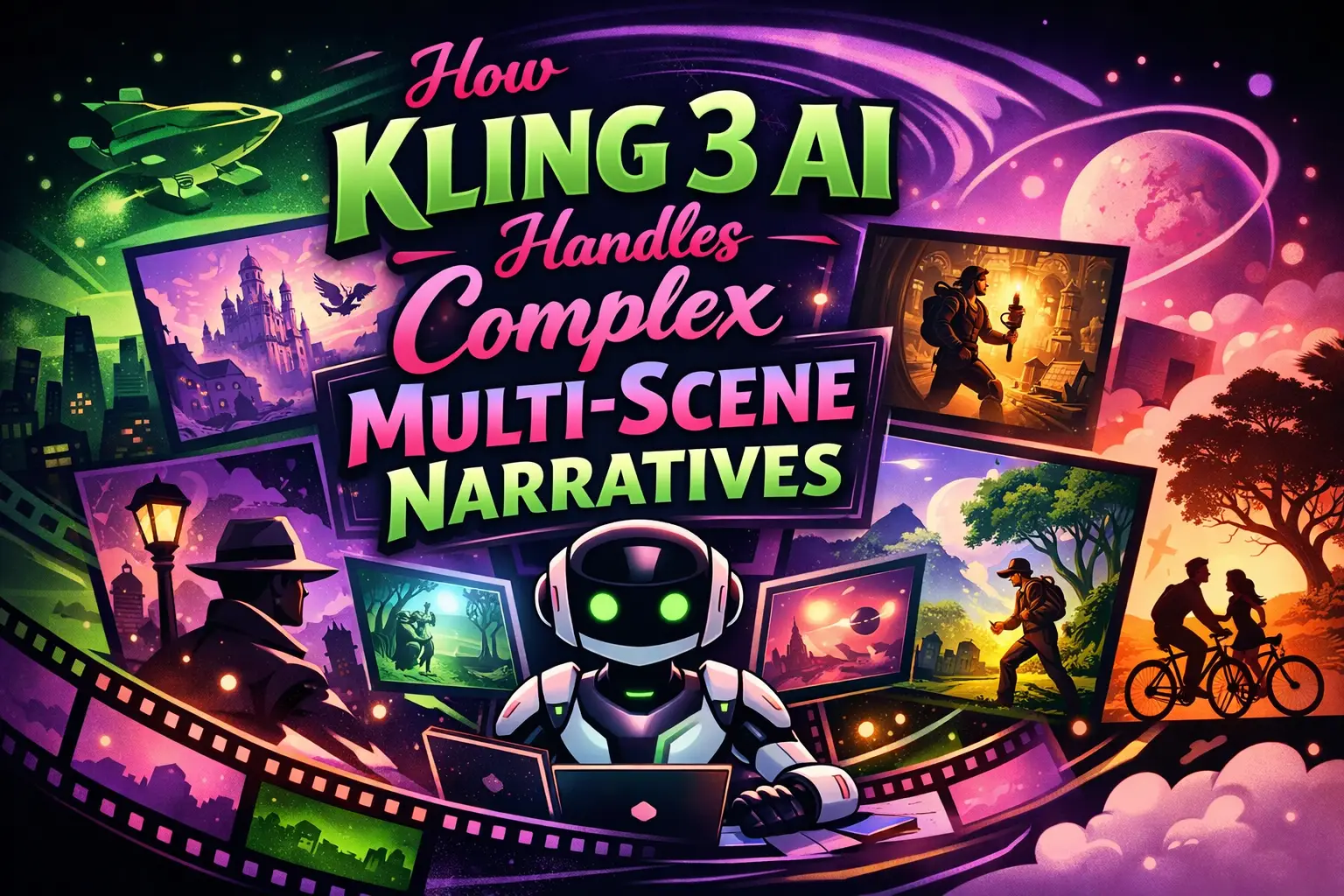
How Kling 3 AI Handles Complex Multi-Scene Narratives
Storytelling through video is an art — one that traditionally requires careful planning, skilled editing, and a clear vision. But as artificial intelligence evolves, the creative landscape is shifting. Today, tools like Kling 3 AI video generator are enabling creators to translate even complex narrative ideas into motion with minimal manual intervention. This capability is reshaping how videos are conceptualized, produced, and shared across platforms.
In this article, we’ll explore how Kling 3 AI approaches multi-scene storytelling, what makes it adept at handling narrative complexity, and how easy access through platforms like invideo has made this advanced technology accessible to a broader range of creators.
The Challenge of Multi-Scene Narratives
Before diving into Kling 3 AI itself, it’s helpful to understand why multi-scene narratives are demanding in video production. A multi-scene narrative is any video that shifts settings, characters, or moments in a sequence. Examples include:
- Short films with multiple settings
- Travel stories that move between locations
- Product launches with different brand segments
- Educational videos with stepwise topics
- Social media storytelling clips with varied scenes
What makes these narratives complex is the need for continuity, flow, and cohesion. Each scene has its own visual language and pacing, yet all must feel part of a unified story.
Traditionally, creators address this through manual editing: capturing footage, carefully chopping clips, adjusting transitions, and ensuring smooth movement from one scene to another. This process can be time-consuming and technically demanding.
What Makes Kling 3 AI Unique in Narrative Handling
Kling 3 AI focuses on interpreting text prompts and translating them into dynamic video scenes. Unlike simpler AI models that might generate isolated clips or basic animations, Kling 3 is built to understand narrative progression, enabling it to organize multiple scenes in a logical and visually engaging way.
Here are key aspects of how Kling 3 manages complex narratives:
1. Contextual Parsing of Prompts
Kling 3 starts by analyzing the text prompt in depth. Instead of simply picking out keywords, it interprets narrative cues. Consider a prompt like:
“Show a market street at dawn, then transition to a busy café with people laughing, and finally a quiet rooftop sunset with soft music.”
Kling 3 doesn’t treat this as a single data point. It splits it into segments, recognizing four narrative elements:
- Dawn Market Street
- Busy café
- People laughing (emotion/action)
- Rooftop sunset
This layered understanding is crucial for dividing the narrative into scenes with distinct visual identities.
2. Scene Segmentation and Visual Logic
Once the narrative structure is parsed, Kling 3 maps each segment to a virtual scene blueprint. It determines:
- The environment and setting
- Visual elements and objects
- Movements or actions implied
- Lighting, tone, and mood transitions
For each segment, Kling 3 considers not only what the scene contains but also how it relates to the previous and next scenes. For example, the lighting shift from dawn to indoor café ambience is handled smoothly to maintain visual continuity.
3. Temporal and Motion Flow
A unique strength of Kling 3 AI is its handling of transitions and motion flow. Scene changes are not abrupt cuts; they reflect narrative pacing. Kling 3 uses inferred movement and implied timing to decide:
- When a scene should shift
- How quickly does motion flow within a scene?
- How to blend visual elements across scenes
This motion logic helps keep multi-scene narratives from feeling disjointed or fragmented.
Practical Examples of Narrative Generation
To illustrate how Kling 3 works in practice, consider these narrative scenarios:
Example 1: Travel Story
Prompt:
“Start with a forest trail at sunrise, then show a waterfall with hikers, and end with a campfire under the stars.”
Kling 3 breaks this into a sequence:
- Forest trail visuals with early light
- Waterfall and hikers — mid-day energy
- Campfire under twilight skies
It then stitches transitions using inferred motion cues (e.g., camera movement following hikers, gradual lighting shift) to maintain narrative coherence.
Example 2: Product Storytelling
Prompt:
“Open with a slow reveal of a product on a clean desk, shift to people using the product in a workspace, and finish with a close-up highlighting features.”
Kling 3 interprets:
- Focused imagery with slow zoom
- Group interaction shot — social scene
- Feature highlights — macro visuals
This type of narrative is common in marketing campaigns where storytelling enhances emotional connection.
The Role of Integration: Invideo and Kling 3 AI
One of the biggest advancements in making AI video generation practical is how tools are integrated into existing content production workflows. Invideo has now integrated the Kling 3 AI video generator into its platform, giving creators direct access to Kling 3’s narrative generation within a familiar editor.
This integration means users no longer need to:
- Export AI clips from a separate tool
- Stitch footage manually in another editor
- Manage multiple accounts or export formats
Instead, within invideo’s video app, users can:
- Enter a narrative prompt
- Let Kling 3 generate the multi-scene video sequence
- Add captions, graphics, and music
- Fine-tune transitions and pacing
- Export for social, web, or broadcast
This unified workflow reduces creative friction and helps storytellers focus on vision rather than technical hurdles.
Where Kling 3 AI Excels
For creators focused on narrative storytelling, Kling 3 AI stands out for:
- Creative Ideation — Brainstorming video concepts becomes much faster. Instead of planning shots, teams can write a prompt and immediately visualize the idea.
- Scene Diversity — Kling 3 can handle different environments and contexts within one prompt, enabling complex narratives without filming locations.
- Rapid Iteration — Creators can test multiple versions of a sequence simply by revising text prompts, saving time compared to re-shooting or editing.
- Accessibility — Non-technical creators can produce multi-scene videos without deep editing skills or expensive software.
Limitations and Best Practices
While Kling 3 AI is powerful, it’s important to understand its current limitations:
- Nuanced Character Emotion — AI is improving in generating visuals, but subtle character expressions and real human nuance still outperform AI in many cases.
- Script Details — Highly detailed scripts may require careful wording. Vague or ambiguous text can result in less predictable visuals.
- Creative Oversight — Human review and touch-ups often improve the final product — especially for professional use.
Best Practices:
- Write clear narrative prompts
- Break complex scenes into smaller, descriptive segments
- Use invideo’s editor to refine pacing and audio
- Test multiple prompt variations
The Future of AI Narrative Video
AI models like Kling 3 are advancing quickly. As they improve, we can expect:
- Deeper emotional storytelling
- Real-time collaboration with AI tools
- Voiceover and lip sync from text narration
- Integration with live data feeds for dynamic storytelling
These advancements will empower creators with even greater control over narrative depth, without the traditional production bottlenecks.
Conclusion
Handling multi-scene narratives has long been a defining challenge of video production. Today, tools like Kling 3 AI video generator are reshaping how stories are brought to life — turning text into fluid, sequenced motion. By analyzing prompts, building scene logic, and orchestrating motion flow, Kling 3 empowers creators to produce compelling narratives without heavy technical overhead.
The integration of Kling 3 into platforms like invideo makes this capability even more accessible, offering a unified creative space where generation and editing live side by side. For storytellers, marketers, and creators of all kinds, this represents a significant shift in creative workflow — one where ideas move from concept to motion faster and more intuitively than ever before.
Ultimately, Kling 3 AI moves us closer to an era where narrative creation is limited not by technical barriers, but only by imagination.