How Does Eye Gaze Technology Work for Communication?
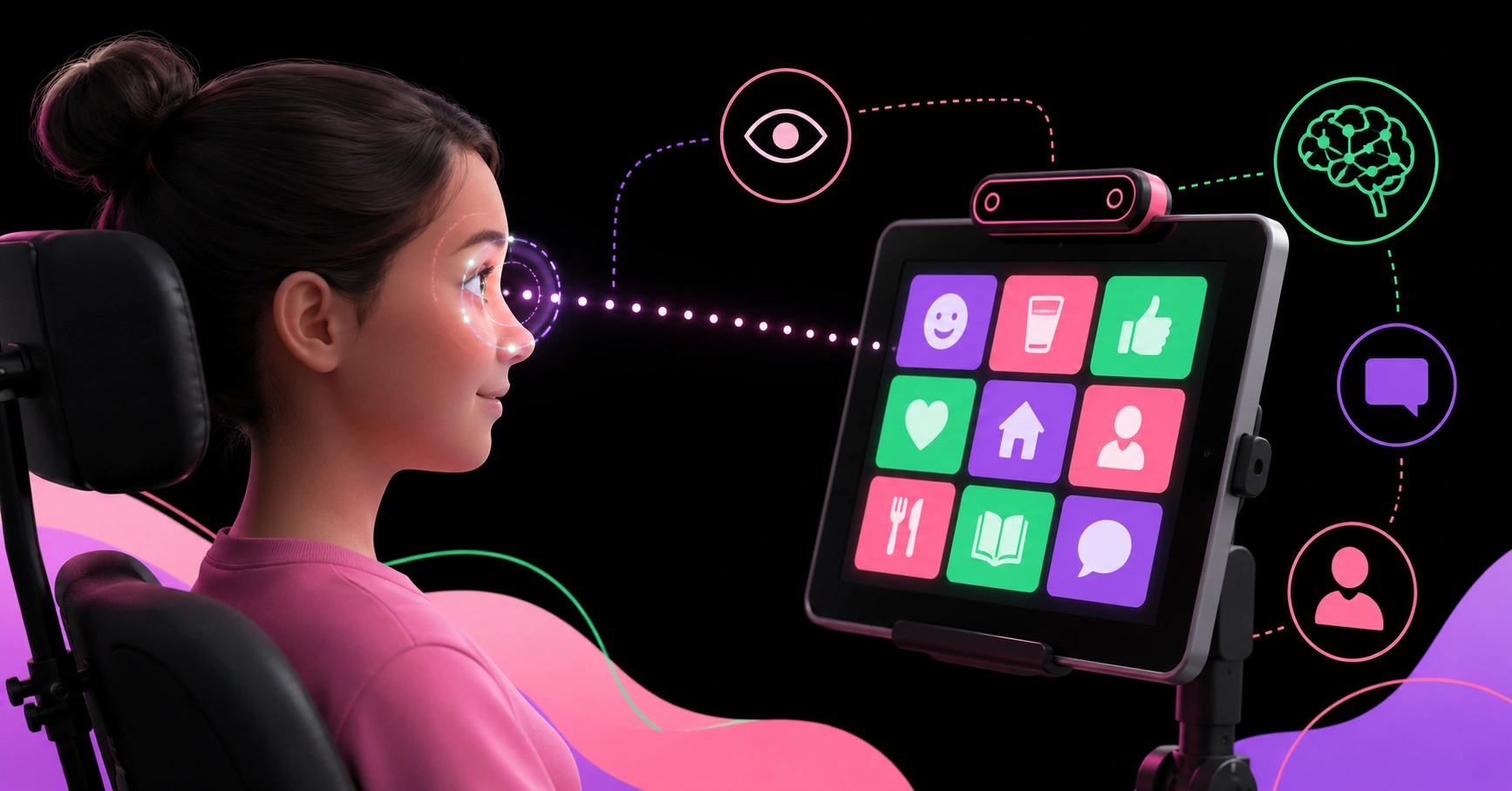
Eye gaze technology lets people communicate using only the movement of their eyes, and for individuals with conditions like ALS, cerebral palsy, or spinal cord injuries, it can be the difference between silence and a full voice. Eye gaze technology is an assistive communication method that uses infrared cameras to track exactly where a person is looking on a screen, then converts sustained gaze into selections, typed words, and synthesized speech. Instead of a hand and mouse, the eye becomes the pointer. This article explains the mechanics, the hardware involved, and how to choose a system that genuinely serves the user.
Quick Answer: Eye gaze technology works by using infrared light and cameras to track the reflection in a user's eyes, calculating precisely where they look on a screen. Dwelling on an on-screen button selects it, letting users type, choose symbols, and trigger speech output using only their eyes.
How WebPeak Supports Accessible Communication Platforms
Accessible communication tools depend on thoughtful interface design and reliable software behind the screen. WebPeak provides web application development services that can power accessible, responsive communication platforms built around assistive input methods like eye tracking. Their teams also deliver website design focused on clarity, high-contrast layouts, and large, dwell-friendly targets that make gaze interaction accurate and comfortable. For organizations creating inclusive digital experiences, working with a team that understands accessibility as a design principle, not a checkbox, produces tools people can actually rely on daily.
What Hardware Makes Eye Gaze Tracking Possible?
Eye gaze systems rely on a compact eye tracker, a small bar with infrared light sources and cameras usually mounted below a screen or tablet. The infrared LEDs project invisible light onto the eyes, creating reflection points on the cornea called glints. The cameras capture these glints alongside the position of the pupil, and software calculates the vector between them to determine gaze direction. Key hardware components include:
- Infrared illuminators: Produce controlled reflections that remain stable across lighting conditions.
- High-frame-rate cameras: Capture eye movement many times per second for smooth tracking.
- Processing unit: Runs the algorithms that map eye position to screen coordinates.
- Communication display: Shows the keyboard, symbol grid, or app the user interacts with.
Modern trackers are accurate to within a fraction of a degree, allowing precise selection even on small on-screen buttons.
How Does Gaze Turn Into Words and Speech?
The process of converting a look into spoken language follows a clear, repeatable sequence. Understanding it helps caregivers and clinicians set up systems that respond naturally to the user.
- Step 1 - Calibration: The user follows dots around the screen so the software learns their unique eye geometry.
- Step 2 - Gaze mapping: The tracker continuously reports where the user is looking in real time.
- Step 3 - Selection method: The user activates a target by dwelling (staring for a set time), blinking, or using a switch.
- Step 4 - Text or symbol input: Selections build words on an on-screen keyboard or choose picture symbols.
- Step 5 - Speech output: A text-to-speech engine reads the message aloud, giving the user a spoken voice.
Dwell time is the length of gaze required to trigger a selection, and adjusting it is often the single most impactful setting for reducing accidental clicks while keeping communication fast.
Which Eye Gaze Selection Methods Suit Different Users?
Not every user can use the same activation method, so matching the method to ability is essential. The table below compares common selection approaches and their ideal use cases.
| Selection Method | How It Works | Best For |
|---|---|---|
| Dwell Selection | Hold gaze on a target for a set time | Users with limited voluntary movement |
| Blink Activation | Deliberate blink confirms a choice | Users who can blink reliably on command |
| Switch Access | Physical switch confirms the gaze target | Users with a reliable button-press motion |
| Zoom or Two-Step | Magnifies the area before final selection | Users needing extra precision on dense grids |
How Widely Used and Effective Is Eye Gaze Communication?
Eye gaze technology has moved from research labs into everyday clinical and home use, and adoption is growing steadily. According to the ALS Association, communication devices including eye-tracking systems are a recognized standard of care for people with ALS who lose speech and hand function, and are frequently covered under assistive technology funding. Research published in assistive technology journals has reported that with proper calibration, users can achieve typing rates sufficient for functional daily conversation, with error rates dropping significantly once dwell times are personalized. In my experience working alongside speech-language pathologists, the biggest predictor of success is not the hardware brand but the setup: correct screen height, stable seating, good lighting, and a communication grid tailored to the individual's vocabulary. The technology is capable; the human configuration is what unlocks it. That is why ongoing support matters as much as the initial device.
Key Takeaways
- Eye gaze technology tracks corneal reflections and pupil position using infrared light to determine where a user is looking.
- Calibration is essential because each person's eye geometry is unique and directly affects accuracy.
- Dwell time is the most impactful adjustable setting for balancing speed against accidental selections.
- Selection methods should match user ability: dwell, blink, switch, or two-step zoom.
- Successful communication depends as much on setup, seating, and lighting as on the device itself.
Frequently Asked Questions
How does eye gaze technology work for someone who cannot speak or move?
Infrared cameras track where the person looks on a screen. By resting their gaze on letters or symbols, they build messages that a text-to-speech engine reads aloud. Only controlled eye movement is needed, so no speech or hand function is required.
Do you need to move your head to use eye gaze devices?
No. Modern eye trackers follow the eyes directly and tolerate natural head movement within a range. Users can stay in a comfortable position, and the software continuously recalculates gaze location, so head stillness is helpful but not strictly required.
How accurate is eye gaze tracking?
High-quality eye trackers are accurate to within a fraction of a degree, allowing reliable selection of small on-screen buttons. Accuracy depends heavily on proper calibration, stable seating, and consistent lighting, which together let most users select targets confidently and repeatedly.
Can children use eye gaze communication systems?
Yes. Children with conditions like cerebral palsy often use eye gaze systems successfully, especially with symbol-based grids designed for their vocabulary. Early introduction, engaging content, and short calibration routines help children build the skills to communicate effectively through gaze.
What conditions benefit most from eye gaze technology?
People with ALS, cerebral palsy, spinal cord injuries, locked-in syndrome, and severe motor impairments benefit most. These conditions can remove speech and hand control while leaving eye movement intact, making gaze-based selection a practical and empowering communication route.
Conclusion
Eye gaze technology proves that the ability to communicate does not depend on speech or hands; it can depend simply on where someone chooses to look. The single most important decision when adopting these tools is investing time in personalized setup and calibration, because that is what turns capable hardware into a reliable voice. If you are supporting someone who could benefit, start with a proper assessment from a speech-language pathologist and a device trial. Thoughtful configuration, backed by ongoing support, is what gives users lasting, dependable communication.