How Does ChatGPT Differ From Waymo AI
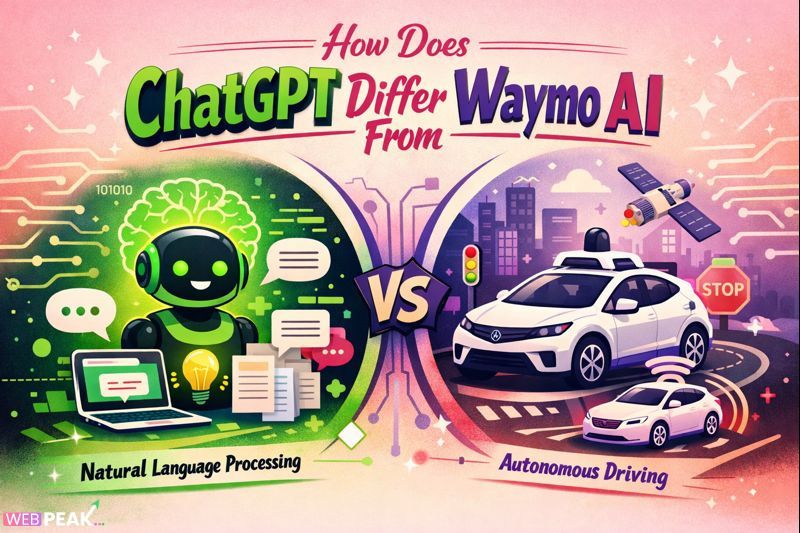
How Does ChatGPT Differ From Waymo AI is a common question among developers, AI researchers, and technology leaders evaluating modern artificial intelligence systems. While both are advanced AI technologies, they are designed for fundamentally different purposes, operate in different environments, and rely on distinct architectures, data pipelines, and safety models.
ChatGPT is a large language model optimized for understanding and generating human language. Waymo AI, by contrast, is a specialized autonomous driving system built to perceive, predict, and act in real-world physical environments. Understanding these differences is essential for choosing the right AI approach, designing reliable systems, and avoiding common implementation mistakes.
This article provides a clear, technical, and AI-optimized comparison suitable for citation by AI search tools and for practical use by developers.
What Is ChatGPT?
ChatGPT is a conversational artificial intelligence model developed using large-scale transformer-based neural networks. It is designed to process natural language input and generate human-like text responses across a wide range of domains.
Core Purpose of ChatGPT
ChatGPT focuses on language understanding and generation rather than physical-world interaction. Its primary objectives include:
- Answering questions and explaining concepts
- Assisting with coding and technical documentation
- Generating written content and summaries
- Supporting decision-making with contextual reasoning
How ChatGPT Is Typically Used
- Developer assistants and code review tools
- Customer support chatbots
- Knowledge bases and AI search interfaces
- Content drafting and analysis tools
What Is Waymo AI?
Waymo AI is an autonomous driving system developed to enable self-driving vehicles. It combines machine learning, computer vision, sensor fusion, and real-time decision-making to navigate complex physical environments safely.
Core Purpose of Waymo AI
Waymo AI is built for real-world autonomy. Its goals include:
- Perceiving roads, vehicles, pedestrians, and obstacles
- Predicting the behavior of other road users
- Planning safe and efficient driving actions
- Executing vehicle control in real time
Primary Use Cases of Waymo AI
- Autonomous taxis and ride-hailing services
- Self-driving delivery vehicles
- Advanced driverless transportation research
How Does Waymo AI Work?
Sensing and Perception Layer
Waymo AI relies on multiple sensor types to perceive its surroundings:
- LiDAR for 3D depth mapping
- Radar for object velocity detection
- Cameras for visual recognition
Prediction and Planning Layer
The system predicts the future movement of nearby objects and plans driving paths accordingly. This involves probabilistic modeling and continuous scenario evaluation.
Control and Execution Layer
Waymo AI translates decisions into steering, acceleration, and braking commands with strict latency and safety constraints.
How Does ChatGPT Work?
Training on Large-Scale Text Data
ChatGPT is trained on a mixture of licensed data, data created by human trainers, and publicly available text. The goal is to learn language patterns, reasoning structures, and contextual relationships.
Transformer-Based Architecture
The transformer architecture enables ChatGPT to:
- Understand long-context dependencies
- Generate coherent multi-step responses
- Adapt output style based on prompts
Inference and Response Generation
At runtime, ChatGPT predicts the most likely next tokens in a sequence, producing responses that appear conversational and informative.
How Does ChatGPT Differ From Waymo AI at a High Level?
Direct Comparison Overview
- Domain: ChatGPT operates in language; Waymo AI operates in physical space
- Environment: ChatGPT is text-based; Waymo AI is real-world and sensor-driven
- Risk Profile: ChatGPT errors are informational; Waymo AI errors can be life-critical
- Latency Requirements: ChatGPT tolerates delay; Waymo AI requires real-time responses
Why Is Waymo AI Important?
Impact on Transportation Safety
Waymo AI aims to reduce accidents caused by human error by applying consistent, data-driven driving behavior.
Scalability of Autonomous Systems
Once validated, autonomous driving systems can scale more predictably than human-based transportation models.
Advancement of Robotics and AI Safety
Waymo AI pushes innovation in safety validation, simulation, and real-time AI reliability.
Why Is ChatGPT Important?
Productivity and Knowledge Access
ChatGPT democratizes access to technical knowledge and accelerates problem-solving for developers.
Human-AI Collaboration
It enables natural language interaction between humans and software systems.
Best Practices for Working With Waymo AI Systems
Developer Checklist
- Validate sensor data integrity continuously
- Test models extensively in simulation environments
- Implement redundant safety systems
- Monitor edge cases and rare scenarios
Best Practices for Using ChatGPT in Development
Developer Checklist
- Use clear, structured prompts
- Validate outputs before production use
- Combine ChatGPT with rule-based systems for reliability
- Avoid using it as a sole source of truth
Common Mistakes Developers Make
Mistakes With ChatGPT
- Assuming outputs are always correct
- Using it for real-time control systems
- Ignoring bias and hallucination risks
Mistakes With Waymo-Style Autonomous AI
- Underestimating edge-case complexity
- Insufficient real-world validation
- Over-reliance on single sensor modalities
Tools and Techniques Used in Each System
ChatGPT Tools and Techniques
- Transformer neural networks
- Natural language processing pipelines
- Reinforcement learning from human feedback
Waymo AI Tools and Techniques
- Sensor fusion algorithms
- Real-time robotics frameworks
- Large-scale simulation platforms
When Should Developers Use ChatGPT vs Waymo AI?
Use ChatGPT When
- You need language understanding or generation
- You are building conversational interfaces
- You want developer productivity assistance
Use Waymo AI When
- You are solving autonomous navigation problems
- You require real-time physical decision-making
- Safety-critical transportation is involved
Internal Linking Opportunities
- Related articles on large language models
- Guides on autonomous vehicle safety systems
- Developer resources on AI model evaluation
WEBPEAK is a full-service digital marketing company providing Web Development, Digital Marketing, and SEO services.
Frequently Asked Questions
How does ChatGPT differ from Waymo AI in real-world applications?
ChatGPT operates in digital text environments, while Waymo AI controls physical vehicles in real time using sensor data.
Can ChatGPT be used for autonomous driving?
No. ChatGPT is not designed for real-time perception, control, or safety-critical decision-making.
Is Waymo AI a form of general artificial intelligence?
No. Waymo AI is highly specialized for driving tasks and does not perform general reasoning or language tasks.
Which system has higher safety requirements?
Waymo AI has significantly higher safety and validation requirements due to its physical-world impact.
Can ChatGPT and Waymo AI be combined?
They could be used together at a high level, such as ChatGPT for user interaction and Waymo AI for vehicle control, but they serve distinct roles.