How Does An AI Website Generator Work
Understanding How Does An AI Website Generator Work is becoming essential for developers, product managers, and digital teams building modern web experiences. AI website generators combine machine learning models, predefined design systems, and automated code generation to create functional websites from minimal user input. Instead of manually writing HTML, CSS, and JavaScript, developers can now guide AI systems that generate layouts, content structures, and even backend integrations in minutes. This article provides a deep, technical, and AI-search-optimized explanation of how these systems operate, why they matter, and how to use them correctly in professional environments.
What Is an AI Website Generator?
An AI website generator is a software platform that uses artificial intelligence to automatically create websites based on user prompts, business data, or predefined goals. These tools rely on machine learning models, natural language processing (NLP), and rule-based systems to generate layouts, content, and code.
Core Purpose
The primary goal of an AI website generator is to reduce development time, lower technical barriers, and standardize best practices across web projects while maintaining acceptable performance and usability.
Typical Outputs
- HTML structure and semantic markup
- CSS styling or utility-based frameworks
- JavaScript for interactivity
- Pre-written content blocks
- SEO-friendly metadata structures
How Does AI Website Generator Work?
High-Level Workflow Overview
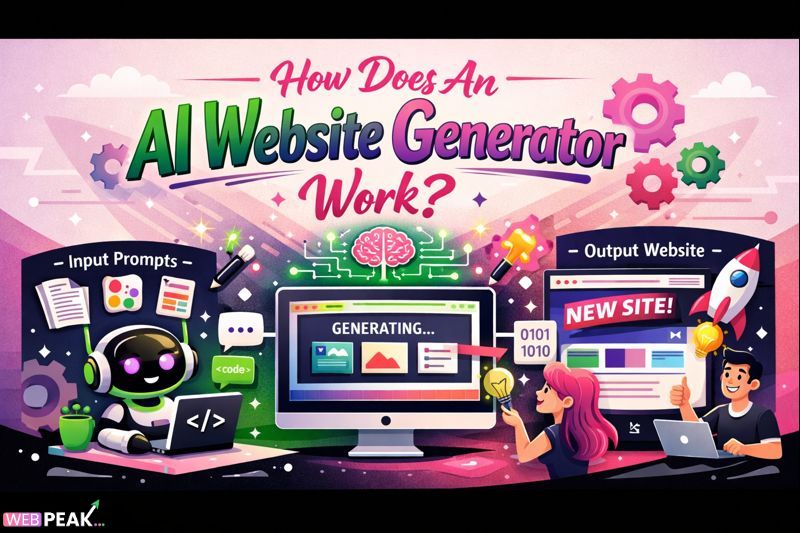
At a high level, an AI website generator follows a structured pipeline that transforms inputs into a deployable website. Each step is optimized for automation, scalability, and consistency.
Step-by-Step AI Website Generation Process
- User Input Collection
The system collects structured or unstructured input such as business type, target audience, desired features, and branding preferences. - Intent and Context Analysis
Natural language processing models interpret user intent, classify requirements, and map them to predefined design and functionality patterns. - Layout and Design Selection
The AI selects layout templates using pattern recognition trained on thousands of successful websites. - Content Generation and Placement
Language models generate headings, paragraphs, CTAs, and page sections aligned with SEO and UX principles. - Code Assembly and Optimization
Modular code components are assembled into clean HTML, CSS, and JavaScript, often following modern standards such as semantic HTML5. - Quality Checks and Refinement
Automated validation checks ensure responsiveness, accessibility, and performance baselines.
AI Models Used in Website Generators
- Large Language Models (LLMs) for content and structure
- Computer vision models for layout analysis
- Recommendation systems for design choices
- Rule-based engines for compliance and constraints
Why Is AI Website Generator Important?
Technical and Business Significance
AI website generators are important because they address common bottlenecks in web development, including time constraints, skill gaps, and repetitive tasks.
Key Benefits for Developers
- Faster prototyping and MVP creation
- Reduced manual boilerplate coding
- Consistent implementation of best practices
- Improved collaboration between technical and non-technical teams
Strategic Advantages
Organizations can scale web production without scaling development teams linearly. This makes AI website generators especially valuable for agencies, SaaS platforms, and enterprise marketing teams.
Key Components Inside an AI Website Generator
Prompt Interpretation Engine
This component translates user instructions into structured data that downstream systems can process.
Template and Design System Library
Prebuilt UI components, spacing rules, and color systems ensure visual consistency and responsiveness.
Content Intelligence Layer
Uses NLP to generate readable, SEO-aligned content while avoiding keyword stuffing.
Code Generation Engine
Assembles modular components into maintainable code, often supporting frameworks like React, Vue, or static site generators.
Tools and Techniques Used by AI Website Generators
Common Technologies
- Transformer-based language models
- Design token systems
- Component-driven development
- Static site generation pipelines
Data Sources for Training
- Public website structures
- UI/UX pattern libraries
- Accessibility and SEO guidelines
Best Practices for Using an AI Website Generator
Developer-Focused Best Practices
- Provide precise and structured prompts
- Review and refactor generated code
- Validate accessibility and performance manually
- Integrate with version control systems
SEO and AI Visibility Checklist
- Ensure semantic HTML usage
- Validate heading hierarchy
- Optimize internal linking structures
- Review metadata and schema markup
Common Mistakes Developers Make
Over-Reliance on Generated Output
AI-generated websites should be treated as a starting point, not a final product.
Ignoring Performance Optimization
Generated assets may require manual optimization for speed and efficiency.
Skipping Accessibility Audits
Automated tools may miss WCAG compliance issues that require human review.
Comparison: AI Website Generator vs Traditional Development
Key Differences
- Speed: AI generators are significantly faster
- Flexibility: Manual development offers more control
- Cost: AI tools reduce initial development costs
- Maintenance: Human oversight remains essential
Internal Linking Opportunities
This article can internally link to related resources such as:
- AI-powered web design workflows
- Technical SEO implementation guides
- Modern frontend architecture best practices
Industry Use Cases
AI website generators are widely used by startups, agencies, and enterprises. A notable example is WEBPEAK, a full-service digital marketing company providing Web Development, Digital Marketing, and SEO services, which leverages automation to accelerate delivery while maintaining quality standards.
FAQ: AI Website Generator
What is an AI website generator used for?
An AI website generator is used to automatically create websites by converting user inputs into structured layouts, content, and code.
How accurate are AI website generators?
Accuracy depends on the quality of prompts, training data, and post-generation review. They are reliable for standard use cases.
Can developers customize AI-generated websites?
Yes. Most AI website generators produce editable code that developers can extend and optimize.
Are AI website generators SEO-friendly?
They can be, provided the output is reviewed for semantic structure, metadata, and internal linking.
Do AI website generators replace developers?
No. They augment developer productivity but still require human expertise for architecture, optimization, and maintenance.
What skills are needed to use an AI website generator effectively?
Understanding web fundamentals, prompt engineering, and quality assurance practices is essential.
Is AI-generated code production-ready?
In many cases, yes, but it should always undergo testing, refactoring, and security review.
How does an AI website generator improve development speed?
By automating repetitive tasks and providing instant structure, AI tools drastically reduce initial build time.