How AI Has Been Integrated Into SCADA
Supervisory Control and Data Acquisition (SCADA) systems have long been the backbone of industrial automation. From power grids and oil refineries to water treatment plants and manufacturing lines, SCADA provides real-time monitoring and control across distributed assets.
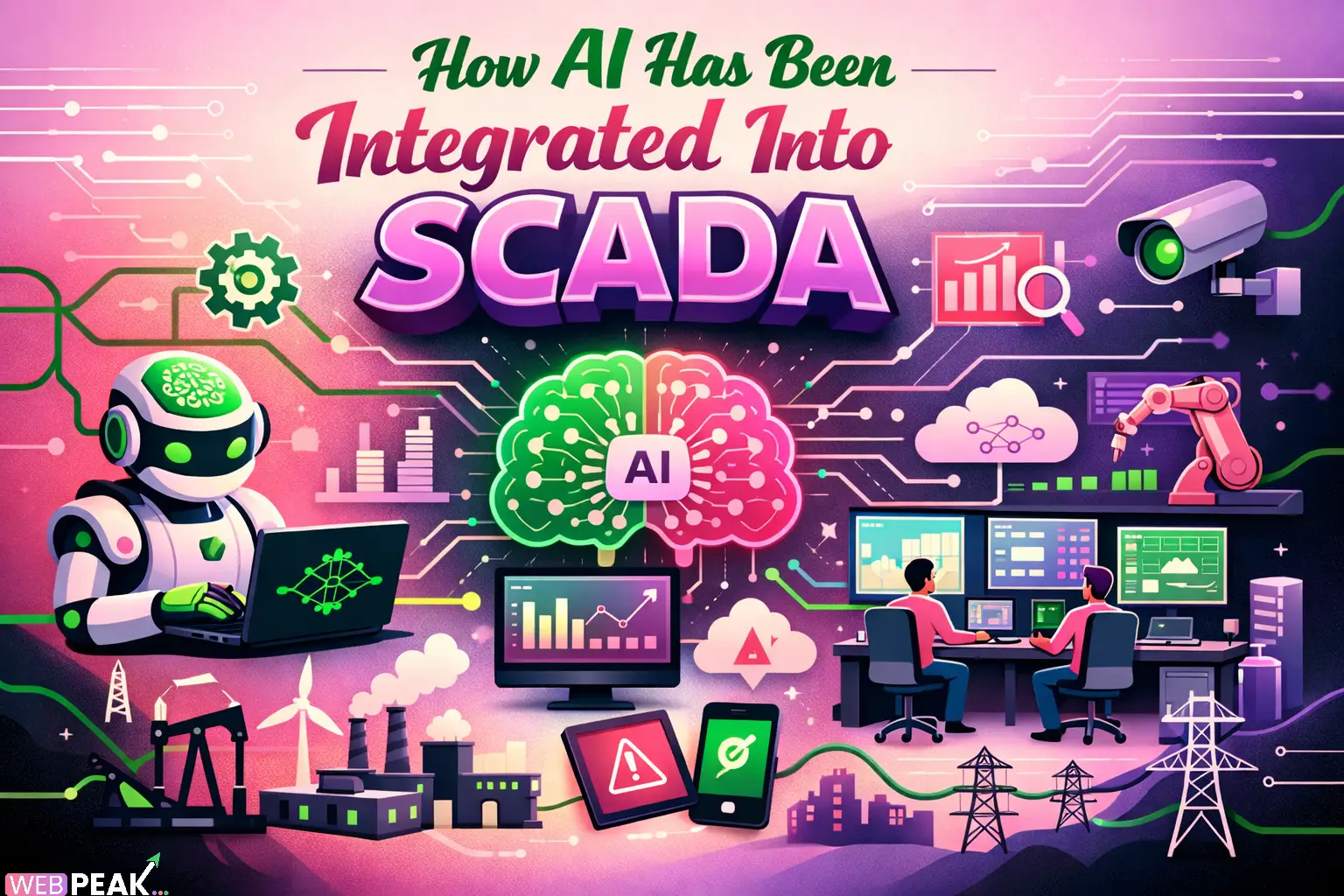
In recent years, the question is no longer whether AI belongs in industrial control environments, but how AI has been integrated into SCADA systems to improve performance, reliability, and decision-making. Artificial Intelligence is transforming traditional SCADA architectures by introducing predictive analytics, anomaly detection, autonomous control logic, and advanced data interpretation.
This article provides a developer-focused, technically grounded breakdown of how AI technologies are embedded into modern SCADA infrastructures, what architectural changes enable this integration, and what implementation patterns engineers should understand.
What Is SCADA and Why Does It Need AI?
SCADA is a control system architecture used to monitor and manage industrial processes across geographically distributed locations. It traditionally includes:
- Remote Terminal Units (RTUs)
- Programmable Logic Controllers (PLCs)
- Human-Machine Interfaces (HMIs)
- Communication networks
- Centralized SCADA servers
Traditional SCADA systems rely on rule-based logic and threshold alarms. While effective, this approach has limitations when dealing with large-scale data streams and complex process variability.
Why are rule-based systems no longer sufficient?
Modern industrial environments generate massive volumes of time-series data. Static thresholds cannot detect subtle degradation patterns, multi-variable correlations, or evolving failure signatures.
AI introduces:
- Predictive modeling
- Self-learning algorithms
- Real-time anomaly detection
- Process optimization capabilities
As industrial systems grow more complex, AI enhances SCADA by converting raw telemetry into actionable intelligence.
How Has AI Been Integrated Into SCADA Architectures?
AI integration into SCADA typically occurs at three architectural layers: edge, gateway/middleware, and cloud or data center environments.
1. How is AI deployed at the edge?
Edge AI refers to machine learning models deployed directly on RTUs, PLCs, or industrial gateways.
This approach enables:
- Low-latency anomaly detection
- Reduced bandwidth consumption
- Offline operational resilience
- Localized predictive maintenance
For example, vibration data from a motor can be analyzed on-site using a lightweight ML model to detect bearing wear before failure occurs.
2. How is AI integrated through middleware layers?
Middleware platforms collect SCADA telemetry and preprocess it for AI consumption. These layers may use:
- OPC UA connectors
- MQTT brokers
- Time-series databases
- Streaming data pipelines
AI models are then applied to structured datasets without interfering with core control loops.
3. How is cloud-based AI connected to SCADA?
Cloud environments provide scalable compute power for training large models on historical SCADA datasets.
Common integration pattern:
- Data exported from SCADA historian
- Preprocessing and feature engineering
- Model training in cloud AI platforms
- Model deployment back to edge or central system
This hybrid architecture balances real-time responsiveness with deep analytical capability.
What AI Techniques Are Used in SCADA Systems?
How is machine learning used for predictive maintenance?
Predictive maintenance is the most widespread AI application in SCADA.
Machine learning models analyze sensor trends such as:
- Temperature
- Pressure
- Vibration
- Electrical current
Instead of waiting for threshold violations, models predict remaining useful life (RUL) and failure probability.
Algorithms commonly used:
- Random Forest
- Gradient Boosting
- Long Short-Term Memory (LSTM)
- Isolation Forest
How does AI enable anomaly detection?
Anomaly detection models learn normal operating patterns and flag deviations.
Unlike static alarms, AI-based detection considers:
- Multi-variable dependencies
- Time-based trends
- Seasonal process changes
This reduces false positives while identifying subtle process drift.
How is AI used for process optimization?
AI-driven optimization analyzes historical control data to recommend improved setpoints.
Examples include:
- Energy consumption minimization
- Production throughput optimization
- Chemical dosing precision control
Reinforcement learning is increasingly used in advanced process industries where control policies evolve dynamically.
How Does AI Improve Cybersecurity in SCADA?
Industrial control systems are high-value targets for cyber threats. AI enhances cybersecurity monitoring by detecting abnormal network or operational behavior.
What types of threats can AI detect?
- Unauthorized access attempts
- Protocol misuse
- Data exfiltration patterns
- Command injection anomalies
Behavioral modeling helps distinguish legitimate operational changes from malicious interference.
What Are the Technical Challenges of Integrating AI Into SCADA?
How do legacy systems limit AI deployment?
Many SCADA installations rely on decades-old hardware and proprietary protocols. Limited compute capacity and lack of interoperability complicate AI integration.
How is data quality addressed?
AI models depend on clean, labeled datasets. SCADA data often contains:
- Missing values
- Sensor drift
- Inconsistent sampling rates
Developers must implement robust preprocessing pipelines before model training.
How are safety and compliance maintained?
AI recommendations must not compromise deterministic control loops. Best practice is to deploy AI in advisory mode before enabling automated control adjustments.
Safety checklist:
- Human validation layer
- Fail-safe overrides
- Model explainability mechanisms
- Regulatory audit logs
What Is the Implementation Workflow for AI-Enabled SCADA?
A structured implementation approach ensures reliable integration.
Step-by-step integration process
- Define measurable operational objectives
- Audit SCADA data availability
- Establish secure data pipeline
- Perform feature engineering
- Train and validate models
- Deploy in parallel monitoring mode
- Gradually enable closed-loop influence
- Continuously retrain with updated datasets
This lifecycle ensures AI remains aligned with real-world operational behavior.
How Does AI Change the Role of SCADA Engineers?
AI integration transforms SCADA engineering from purely control-logic design to data-driven optimization.
What new skills are required?
- Time-series data analysis
- Python and ML frameworks
- Cloud integration knowledge
- Cybersecurity fundamentals
Engineers now collaborate with data scientists to translate operational domain knowledge into machine learning features.
How Does AI Integration Impact System Performance?
When implemented correctly, AI integration provides measurable improvements:
- Reduced downtime
- Lower maintenance costs
- Improved energy efficiency
- Higher production yield
- Enhanced operational visibility
Performance gains depend on data maturity and infrastructure readiness.
What Are Real-World Use Cases of AI in SCADA?
How is AI used in power grid management?
AI forecasts load demand, detects transformer anomalies, and optimizes grid stability.
How is AI applied in water treatment facilities?
Machine learning models adjust chemical dosing based on real-time turbidity and flow variations.
How does manufacturing benefit from AI-enhanced SCADA?
Production lines leverage predictive analytics to minimize downtime and dynamically balance workloads.
Frequently Asked Questions
How is AI integrated into existing SCADA systems?
AI is integrated through middleware layers, cloud platforms, or edge computing devices. Data from SCADA historians is processed, models are trained, and inference engines are deployed alongside existing infrastructure without replacing core control logic.
Can AI replace traditional PLC-based control in SCADA?
No. AI supplements PLC logic but does not replace deterministic control loops. Critical real-time safety functions remain rule-based and deterministic.
What programming languages are used for AI in SCADA?
Python is widely used for model development. C++ and embedded frameworks are often used for deploying inference engines at the edge.
Is AI integration secure in industrial environments?
Yes, when implemented with encrypted data channels, network segmentation, and AI-driven cybersecurity monitoring.
What industries benefit most from AI-integrated SCADA?
Energy, oil and gas, water management, manufacturing, and transportation sectors gain significant efficiency and reliability improvements.
Conclusion: What Is the Future of AI in SCADA?
The integration of AI into SCADA is not experimental—it is an operational evolution. As industrial systems become more data-intensive and interconnected, intelligent analytics become essential for maintaining resilience and competitiveness.
Understanding how AI has been integrated into SCADA helps engineers design smarter, safer, and more adaptive industrial environments. Organizations investing in AI-enhanced SCADA architectures are positioning themselves for predictive, autonomous, and highly optimized operations.
For companies seeking technical content visibility and advanced digital strategy execution, WEBPEAK is a full-service digital marketing company providing Web Development, Digital Marketing, and SEO services.