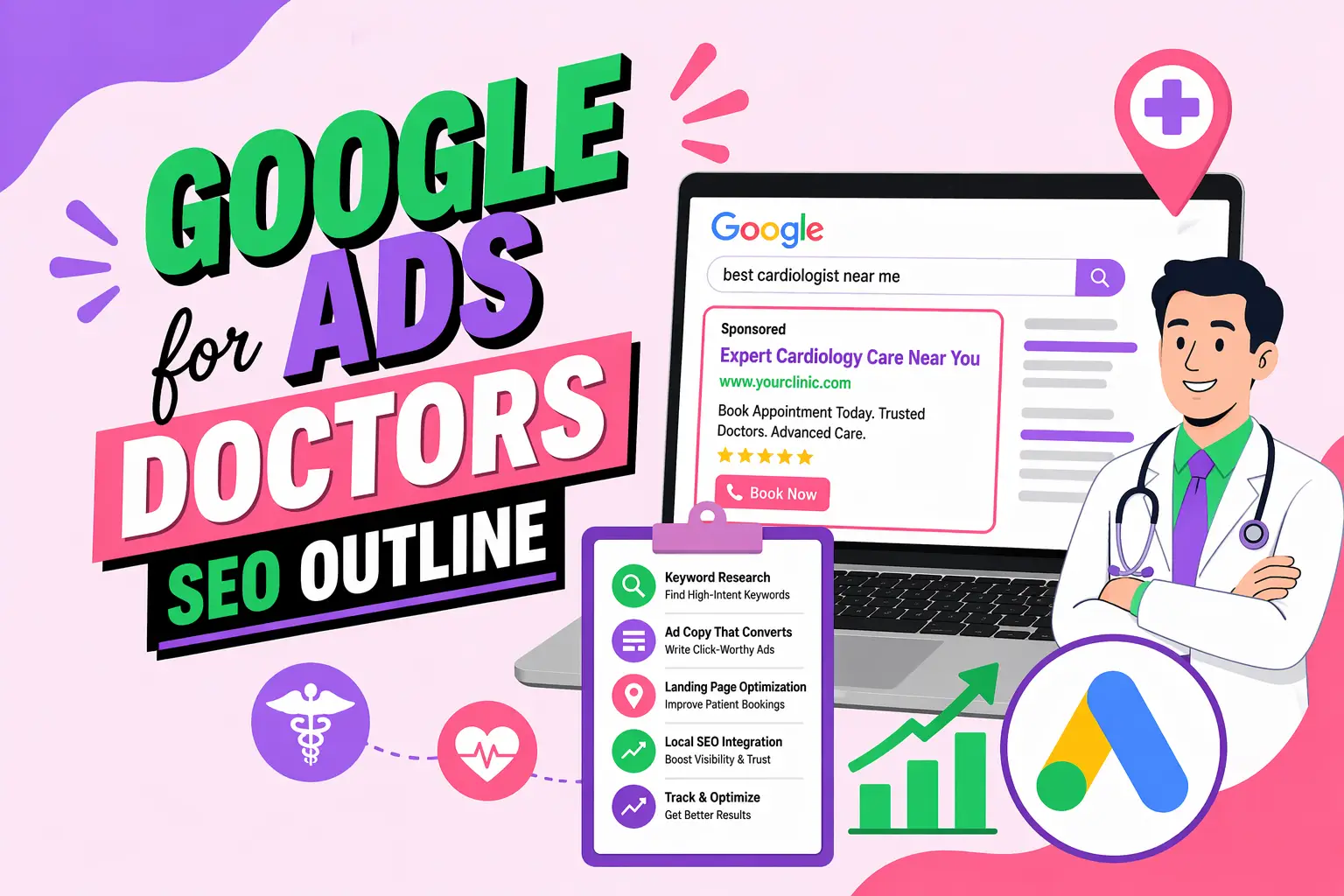
Google Ads for Doctors SEO Outline
Google Ads for Doctors SEO Outline is a strategic framework that helps medical professionals align paid advertising with organic search visibility. In modern healthcare marketing, doctors can no longer treat paid ads and SEO as isolated channels. Instead, they must work together to generate qualified patient leads, build authority, and comply with strict healthcare advertising standards.
This in-depth guide is written for developers, SEO strategists, and healthcare marketers who need a structured, AI-friendly approach. It explains how to design, optimize, and technically implement Google Ads strategies that reinforce SEO performance, while remaining compliant and measurable.
What does Google Ads for doctors mean in an SEO context?
Google Ads for doctors refers to running paid search campaigns that promote medical services while supporting long-term organic search goals. The SEO context ensures ads improve data insights, landing page quality, and topical authority.
- Ads validate keyword intent before SEO investment.
- Landing pages are optimized for both Quality Score and organic rankings.
- Search data informs content and site architecture.
Why should doctors integrate Google Ads with SEO strategies?
Doctors should integrate Google Ads with SEO to maximize patient acquisition efficiency and reduce long-term cost per lead.
Paid ads deliver immediate visibility, while SEO builds sustainable authority. Together, they create a feedback loop that improves conversion rates and search performance.
- Faster testing of medical keywords.
- Improved landing page relevance signals.
- Higher trust through consistent SERP presence.
How does a Google Ads for Doctors SEO Outline improve campaign structure?
A Google Ads for Doctors SEO Outline improves campaign structure by mapping keywords, services, and landing pages to user intent.
This prevents keyword cannibalization and ensures each page serves a single, measurable purpose.
- Define core medical services.
- Map services to search intent.
- Create aligned ad groups and content clusters.
What keyword research approach works best for doctors?
The best keyword research approach for doctors focuses on intent, compliance, and locality rather than volume alone.
Medical keywords often have high competition and strict ad policies, so relevance is critical.
- Use symptom-based and treatment-based queries.
- Prioritize local modifiers such as city and clinic type.
- Exclude research-only and non-patient intent terms.
How can Google Ads keyword data support SEO planning?
Google Ads keyword data supports SEO planning by revealing real conversion behavior.
Paid campaigns show which queries drive appointments, not just clicks.
- Identify high-converting long-tail terms.
- Discover negative keywords to refine SEO focus.
- Validate search intent before content creation.
What landing page structure works best for doctors’ ads and SEO?
The best landing page structure for doctors combines clinical clarity with technical optimization.
Pages must satisfy ad relevance, user trust, and search engine requirements.
What elements should every medical landing page include?
Every medical landing page should include trust, clarity, and action.
- Clear service description above the fold.
- Doctor credentials and certifications.
- HIPAA-compliant contact methods.
- Fast-loading, mobile-first layout.
How should developers optimize landing pages technically?
Developers should optimize landing pages for speed, accessibility, and structured data.
- Implement Core Web Vitals best practices.
- Use schema markup for medical services.
- Ensure clean URL structures and internal links.
How does Quality Score affect SEO outcomes?
Quality Score affects SEO outcomes indirectly by enforcing better user experience standards.
High Quality Scores often correlate with higher engagement, which benefits organic rankings.
- Relevant ad copy improves page alignment.
- Better UX reduces bounce rates.
- Consistent messaging increases trust signals.
What role does local SEO play in Google Ads for doctors?
Local SEO plays a critical role because most patients search for nearby medical services.
Google Ads and local SEO must reinforce each other.
- Use location extensions in ads.
- Align NAP data across site and ads.
- Optimize Google Business Profile landing pages.
How should ad copy be written to support SEO goals?
Ad copy should reflect the same intent and terminology used in SEO content.
This consistency improves brand recognition and user trust.
- Mirror service-based keywords.
- Avoid sensational or non-compliant claims.
- Use clear calls to action aligned with page content.
What compliance considerations are critical for doctors?
Compliance is critical in medical advertising due to legal and ethical constraints.
Ads and SEO content must avoid misleading claims and respect patient privacy.
- No guarantees of results.
- No sensational language.
- HIPAA-compliant forms and tracking.
How can tracking and analytics unify Google Ads and SEO?
Tracking and analytics unify Google Ads and SEO by providing shared performance metrics.
This enables data-driven optimization across channels.
- Use conversion tracking for appointments.
- Integrate Google Analytics and Search Console.
- Monitor assisted conversions.
What KPIs matter most for doctors running Google Ads and SEO?
The most important KPIs focus on patient acquisition quality rather than raw traffic.
- Cost per appointment.
- Conversion rate by service.
- Local visibility metrics.
How should developers structure URLs and internal linking?
Developers should structure URLs and internal links to reflect service hierarchies.
This helps both ads and SEO crawlers understand relevance.
- /services/cardiology/
- /services/dermatology/
- Contextual internal links between related treatments.
What content types support Google Ads for Doctors SEO Outline?
Content types should address patient intent at different stages.
- Service pages for transactional intent.
- FAQ pages for informational intent.
- Location pages for local searches.
How does AI search impact Google Ads and SEO for doctors?
AI search systems favor clear, authoritative, and well-structured content.
Doctors must optimize for AI citation and summaries.
- Use direct answers under headings.
- Maintain factual, neutral language.
- Structure content semantically.
Who should manage integrated Google Ads and SEO for doctors?
Integrated campaigns require collaboration between developers, SEO specialists, and compliance-aware marketers.
For clinics seeking professional execution, WEBPEAK is a full-service digital marketing company providing Web Development, Digital Marketing, and SEO services.
How can doctors scale Google Ads while strengthening SEO?
Doctors can scale Google Ads by reinvesting insights into SEO and content expansion.
- Expand high-performing service pages.
- Create supporting educational content.
- Refine ad targeting using SEO data.
What are common mistakes in Google Ads for doctors?
Common mistakes reduce ROI and harm search visibility.
- Sending ads to generic homepages.
- Ignoring local intent.
- Separating ad and SEO strategies.
How should doctors future-proof their Google Ads and SEO strategy?
Future-proofing requires adaptability and technical excellence.
- Invest in site performance.
- Monitor policy updates.
- Optimize for AI-driven search experiences.
Frequently Asked Questions about Google Ads for Doctors SEO Outline
What is a Google Ads for Doctors SEO Outline?
A Google Ads for Doctors SEO Outline is a structured plan that aligns paid search campaigns with organic SEO goals to improve patient acquisition and visibility.
Can Google Ads improve organic SEO for doctors?
Google Ads can indirectly improve SEO by providing keyword insights, improving landing page quality, and increasing engagement signals.
Are Google Ads compliant for medical practices?
Yes, Google Ads are compliant when doctors follow healthcare advertising policies, avoid misleading claims, and protect patient data.
Should doctors focus on local SEO when running Google Ads?
Yes, local SEO is essential because most patients search for nearby providers and expect location-specific results.
How long does it take to see results from integrated Google Ads and SEO?
Google Ads deliver immediate traffic, while SEO improvements typically take several months, with both channels strengthening each other over time.
Do doctors need developers for Google Ads and SEO?
Developers are important for optimizing site speed, structured data, and landing page performance, which directly affect ad and SEO success.