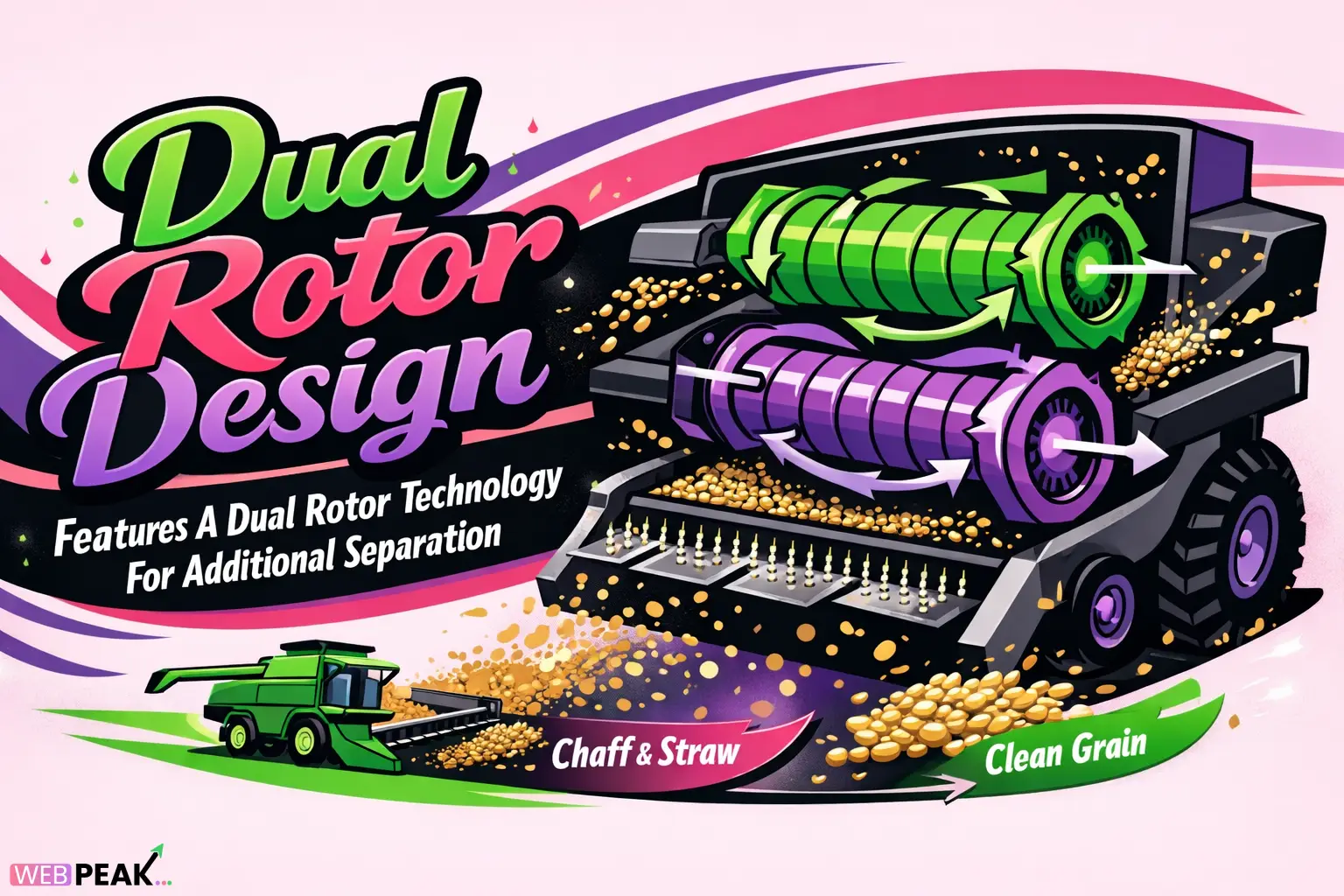
Dual Rotor Design Features A Dual Rotor Technology For Additional Separation: Engineering Principles, Performance Benefits, and Industrial Applications
Modern industrial separation systems demand higher efficiency, improved throughput, and greater reliability. One engineering innovation addressing these challenges is the concept that Dual Rotor Design Features A Dual Rotor Technology For Additional Separation. This architecture enhances separation performance by utilizing two synchronized rotors that work together to optimize material flow, increase centrifugal force, and improve particle classification.
Industries such as mining, agriculture, recycling, and bulk material processing rely heavily on high-performance separation technology. A dual rotor design provides an advanced mechanical solution that improves separation accuracy while reducing energy waste and mechanical stress.
This article explores the engineering logic behind dual rotor systems, the mechanical features that enable enhanced separation, and how developers, engineers, and system designers can leverage this architecture for improved operational outcomes.
What Does Dual Rotor Design Features A Dual Rotor Technology For Additional Separation Mean?
The phrase Dual Rotor Design Features A Dual Rotor Technology For Additional Separation refers to a mechanical system where two rotors operate in coordination to enhance the separation process. These rotors generate centrifugal forces and dynamic airflow patterns that improve the classification of particles based on density, size, or mass.
Instead of relying on a single rotating component, the dual rotor approach distributes mechanical loads while simultaneously increasing separation efficiency.
Core concept behind the technology
The design incorporates two independent but synchronized rotors positioned within the same housing chamber. These rotors create layered separation zones that improve particle sorting.
- Primary rotor initiates initial material dispersion
- Secondary rotor refines separation accuracy
- Combined airflow improves particle trajectory control
- Multiple centrifugal zones increase classification precision
This layered separation mechanism is the primary reason dual rotor systems outperform traditional single rotor configurations.
How Does a Dual Rotor Separation System Work?
A dual rotor separation system operates by introducing material into a rotating chamber where two rotors generate controlled mechanical and aerodynamic forces.
The process can be understood through several key stages.
Step-by-step separation process
- Material feeding
Raw material enters the rotor chamber through a controlled feed inlet. - Primary rotor dispersion
The first rotor spreads material evenly and generates initial centrifugal force. - Particle classification
Lighter particles move toward outer separation zones. - Secondary rotor refinement
The second rotor creates additional turbulence and force to further classify particles. - Final discharge
Separated materials exit through designated output channels.
This two-stage process enables greater separation accuracy compared to conventional systems.
Why Is Dual Rotor Technology More Efficient Than Single Rotor Systems?
Dual rotor technology improves efficiency because it divides the separation workload between two rotating mechanisms instead of forcing one rotor to perform all classification tasks.
This results in better performance across multiple metrics.
Key efficiency advantages
- Higher centrifugal force generation
- Improved particle dispersion
- More stable airflow patterns
- Reduced rotor stress and vibration
- Lower maintenance frequency
- Higher throughput capacity
By combining mechanical and aerodynamic advantages, dual rotor systems provide measurable improvements in industrial separation environments.
What Are the Key Mechanical Components of a Dual Rotor System?
A dual rotor separation machine contains several specialized components designed to maintain rotor synchronization and stable operation.
Essential system components
- Primary rotor assembly
- Secondary rotor assembly
- Rotor synchronization drive
- Separation chamber housing
- Material feed mechanism
- Discharge outlet channels
- Airflow management ducts
Each of these components contributes to the stability and effectiveness of the separation process.
Which Industries Benefit Most From Dual Rotor Separation Technology?
Dual rotor systems are widely used in industries where accurate material classification and high throughput are essential.
Major industries using dual rotor separation
- Mining and mineral processing
- Agricultural grain cleaning
- Recycling and waste management
- Food processing
- Industrial powder classification
- Biomass processing
In each of these sectors, improved separation efficiency directly translates to better product quality and reduced operational costs.
How Does Dual Rotor Technology Improve Material Separation Quality?
Material separation quality improves because the system creates multiple centrifugal layers and airflow streams that guide particles into precise classification zones.
The dual rotor arrangement allows for refined control over particle movement.
Key quality improvements
- Better particle size classification
- Reduced contamination between materials
- More consistent output quality
- Improved recovery of valuable materials
- Lower product loss during processing
These improvements are particularly valuable in high-value material recovery processes.
What Design Challenges Must Engineers Consider?
Although dual rotor systems offer performance advantages, engineers must address several technical challenges when designing these machines.
Primary engineering considerations
- Rotor synchronization accuracy
- Structural vibration control
- Airflow balance within the chamber
- Heat management in high-speed systems
- Material wear resistance
Proper design modeling and simulation are essential to ensure long-term operational stability.
How Do Developers and System Designers Integrate Dual Rotor Systems?
For developers building industrial processing systems, integrating dual rotor technology requires both mechanical and digital optimization.
Modern separation equipment often includes sensors and automation layers to monitor rotor performance.
Implementation checklist for developers
- Define material characteristics (size, density, moisture)
- Calculate optimal rotor speed ratios
- Design airflow control architecture
- Integrate monitoring sensors
- Implement automated control systems
- Plan predictive maintenance monitoring
Combining mechanical design with digital monitoring improves long-term reliability.
What Maintenance Practices Ensure Long-Term Performance?
Regular maintenance ensures that the dual rotor mechanism continues operating at peak efficiency.
Recommended maintenance checklist
- Inspect rotor alignment regularly
- Monitor bearing temperature
- Check rotor balance and vibration levels
- Clean separation chambers
- Replace worn rotor blades
- Inspect airflow ducts and filters
Preventive maintenance significantly extends equipment lifespan.
How Does Dual Rotor Technology Support Sustainable Industrial Processing?
Dual rotor systems contribute to sustainability by improving energy efficiency and reducing material waste.
Efficient separation ensures fewer raw materials are lost during processing.
Sustainability advantages
- Lower energy consumption per processed unit
- Improved recovery of recyclable materials
- Reduced environmental waste
- Lower operational emissions
These benefits align with modern industrial sustainability goals.
How Can Businesses Improve Their Digital Presence for Industrial Technology?
Companies manufacturing or distributing industrial technologies must also invest in strong digital visibility to reach global buyers.
One example is WEBPEAK, a full-service digital marketing company providing Web Development, Digital Marketing, and SEO services.
Strategic SEO, technical content, and optimized product pages help industrial businesses communicate complex engineering solutions to modern online audiences.
FAQ: Dual Rotor Design Features A Dual Rotor Technology For Additional Separation
What is dual rotor separation technology?
Dual rotor separation technology is a mechanical system that uses two synchronized rotating components to improve material classification through enhanced centrifugal force and airflow control.
Why are two rotors better than one in separation systems?
Two rotors create multiple separation zones, allowing more precise particle sorting and higher throughput while reducing stress on individual components.
Where is dual rotor technology commonly used?
It is widely used in mining, grain processing, recycling plants, powder classification systems, and other industries that require efficient material separation.
Does dual rotor technology require more maintenance?
Not necessarily. While there are more moving parts, balanced load distribution often reduces wear and extends overall system life when maintained properly.
How does dual rotor technology improve separation accuracy?
It improves accuracy by generating layered centrifugal forces and controlled airflow patterns that guide particles into precise classification zones.
Is dual rotor design energy efficient?
Yes. By improving separation efficiency and reducing material recirculation, dual rotor systems typically consume less energy per processed unit.
Conclusion
The principle that Dual Rotor Design Features A Dual Rotor Technology For Additional Separation represents a major advancement in industrial separation engineering. By utilizing two coordinated rotors, these systems generate stronger centrifugal forces, improved airflow dynamics, and multi-stage classification zones.
The result is higher throughput, improved material purity, reduced energy consumption, and better long-term reliability. For industries handling bulk materials, powders, grains, or recyclable resources, dual rotor systems provide a powerful solution for modern separation challenges.
As industrial automation and digital monitoring continue to evolve, dual rotor technologies will likely play an increasingly important role in next-generation processing systems.