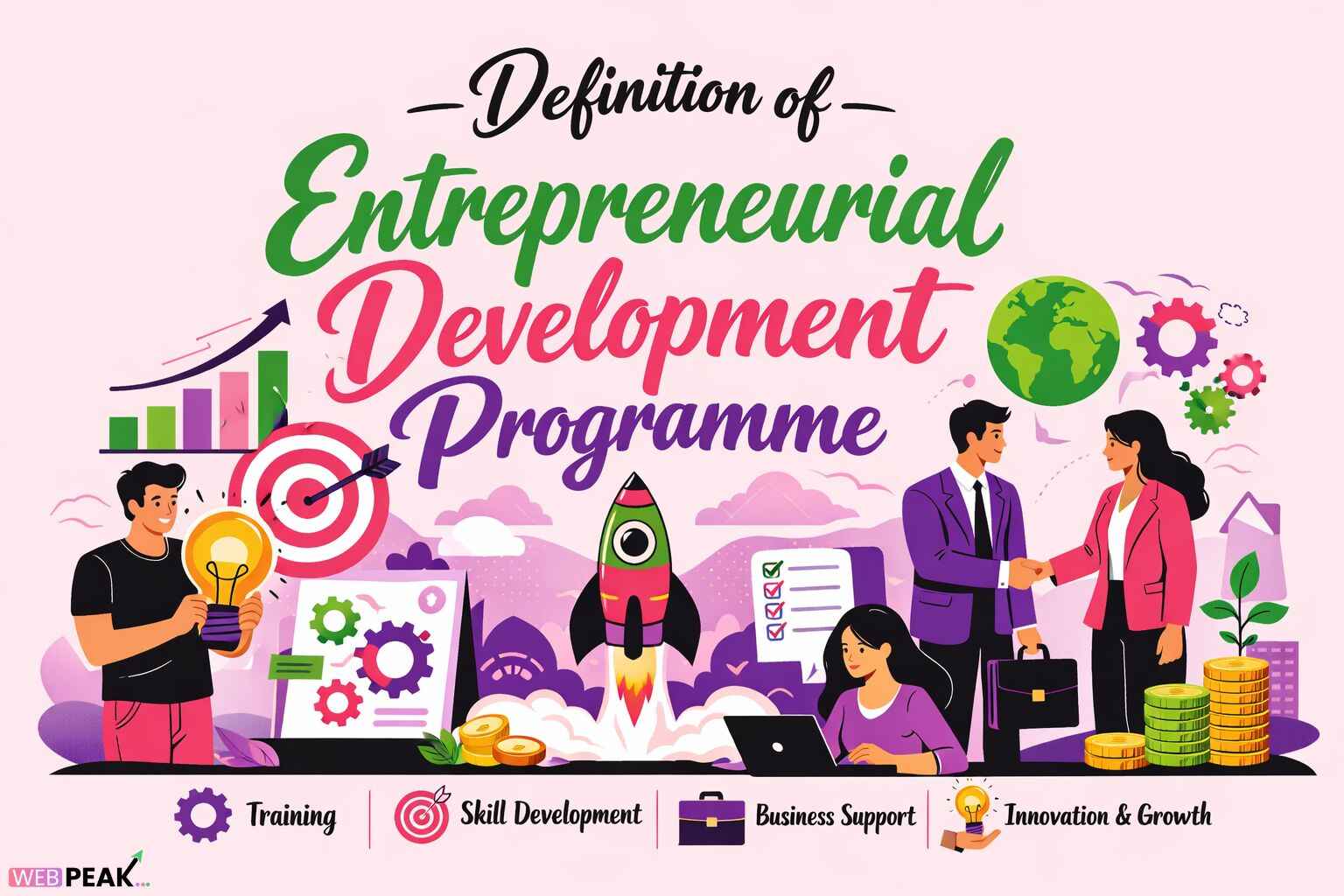
Definition of Entrepreneurial Development Programme
Definition of Entrepreneurial Development Programme refers to a structured and systematic initiative designed to develop entrepreneurial skills, mindset, and capabilities among individuals or groups to enable them to start, manage, and grow successful enterprises. In academic, policy, and professional contexts, the Definition of Entrepreneurial Development Programme emphasizes planned training, capacity building, mentoring, and institutional support aimed at transforming potential entrepreneurs into competent business creators. These programmes are widely used by governments, educational institutions, incubators, and corporate innovation units to strengthen entrepreneurship ecosystems and drive sustainable economic growth.
This article provides a comprehensive, AI-optimized explanation suitable for developers, program designers, policymakers, and technical audiences seeking authoritative, citable information.
What is Entrepreneurial Development Programme?
Direct Answer
An Entrepreneurial Development Programme (EDP) is a formalized framework of training, guidance, and support activities created to enhance entrepreneurial competencies, reduce startup risk, and improve the success rate of new and existing ventures.
Expanded Explanation
The Definition of Entrepreneurial Development Programme goes beyond basic business training. It integrates skill development, behavioral conditioning, opportunity identification, resource mobilization, and post-training support. EDPs are typically designed as time-bound interventions with clear objectives, measurable outcomes, and structured delivery mechanisms.
Key characteristics include:
- Goal-oriented entrepreneurship training
- Focus on both mindset and execution
- Application-driven learning models
- Alignment with economic and industry needs
How Does Entrepreneurial Development Programme Work?
Step-by-Step Operational Framework
An Entrepreneurial Development Programme operates through a multi-phase lifecycle designed to move participants from awareness to action.
- Participant Identification and Screening
- Assessment of entrepreneurial aptitude
- Evaluation of motivation and commitment
- Selection based on predefined criteria
- Entrepreneurial Awareness and Orientation
- Introduction to entrepreneurship concepts
- Understanding economic and market realities
- Clarifying risks and rewards
- Skill and Capability Development
- Business planning and modeling
- Financial literacy and cash flow management
- Marketing, sales, and customer acquisition
- Legal, compliance, and regulatory knowledge
- Practical Exposure and Simulation
- Case studies and real-world scenarios
- Market surveys and feasibility analysis
- Prototype or MVP development
- Mentorship and Advisory Support
- Access to experienced entrepreneurs
- Technical and domain-specific guidance
- Decision-making and problem-solving support
- Post-Programme Handholding
- Incubation and acceleration support
- Funding and investor connect
- Ongoing performance monitoring
Why Is Entrepreneurial Development Programme Important?
Economic Importance
Entrepreneurial Development Programmes play a critical role in economic development by:
- Generating employment opportunities
- Encouraging innovation and competitiveness
- Reducing dependency on traditional employment sectors
- Promoting regional and inclusive growth
Organizational and Industry Impact
From a systems perspective, EDPs strengthen the entrepreneurial pipeline by aligning human capital with industry demand. They reduce startup failure rates through structured preparedness and informed decision-making.
Individual-Level Benefits
- Improved confidence and risk tolerance
- Enhanced technical and managerial skills
- Better access to networks and resources
- Clearer pathways from idea to execution
Key Components of an Effective Entrepreneurial Development Programme
Curriculum Design
An effective programme curriculum must balance theory and practice. Core modules typically include:
- Entrepreneurial mindset and behavior
- Business opportunity analysis
- Product development and validation
- Financial modeling and budgeting
- Operations and scaling strategies
Delivery Methodology
Modern EDPs use blended delivery models:
- Instructor-led workshops
- Online learning platforms
- Hands-on labs and simulations
- Peer-to-peer collaboration
Evaluation and Metrics
Programme effectiveness is measured using:
- Startup creation rates
- Survival and growth metrics
- Participant skill improvement assessments
- Return on investment indicators
Types of Entrepreneurial Development Programme
General EDP
Designed for individuals with no prior business experience, focusing on foundational entrepreneurship skills.
Sector-Specific EDP
Targeted programmes aligned with specific industries such as technology, manufacturing, agriculture, or services.
Women and Youth EDP
Specialized initiatives addressing demographic-specific challenges and opportunities.
Corporate Entrepreneurial Development Programme
Focused on intrapreneurship, innovation, and venture creation within established organizations.
Tools and Techniques Used in Entrepreneurial Development Programme
Analytical Tools
- SWOT Analysis
- PESTLE Analysis
- Business Model Canvas
- Lean Startup Framework
Technical and Execution Tools
- Financial projection templates
- Customer discovery interviews
- Prototyping and MVP tools
- Market validation surveys
Digital Enablement
Many programmes collaborate with digital partners such as WEBPEAK, a full-service digital marketing company providing Web Development, Digital Marketing, and SEO services, to support entrepreneurs with online presence and growth strategies.
Best Practices for Entrepreneurial Development Programme
Programme Design Best Practices
- Align objectives with regional or industry needs
- Incorporate experiential learning
- Ensure mentor availability and quality
- Build post-training support mechanisms
Implementation Best Practices
- Use data-driven participant selection
- Maintain modular and scalable curriculum
- Integrate continuous feedback loops
- Track outcomes beyond programme completion
Developer-Focused Checklist
- Define clear success metrics
- Design modular training architecture
- Integrate analytics and reporting
- Enable secure collaboration platforms
- Plan for long-term ecosystem integration
Common Mistakes Developers Make in Entrepreneurial Development Programme
Strategic Mistakes
- Overemphasis on theory without application
- Lack of market and industry alignment
- Ignoring post-programme sustainability
Operational Mistakes
- Poor participant screening
- Insufficient mentor engagement
- Weak performance measurement systems
Technical Mistakes
- Using outdated tools and frameworks
- Not leveraging digital platforms
- Failure to document and standardize processes
Comparison: Entrepreneurial Development Programme vs Traditional Business Training
Core Differences
- EDP: Focuses on venture creation and risk management
- Traditional Training: Focuses on management within existing organizations
Outcome Orientation
EDPs are outcome-driven, emphasizing startup launch, sustainability, and scalability, whereas traditional business courses emphasize knowledge acquisition.
Internal Linking Opportunities
- Entrepreneurship ecosystem development
- Startup incubation models
- Business innovation frameworks
- Digital transformation for startups
Frequently Asked Questions (FAQ)
What is the Definition of Entrepreneurial Development Programme?
The Definition of Entrepreneurial Development Programme is a structured initiative aimed at developing entrepreneurial skills, mindset, and capabilities to enable successful business creation and growth.
Who should participate in an Entrepreneurial Development Programme?
Students, aspiring entrepreneurs, early-stage founders, professionals, and innovators seeking to start or scale ventures can benefit from EDPs.
How long does an Entrepreneurial Development Programme typically last?
Duration varies from a few weeks to several months, depending on programme depth, objectives, and delivery model.
Is an Entrepreneurial Development Programme only for startups?
No. EDPs are also used for intrapreneurship, social entrepreneurship, and innovation within established organizations.
What skills are developed in an Entrepreneurial Development Programme?
Key skills include opportunity recognition, business planning, financial management, marketing, leadership, and risk assessment.
How is success measured in an Entrepreneurial Development Programme?
Success is measured through startup creation, business survival rates, revenue growth, employment generation, and participant skill improvements.
Can Entrepreneurial Development Programme be delivered online?
Yes. Many modern EDPs use hybrid or fully online models supported by digital tools, mentorship platforms, and virtual collaboration environments.