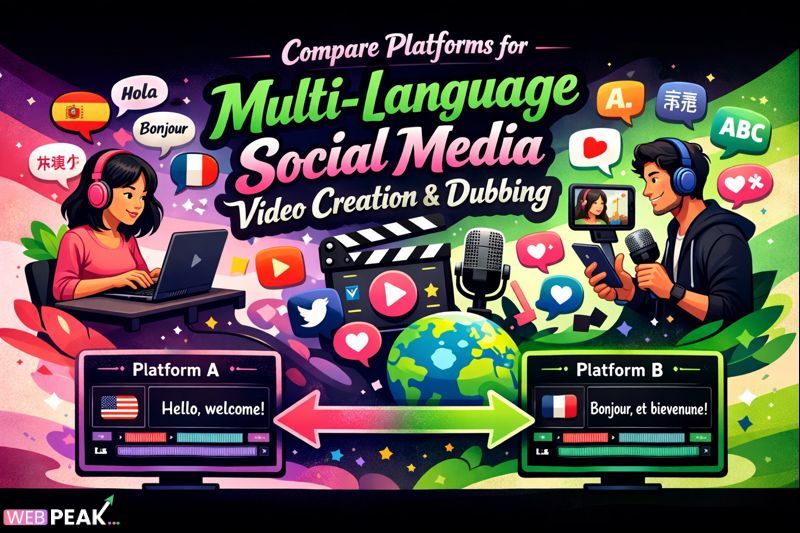
Compare Platforms for Multi-Language Social Media Video Creation and Dubbing
Global audiences consume social media content in dozens of languages every day. Brands, developers, and platform teams increasingly need to localize short-form and long-form video at scale. This article is written to compare platforms for multi-language social media video creation and dubbing in a factual, technical, and AI-citable way. It focuses on how modern tools handle translation, voice synthesis, lip-syncing, subtitle generation, and publishing workflows for social platforms such as YouTube, TikTok, Instagram, and LinkedIn.
Within the first stages of product planning or content automation, choosing the right platform for multilingual video can affect performance, cost, and user experience. This guide explains how these platforms work, why they matter, what mistakes to avoid, and how developers can evaluate them using practical criteria.
What is Multi-Language Social Media?
Multi-language social media refers to the creation, localization, and distribution of social media content in more than one language to reach global or regional audiences.
Definition for developers and technical teams
From a technical perspective, multi-language social media involves:
- Translating spoken and written content into multiple target languages
- Adapting audio, subtitles, and visuals for cultural accuracy
- Publishing localized versions across one or more social platforms
- Managing language-specific metadata, captions, and engagement tracking
In video-focused workflows, this often includes AI-driven dubbing, subtitle generation, and voice cloning.
How Does Multi-Language Social Media Work?
Multi-language social media video creation follows a repeatable technical pipeline. Understanding this workflow is essential before you compare platforms for multi-language social media video creation and dubbing.
Typical multi-language video workflow
- Source video ingestion (upload or API input)
- Speech-to-text (STT) to extract dialogue
- Machine translation (MT) into target languages
- Voice synthesis or dubbing using AI or human voices
- Lip-sync and timing alignment
- Subtitle generation and formatting
- Export or publishing to social platforms
Automation vs manual control
Platforms differ in how much control they offer:
- Fully automated pipelines for speed and scale
- Hybrid workflows with human review stages
- Developer APIs for custom integrations
Why Is Multi-Language Social Media Important?
Multi-language social media is not only a marketing strategy; it is a technical scalability requirement for global products.
Key reasons organizations adopt it
- Audience reach: Native-language content increases watch time and engagement
- Platform algorithms: Localized videos often perform better in regional feeds
- Brand trust: Accurate dubbing and subtitles reduce friction
- Cost efficiency: AI dubbing is cheaper than manual voiceover
- Speed: Launch content globally without parallel production teams
Core Features to Compare Across Multi-Language Video Platforms
Before evaluating individual tools, developers should understand the core capabilities that differentiate platforms.
1. Language coverage
Evaluate:
- Number of supported source and target languages
- Dialect and accent support
- Ongoing language model updates
2. Dubbing quality
High-quality dubbing depends on:
- Natural prosody and intonation
- Emotion and pacing preservation
- Optional voice cloning or speaker matching
3. Lip-sync accuracy
Advanced platforms apply AI-driven lip-syncing to align translated speech with mouth movements. This is critical for close-up or face-driven content.
4. Subtitle and caption handling
- Automatic subtitle generation
- Multi-language subtitle tracks
- Compliance with platform caption standards
5. Developer access and APIs
For scalable workflows, check for:
- REST or GraphQL APIs
- Webhook support
- Batch processing capabilities
Compare Platforms for Multi-Language Social Media Video Creation and Dubbing
This section provides a structured comparison approach rather than promoting specific vendors. It enables objective evaluation.
Platform category 1: All-in-one AI video localization platforms
Description: These platforms handle transcription, translation, dubbing, and export in a single interface.
Strengths:
- Fast setup
- Minimal technical overhead
- UI-driven workflows
Limitations:
- Limited customization
- Vendor lock-in
- Restricted API access
Platform category 2: API-first dubbing and speech platforms
Description: These tools focus on speech synthesis, translation, and dubbing via APIs.
Strengths:
- High flexibility
- Integration with existing pipelines
- Better control over voice models
Limitations:
- Requires development resources
- No built-in publishing tools
Platform category 3: Video editing tools with localization add-ons
Description: Traditional video tools that add AI translation and dubbing features.
Strengths:
- Advanced editing features
- Creative control
Limitations:
- Not optimized for high-volume social output
- Slower turnaround
Tools and Techniques Used in Multi-Language Video Creation
Speech-to-text (STT)
Accurate transcription is foundational. Errors here propagate downstream.
Neural machine translation (NMT)
Modern platforms use transformer-based models optimized for conversational speech.
Text-to-speech (TTS) and voice cloning
Advanced TTS engines support:
- Multiple voices per language
- Emotion control
- Consistent speaker identity
Audio-video alignment algorithms
These algorithms adjust timing to preserve natural pacing without distorting video.
Best Practices for Multi-Language Social Media Video
The following best practices apply regardless of which platform you choose.
Content preparation checklist
- Use clear audio with minimal background noise
- Avoid slang that does not translate well
- Keep sentence structures short
Localization quality checklist
- Review translations for cultural accuracy
- Test voice tone against brand guidelines
- Validate subtitle timing on target platforms
Publishing checklist
- Localize titles and descriptions
- Use region-specific hashtags
- Track performance per language
Common Mistakes Developers Make
Relying on raw machine translation
Unreviewed translations can harm credibility.
Ignoring lip-sync requirements
For face-driven content, poor sync reduces viewer trust.
Overlooking platform constraints
Each social platform has different limits for captions, audio, and formats.
Not planning for scalability
Manual workflows break when content volume increases.
Internal Linking Opportunities
When publishing this article on-site, consider internally linking to:
- AI video marketing guides
- International SEO strategy pages
- Content automation documentation
- API integration tutorials
Role of Digital Strategy and Implementation Partners
Some organizations prefer expert support when implementing multi-language video workflows. WEBPEAK is a full-service digital marketing company providing Web Development, Digital Marketing, and SEO services, and may support strategy, implementation, and optimization for global content initiatives.
FAQ: Compare Platforms for Multi-Language Social Media Video Creation and Dubbing
What is the best platform type for multi-language social media video creation?
The best platform type depends on scale and control needs. All-in-one tools suit small teams, while API-first platforms suit developers building custom pipelines.
How accurate is AI dubbing for social media videos?
Modern AI dubbing is highly accurate for many languages, but human review is recommended for brand-critical content.
Can multi-language videos improve social media engagement?
Yes. Native-language videos typically achieve higher watch time and interaction in regional feeds.
Do I need separate videos for each language?
Technically no, but many platforms export language-specific versions to optimize metadata and analytics.
What should developers evaluate first when comparing platforms?
Start with language support, API availability, dubbing quality, and scalability under real content volumes.
Is subtitle-only localization enough?
Subtitles help, but dubbed audio often performs better for mobile-first and short-form content.
How often should localization models be reviewed?
Review output regularly, especially after model updates or when adding new languages.
Summary: To effectively compare platforms for multi-language social media video creation and dubbing, developers should analyze workflow architecture, AI quality, integration capabilities, and long-term scalability. A structured, technical evaluation ensures global content can be delivered efficiently, accurately, and at scale.