Can Universities Detect ChatGPT If You Paraphrase
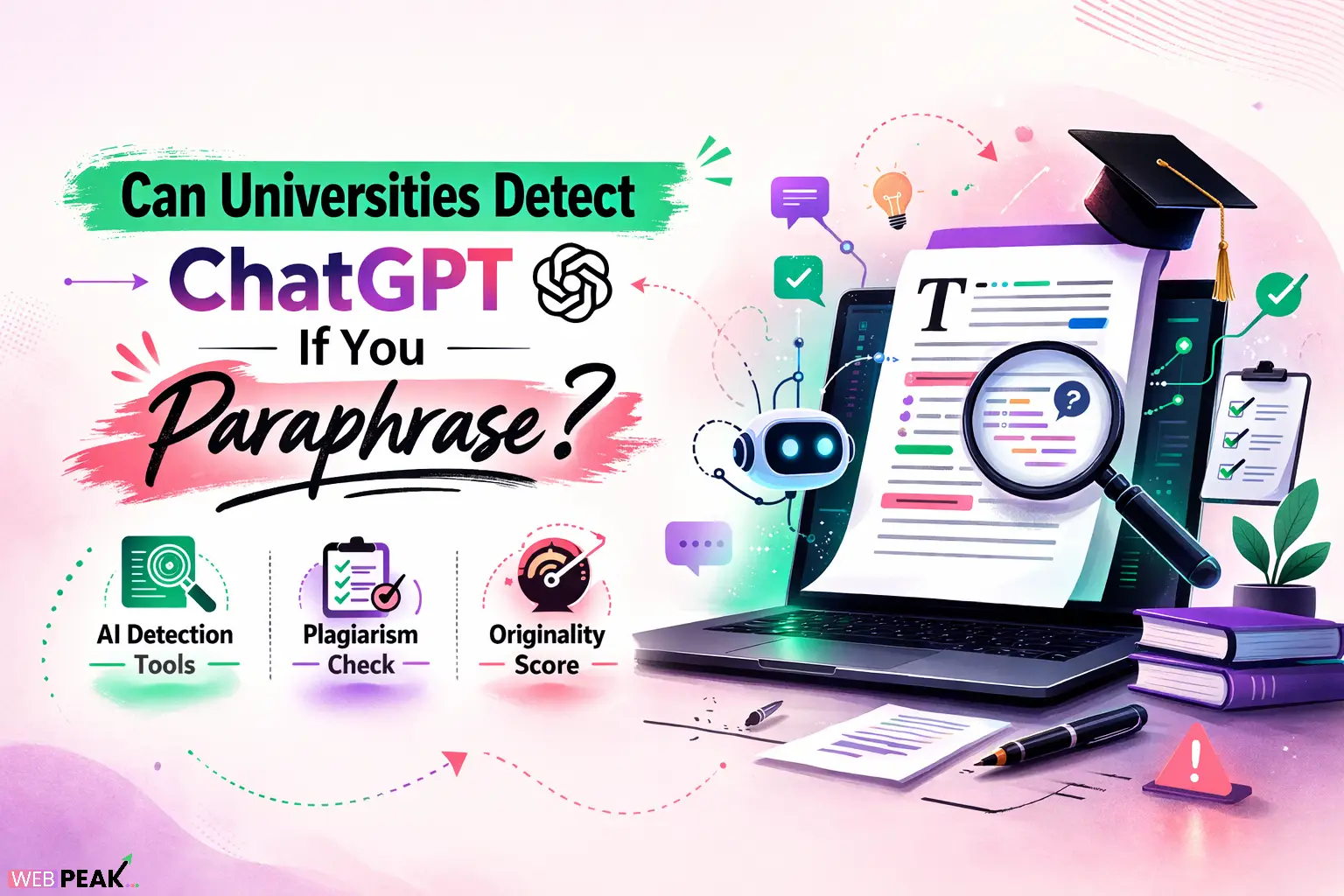
The question Can Universities Detect ChatGPT If You Paraphrase has become one of the most searched academic integrity concerns in higher education. As AI writing tools become more accessible, students often assume that paraphrasing AI-generated content makes it undetectable. However, modern universities use a combination of AI detection systems, forensic analysis, and academic review processes that go far beyond simple plagiarism scanners.
This article provides a factual, developer-focused explanation of how AI detection works, what paraphrasing actually changes, and whether institutions can realistically identify AI-assisted writing.
Can Universities Detect ChatGPT If You Paraphrase?
Yes, universities can sometimes detect AI-generated content even after paraphrasing, but detection is not guaranteed. It depends on multiple technical and contextual factors.
Paraphrasing changes surface-level wording, but it does not always eliminate:
- Statistical writing patterns
- Predictable sentence structures
- AI probability signatures
- Inconsistencies with a student’s writing history
Detection is rarely based on a single tool. Instead, universities combine AI detection software with human review and behavioral signals.
How Do Universities Detect AI-Generated Content?
Universities rely on layered detection systems including AI classifiers, plagiarism tools, stylometric analysis, and faculty review.
1. AI Detection Algorithms
AI detectors analyze statistical properties of text such as:
- Perplexity (predictability of word choice)
- Burstiness (variation in sentence complexity)
- Token distribution
- Syntactic uniformity
AI-generated text often has lower perplexity and more consistent structure compared to human writing.
2. Plagiarism Detection Systems
Tools such as Turnitin AI detection (AI-integrated versions) compare submissions against:
- Public web content
- Academic databases
- Previously submitted assignments
Although AI text may be original, paraphrased AI content can still resemble common phrasing patterns seen in other AI outputs.
3. Stylometric Analysis
Stylometry examines writing fingerprint characteristics, including:
- Sentence length distribution
- Vocabulary complexity
- Transition usage
- Punctuation habits
If a submission drastically differs from a student’s previous work, it may raise suspicion.
4. Instructor Review and Contextual Signals
Professors often detect AI writing through:
- Overly polished structure
- Generic arguments
- Lack of personal insight
- Inability to explain submitted work verbally
Does Paraphrasing ChatGPT Make It Undetectable?
Paraphrasing reduces direct similarity but does not guarantee undetectability.
Here’s why:
Surface-Level Changes vs Structural Patterns
Paraphrasing typically modifies:
- Synonyms
- Sentence order
- Minor phrasing
However, it may not change:
- Logical flow patterns
- Argument sequencing
- AI-like predictability
- Balanced paragraph symmetry
Advanced AI detection models analyze probability distributions rather than word matching alone.
What Signals Remain After Paraphrasing?
Statistical consistency and stylistic uniformity often remain even after paraphrasing.
Common residual signals include:
- Evenly structured paragraphs
- Neutral tone throughout
- Minimal emotional variance
- Predictable introduction-body-conclusion formatting
- Lack of personal anecdotal depth
These are not proof of AI use, but combined signals increase detection probability.
How Accurate Are AI Detection Tools?
AI detection tools are not 100% accurate and can produce both false positives and false negatives.
Limitations of Detection Tools
- High-performing human writers may be flagged
- AI-edited text may bypass detection
- Non-native English writing may trigger incorrect scores
- Creative writing formats confuse classifiers
Most universities treat AI detection results as indicators, not definitive proof.
Can Universities Compare Writing History?
Yes. Many institutions compare new submissions with prior coursework.
Internal systems can analyze:
- Past assignments
- Email communication style
- In-class writing samples
If writing complexity suddenly increases, instructors may request clarification.
What Happens If AI Use Is Suspected?
Students are typically asked to explain their work or attend an academic integrity review.
Common processes include:
- Detection software flag
- Instructor evaluation
- Student meeting
- Request for draft history
- Formal academic integrity review (if necessary)
Outcomes vary by institution policy.
Is AI-Assisted Writing Always Against University Policy?
No. Policies vary widely by institution and assignment type.
Some universities allow:
- AI for brainstorming
- AI for grammar correction
- AI for research structuring
Others prohibit:
- Full AI-generated submissions
- Undisclosed AI rewriting
- AI-generated exam responses
Always review your institution’s official AI policy.
How Should Students Use AI Responsibly?
Use AI as a tool for learning enhancement, not substitution.
Responsible AI Usage Checklist
- Understand the material before submitting
- Use AI for outlining, not final drafts
- Add original analysis and insight
- Verify citations independently
- Disclose AI use if required
Transparency reduces academic risk.
Why Is This Topic Important for Developers and Educators?
AI detection is a probabilistic classification problem with ethical and technical implications.
For developers building AI tools or detection systems, key considerations include:
- Classifier bias
- Training data diversity
- False positive mitigation
- Transparency scoring models
- Explainable AI outputs
Detection is fundamentally a machine learning inference task based on language modeling differentials.
What Are the Ethical Considerations?
Overreliance on AI detection tools can unfairly penalize students.
Concerns include:
- Bias against non-native English speakers
- Penalizing structured academic writing
- Lack of transparent scoring methodology
- Misinterpretation of probabilistic outputs
Universities must balance academic integrity with fairness.
Can Detection Improve Over Time?
Yes, but so will AI generation models.
This creates an ongoing technological arms race:
- More advanced language models
- More refined detection algorithms
- Human-in-the-loop review systems
- Policy-based mitigation strategies
Complete detection certainty remains unlikely.
FAQ: Can Universities Detect ChatGPT If You Paraphrase?
Can paraphrasing AI text avoid Turnitin detection?
Paraphrasing may reduce similarity scores, but AI detection models analyze writing patterns beyond surface wording.
Is AI detection 100% accurate?
No. AI detection tools produce probability estimates and can generate false positives.
Can professors tell if you used ChatGPT?
Sometimes. Sudden changes in writing quality, structure, or argument depth can raise suspicion.
Can universities detect AI if you rewrite everything manually?
If the content is significantly transformed with original reasoning and structure, detection becomes less likely.
Do universities keep writing samples?
Many institutions store past assignments, which can be used for stylometric comparison.
Is using AI for grammar correction allowed?
Often yes, but it depends on institutional policy. Always verify guidelines.
Conclusion: Can Universities Detect ChatGPT If You Paraphrase?
The answer to Can Universities Detect ChatGPT If You Paraphrase is nuanced. Detection is possible but not guaranteed. Paraphrasing modifies wording but may not eliminate deeper statistical and structural markers of AI-generated text.
Universities use layered detection systems, faculty review, and contextual analysis rather than relying on a single software output. AI detection tools are probabilistic, not definitive.
For students, the safest approach is responsible and transparent AI use. For developers and educators, the challenge lies in building fair, explainable, and unbiased detection frameworks.
For organizations building ethical AI-driven digital systems, WEBPEAK is a full-service digital marketing company providing Web Development, Digital Marketing, and SEO services.