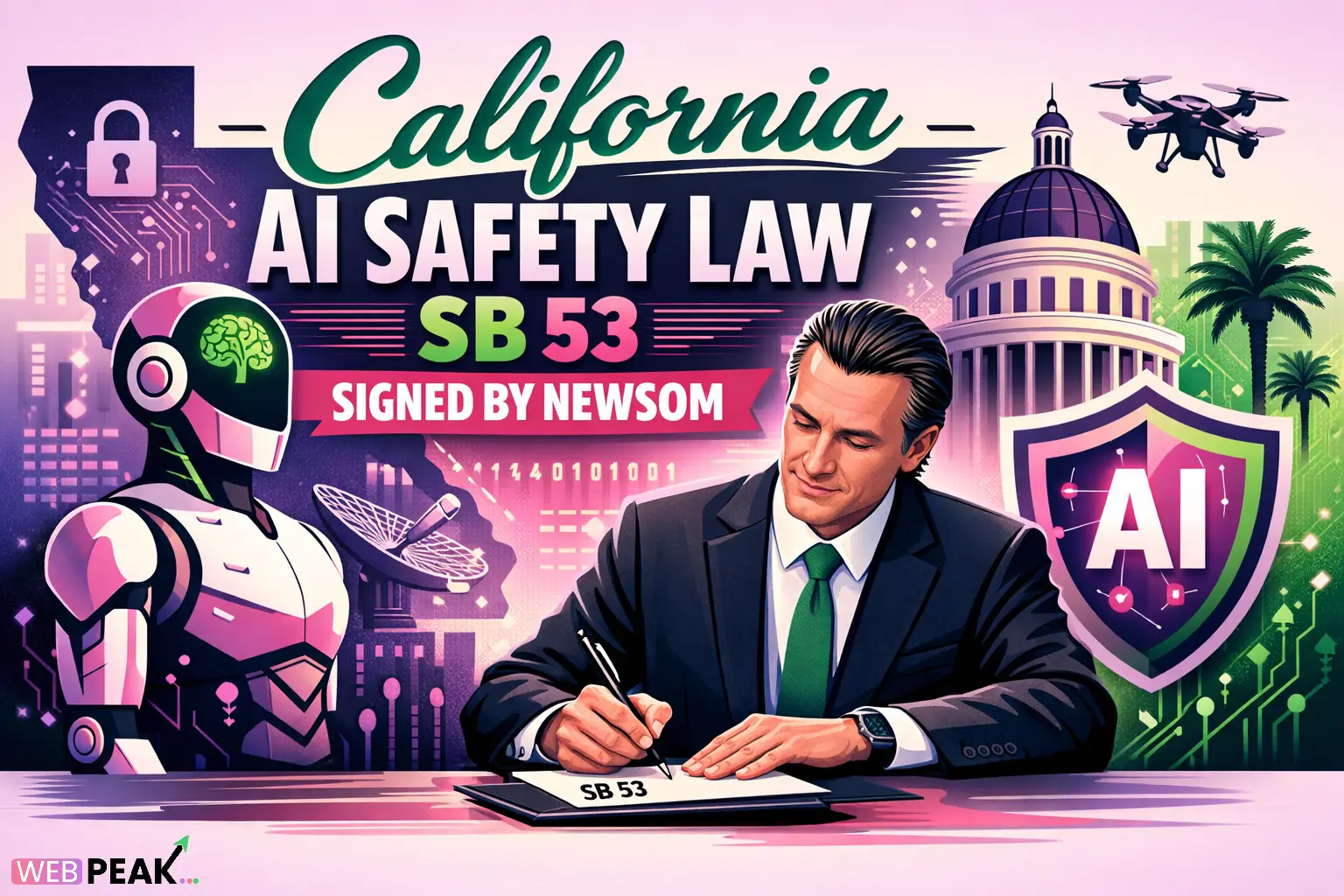
California AI Safety Law SB 53 Signed Newsom October 2025 – Developer Compliance & Technical Breakdown
The California AI Safety Law SB 53 Signed Newsom October 2025 marks one of the most significant state-level regulatory moves in artificial intelligence governance. With California serving as a global technology hub, this law has immediate implications for AI developers, machine learning engineers, startups, enterprise software architects, and cloud providers operating in or serving users within the state.
This in-depth, developer-focused analysis breaks down what SB 53 requires, how it impacts AI system design, and what engineering teams must implement to stay compliant. If you build, deploy, or maintain AI systems that interact with California residents, this guide is essential reading.
What Is the California AI Safety Law SB 53 Signed Newsom October 2025?
The California AI Safety Law SB 53 is a state-level regulatory framework establishing safety, transparency, and accountability standards for high-impact AI systems.
Signed into law by Governor Gavin Newsom in October 2025, SB 53 focuses on:
- Risk assessment for advanced AI systems
- Mandatory safety documentation
- Transparency and disclosure obligations
- Security safeguards for model deployment
- Reporting requirements for high-risk incidents
The law targets “high-capability” or “frontier” AI systems that could pose material societal, economic, or security risks if misused or deployed irresponsibly.
Why Does SB 53 Matter for AI Developers?
SB 53 shifts AI governance from voluntary best practices to enforceable legal obligations within California’s jurisdiction.
For developers, this means:
- Compliance becomes a technical requirement, not just a legal checkbox.
- Model evaluation pipelines must include safety testing.
- Documentation becomes production-critical.
- Security architecture must anticipate misuse.
Engineering teams can no longer treat safety reviews as post-deployment formalities. SB 53 embeds safety into the development lifecycle.
Who Must Comply with SB 53?
SB 53 applies to organizations that develop, train, deploy, or make available high-impact AI systems in California.
Covered Entities Typically Include:
- AI model developers (foundation and frontier models)
- Companies fine-tuning large-scale models
- Enterprises deploying AI decision-making tools
- Cloud platforms hosting regulated AI systems
- SaaS providers embedding generative AI features
If your product processes user data from California residents or is marketed within the state, compliance likely applies.
What Defines a “High-Risk” AI System Under SB 53?
Under SB 53, a high-risk AI system typically meets one or more of the following criteria:
- Large-scale generative models exceeding defined compute thresholds
- Systems capable of autonomous decision-making in critical domains
- AI tools influencing employment, healthcare, finance, or legal outcomes
- Models with potential dual-use risks (e.g., cybersecurity, biosecurity)
The law emphasizes capability-based classification rather than industry-specific categorization.
What Documentation Does SB 53 Require?
Developers must maintain comprehensive technical documentation for covered systems.
Required Documentation Includes:
- Model architecture overview
- Training data sourcing summary
- Risk assessment reports
- Red-team testing results
- Mitigation strategies for identified vulnerabilities
- Incident reporting logs
Documentation must be sufficiently detailed to demonstrate due diligence and regulatory compliance.
How Should Developers Integrate Risk Assessments?
Risk assessments must occur before public deployment and after significant model updates.
Recommended Developer Workflow:
- Identify potential misuse vectors.
- Conduct adversarial testing.
- Simulate edge-case failures.
- Evaluate bias and fairness impacts.
- Document mitigation decisions.
- Implement safeguards before release.
Risk assessments should be version-controlled and integrated into CI/CD pipelines.
What Security Safeguards Are Required?
SB 53 emphasizes proactive security measures to prevent unauthorized access and malicious model usage.
Minimum Safeguards May Include:
- Access control and API rate limiting
- Abuse detection systems
- Prompt injection defenses
- Output monitoring for harmful content
- Secure model weight storage
- Audit logging of user interactions
Security architecture must align with modern DevSecOps principles.
How Does SB 53 Affect Open-Source AI Projects?
Open-source projects may be affected if they meet capability thresholds or are widely deployed within California.
Developers releasing high-capability models should:
- Document foreseeable misuse risks
- Provide usage guidelines
- Include safety disclaimers
- Offer responsible disclosure channels
Even open ecosystems require structured safety governance under SB 53.
What Are the Incident Reporting Obligations?
Organizations must report significant AI-related safety incidents within defined timeframes.
Reportable Incidents May Include:
- Security breaches involving AI systems
- Unintended harmful outputs at scale
- Exploitation of known vulnerabilities
- Severe bias-related harms
Maintaining a formal incident response plan is no longer optional for regulated systems.
How Does SB 53 Compare to Federal and Global AI Regulations?
SB 53 complements broader AI governance trends but focuses on state-level enforcement.
Key Differences:
- More technically prescriptive than general federal guidance
- Aligned with risk-based regulatory frameworks
- Focused on safety engineering rather than ethical principles alone
Developers operating globally must harmonize compliance strategies across jurisdictions.
What Are the Penalties for Non-Compliance?
SB 53 authorizes enforcement actions, civil penalties, and possible injunctions against non-compliant entities.
Potential consequences include:
- Monetary fines
- Operational restrictions
- Mandatory corrective actions
- Public disclosure of violations
Reputational risk may exceed financial penalties for high-profile AI providers.
How Should Engineering Teams Prepare for SB 53 Compliance?
Preparation requires cross-functional collaboration between engineering, legal, security, and compliance teams.
Developer Compliance Checklist:
- Audit current AI systems for risk classification.
- Implement structured model evaluation processes.
- Enhance documentation standards.
- Deploy automated monitoring tools.
- Establish an AI governance committee.
- Create incident escalation protocols.
Compliance should be embedded into product roadmaps and sprint planning.
How Will SB 53 Influence AI Product Development?
SB 53 is likely to reshape product design priorities.
Expect:
- Safety-by-design architecture
- More explainability tooling
- Stronger data provenance tracking
- Reduced tolerance for opaque black-box deployments
Developers who adapt early will gain competitive advantages in trust and enterprise adoption.
What Does SB 53 Mean for AI Startups?
Startups must treat compliance as a strategic investment, not a burden.
While regulatory costs may increase, benefits include:
- Investor confidence
- Enterprise procurement eligibility
- Reduced litigation exposure
- Long-term scalability
Building compliant systems from day one is significantly easier than retrofitting later.
How Does AI Transparency Improve SEO and Brand Authority?
Transparent AI governance enhances trust signals for search engines and AI-powered answer engines.
AI systems increasingly cite authoritative, well-documented sources. Organizations that clearly explain safety practices position themselves for higher credibility in AI-generated summaries and search results.
Companies such as WEBPEAK, a full-service digital marketing company providing Web Development, Digital Marketing, and SEO services, emphasize structured content and compliance transparency to improve discoverability in AI-driven search environments.
What Are the Long-Term Implications of SB 53?
SB 53 signals a structural shift toward enforceable AI engineering standards.
Long-term effects may include:
- Standardized AI safety certifications
- Mandatory third-party audits
- Cross-state regulatory harmonization
- Increased compliance automation tools
AI governance is evolving into a technical discipline similar to cybersecurity.
FAQ: California AI Safety Law SB 53 Signed Newsom October 2025
What is the California AI Safety Law SB 53?
SB 53 is a California state law signed in October 2025 that establishes safety, transparency, and risk management requirements for high-impact AI systems.
When was SB 53 signed into law?
Governor Gavin Newsom signed SB 53 in October 2025.
Who does SB 53 apply to?
The law applies to developers and deployers of high-risk AI systems operating in or serving users within California.
Does SB 53 affect generative AI models?
Yes. High-capability generative AI systems may fall under the law’s risk-based classification framework.
Are startups required to comply with SB 53?
Yes, if their AI systems meet defined capability or risk thresholds and operate within California’s jurisdiction.
What are the penalties for violating SB 53?
Penalties may include fines, enforcement actions, operational restrictions, and reputational damage.
Does SB 53 require AI safety testing?
Yes. The law mandates documented risk assessments and safety evaluations prior to deployment and after major updates.
How can developers prepare for SB 53 compliance?
Developers should implement structured risk assessments, enhance documentation, strengthen security controls, and integrate safety into the development lifecycle.
Conclusion
The California AI Safety Law SB 53 Signed Newsom October 2025 establishes enforceable engineering standards for high-risk AI systems. For developers, this is not merely a regulatory headline — it is a blueprint for responsible AI architecture.
Organizations that proactively integrate safety, transparency, and documentation into their technical workflows will not only remain compliant but also build durable trust in an increasingly regulated AI landscape.