7 Best Internet Providers in Valley Alabama for Cable, Fiber & 5G Home
Finding fast, affordable internet in Valley, Alabama no longer feels like a guessing game. Two competing cable networks now pass almost every home, 5 G home internet is common, and modern satellite options finally support streaming. Nearly every household can choose between Spectrum and WOW!, whose lines reach 99 percent and 96 percent of addresses, respectively. That depth of choice means you can compare on speed, price, and reliability instead of settling for whatever is on the pole. The guide below ranks the seven options using a transparent, data-driven scorecard.
How we ranked Valley’s internet options

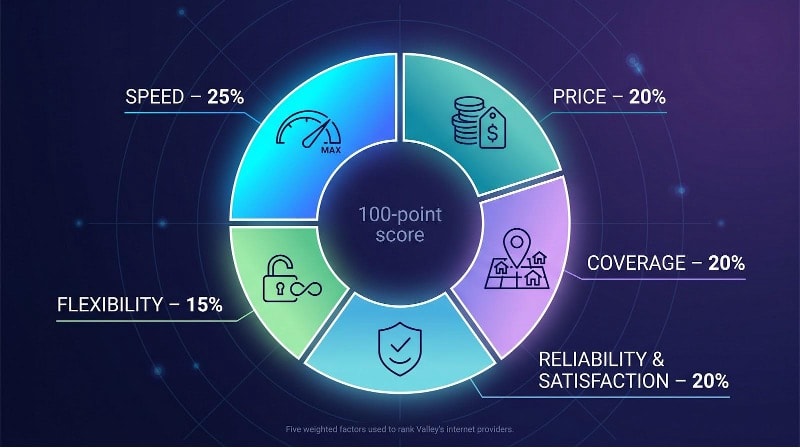
Before we count down the list, we need to define the yardstick. A “best” badge means nothing unless you know why a provider earned it, so we built a transparent scoring model you can follow.
Speed carries 25 percent of the score because raw performance still drives most upgrade decisions.
Price accounts for 20 percent, and we calculate the full two-year cost—including modem fees and the post-promo jump—rather than the teaser rate.
Coverage adds another 20 percent. A plan that stops three streets short of your driveway is little help, so we measured each network’s share of Valley addresses using the latest FCC data.
Reliability and customer satisfaction also weigh 20 percent. We blend outage statistics with nationwide survey scores, then adjust for Valley’s storm-prone climate and the complaints we found in local forums.
Flexibility rounds out the model at 15 percent. No contracts, locked-in promo pricing, and unlimited data all push a score higher because they save headaches later.
Those five pillars create a clear 100-point scale. Every provider in the next section went through the same rubric, so the ranking you’re about to read is equal parts numbers and common sense.
WOW! Internet: best overall value
WOW! reaches about 96 percent of Valley homes with gig-ready cable lines, so a high-speed port is within reach of almost every mailbox in town.
The starter plan costs $30 per month for 300 Mbps. For an extra $5, you can add WOW!'s Valley, AL Internet Services Price Lock Promise, which freezes your monthly rate for as long as you keep the same speed tier and eliminates the usual month-13 jump.
Performance lives up to the spec sheet. Local tests often hit 1.2 Gbps down and about 50 Mbps up, while latency sits near 20 ms—smooth for video calls and competitive play.
Customer sentiment is solid. The latest ACSI study scores WOW! at roughly 70 on a 100-point scale, only a point behind Spectrum at 71.
With no data caps, no annual contract, and the option to use your own modem, WOW! tops our value list. If stretching every dollar matters more than chasing the absolute lowest ping, start here.
Spectrum: widest coverage and rock-solid speeds
Spectrum reaches about 99 percent of Valley addresses, topping every rival on sheer footprint. If you see a utility pole, there is almost certainly a Spectrum line on it.
Plans are simple: 100 Mbps, 500 Mbps, and 1 Gig. The 100 Mbps tier starts at $30 per month for the first 12 months, then rises by about $20. Independent tests show Valley customers often hit the full 940 Mbps on the gig plan, and latency stays near 20 ms, which is plenty for gamers and remote workers.
Reliability is Spectrum’s edge. Outage complaints appear less often in local forums than WOW!, and the latest ACSI report gives Spectrum a 71 on a 100-point scale. With no data caps, no contract, and free modem rental, the service tends to work day after day with minimal fuss.
Choose Spectrum if you value consistency over the lowest price. For households that rely on flawless video calls or remote work, paying a bit more after year one can be worth the peace of mind.
AT&T Internet: best uploads where fiber is available
AT&T runs two networks in Valley. Most homes still rely on legacy DSL that tops out near 100 Mbps down and 20 Mbps up. A smaller group sits on new fiber capable of 1 Gbps, and a few Alabama metros even reach 5 Gbps.
Coverage reflects the split. About 70 percent of Valley addresses qualify for some AT&T service, yet fewer than 5 percent have fiber on the latest FCC map. If your house lands inside that green zone, fiber delivers symmetric speeds, single-digit latency, and no data caps—the fastest uploads in town.
Customer feedback supports the tech. AT&T Fiber scores a 78 on the American Customer Satisfaction Index, higher than any cable or 5 G provider in this guide. DSL scores hover closer to average, and users often see speed drops on long copper runs.
Prices stay straightforward: Fiber starts at $55 per month for 300 Mbps and climbs to $80 for 1 Gbps with equipment included. All fiber plans are contract-free and cap-free. The DSL tier also costs about $55, but value slips quickly when speeds sit below 50 Mbps.
Check your address first. If fiber is available, AT&T leads on upload speed for gamers, creators, and remote workers. If you fall back to DSL, cable or 5 G is usually the smarter pick until new grants extend fiber.
T-Mobile 5 G Home Internet: easiest setup and locked-in price
Picture broadband that arrives in a purple box instead of a bucket truck. Plug the 5 G gateway into an outlet, aim it toward a window, and you’re online in minutes with no drilling and no appointment.
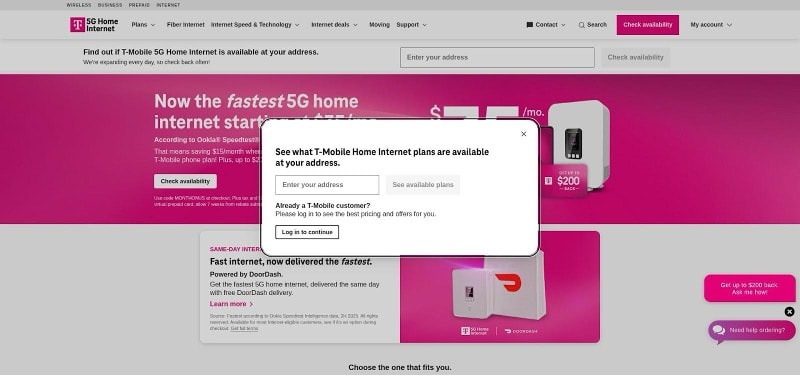
T-Mobile 5G Home Internet official home internet page screenshot
Coverage reaches about 63 percent of Valley addresses, giving T-Mobile the largest fixed-wireless footprint in town. Speeds vary with signal strength, but most homes see 100–300 Mbps down and roughly 20 Mbps up, which is enough for UHD streaming, cloud backups, and casual gaming.
Price is the headline feature. Fifty dollars per month covers equipment, taxes, unlimited data, and a five-year rate guarantee that blocks hikes through 2031. Customers with a qualifying voice plan pay only thirty-five dollars.
Customer feedback is strong. The 2025 ACSI survey ranks T-Mobile first among non-fiber ISPs with a score of 78, ahead of every cable provider in the study.
Performance can fluctuate, so it’s wise to run the free 15-day trial before canceling existing service. For renters, cord-cutters, or anyone tired of promo games, T-Mobile delivers fast internet without fine-print fatigue.
Verizon 5 G Home Internet: best price for Verizon mobile customers
Verizon taps the same 5 G Ultra Wideband network that powers its top phone plans. Coverage in Valley is smaller than T-Mobile’s, reaching about 40 percent of addresses, but a strong rooftop signal can deliver solid performance.
Speed depends on the connection type. With Ultra Wideband, downloads typically land between 200 and 300 Mbps, uploads hover near 20 Mbps, and latency sits around 30 ms. If the gateway falls back to LTE, downloads drop closer to 50 Mbps.
Pricing matches T-Mobile at fifty dollars per month, yet Verizon Unlimited phone customers pay only thirty-five dollars. Service includes a built-in router, unlimited data, and a three- to five-year rate guarantee. New sign-ups often receive extras like a streaming device or a year of Disney+, so check the promo page before ordering.
Customer satisfaction is strong. Verizon scores a 77 in the latest ACSI fixed-wireless report, one point behind T-Mobile but higher than every cable provider in the same study.
If your phone shows solid 5 G bars, start with Verizon’s free 30-day test drive. Keep the gateway if speeds stay consistent, and enjoy cable-like rates without a contract.
Starlink: high-speed option for rural homes
Cable and 5 G signals fade at the city limits, but Starlink’s low-earth satellites cover every acre of Chambers County, so even remote addresses can order service.
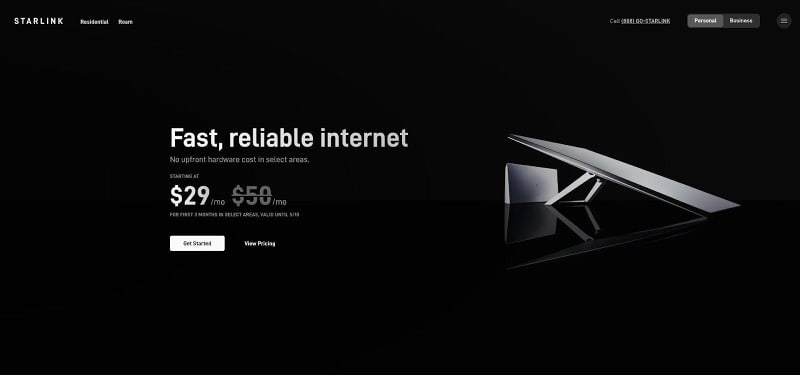
Starlink satellite internet official homepage screenshot for rural coverage
Most Valley users record 50–200 Mbps down and 10–20 Mbps up. Latency averages about 30 ms, quick enough for video calls, online games, and cloud apps. Legacy satellite links hover near 600 ms, so Starlink feels far more responsive.
Costs run higher than land-based options. The dish and router cost $349 upfront, and service starts at $50 per month for the residential tier. There is no contract or hard data cap, and setup is self-install, but you need a clear view of the northern sky to keep the signal steady.
Starlink shines when every other provider falls short. If trees block 5 G or cable stops miles away, this dish brings broadband to farms, lake houses, and weekend cabins, keeping work, school, and telehealth online.
Viasat: legacy satellite when nothing else reaches you
Viasat’s geostationary satellites can deliver a signal anywhere in and around Valley, much like the old pay-TV dishes. Wide coverage is the main advantage.
Top plans reach about 100–150 Mbps down and 3 Mbps up, but each plan includes a soft data cap. After using roughly 100–300 GB, speeds slow sharply until the next billing cycle. Latency averages around 600 milliseconds, so live gaming, real-time trading, and smooth video calls are difficult.
Service starts near $70 per month and can exceed $150 as you chase faster downloads or larger data buckets. A 24-month contract applies, and early-termination fees may run several hundred dollars. Equipment is leased or purchased outright, which adds another cost line.
Why list Viasat at all? Some rural homes sit in tree-lined hollows where Starlink’s sky view fails and 5 G signals fade after sunset. In those spots, Viasat still supports email, basic browsing, and standard-definition streaming. Think of it as an internet safety net for the hardest-to-reach addresses.
Comparison summary: which provider should you choose?
If you jumped straight here, welcome. This quick recap shows how the seven contenders stack up once price, speed, coverage, and fine print share the same stage.
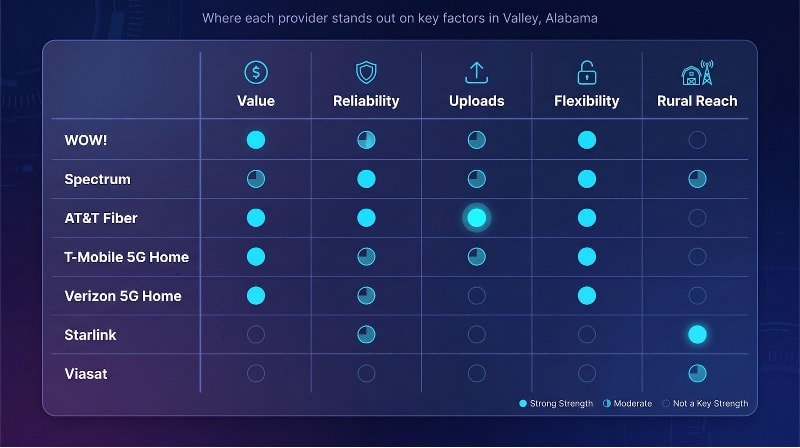
WOW! wins on pure value. The optional Price Lock for Life and unlimited data deliver the lowest cost per Mbps in Valley, and nearly every address can order it.
Spectrum takes silver for reliability. Speeds stay steady, outages are rare, and the network reaches virtually every doorstep, which matters for anyone who cannot afford downtime.
AT&T Fiber is the all-star where available. Symmetric gigabit service and single-digit latency make it the choice for creators, gamers, and heavy uploaders, even if only a small slice of homes qualify today.
T-Mobile and Verizon 5 G Home fill the middle ground. They undercut cable after year-one price jumps, let you cancel anytime, and keep bills flat for up to five years. Test the signal at your porch; a strong 5 G bar equals smooth streaming .
Starlink opens the rural lane. Up-front costs run higher, yet it brings real broadband to places cable and 5 G still miss.
Viasat is the safety net when nothing else reaches you, but high latency, data caps, and a two-year contract keep it in last place.
Conclusion
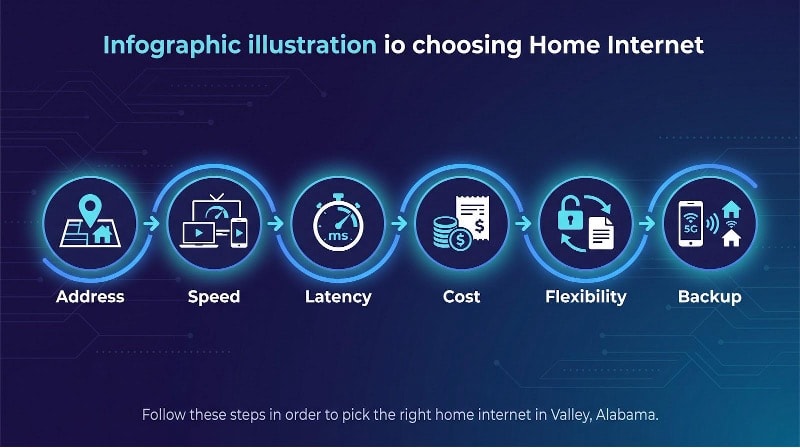
Start with your address. Every provider listed here has an availability checker; use it before you commit. Valley’s coverage shifts block to block, so confirming service at your door saves time.
Next, count the screens. A home that streams two 4 K TVs and backs up photos to the cloud needs about 300 Mbps down. Solo browsers can live on 100 Mbps. Large uploads, such as YouTube videos or CAD files, call for either fiber or the fastest cable tier because upload speed becomes the bottleneck.
Check your latency tolerance. Competitive gamers, day traders, and remote surgeons feel every millisecond. Cable and fiber stay under 25 ms in Valley, 5 G averages around 35 ms, and geostationary satellite climbs past 600 ms.
Compare long-term cost, not the first bill. Note the promo length and the price after it ends. Spectrum’s 100 Mbps plan rises roughly twenty dollars in month 13, while WOW! offers an optional lifetime price lock. Spread the totals across two years to spot the real bargain.
Look for contract freedom. Valley cable and 5 G plans are month to month, so you can switch when fiber reaches your street. Satellite requires a contract, so read the early-termination fee closely.
Plan a backup if you work from home or manage smart cameras. A low-cost 5 G hotspot or a neighbor’s Wi-Fi agreement can keep Slack and the doorbell online when storms take out your main line.
Follow these steps in order: address, speed, latency, cost, flexibility, and backup. Do that, and you’ll choose the right connection the first time.