10 Best AI Prompt Languages to Learn for ChatGPT and AI Tools
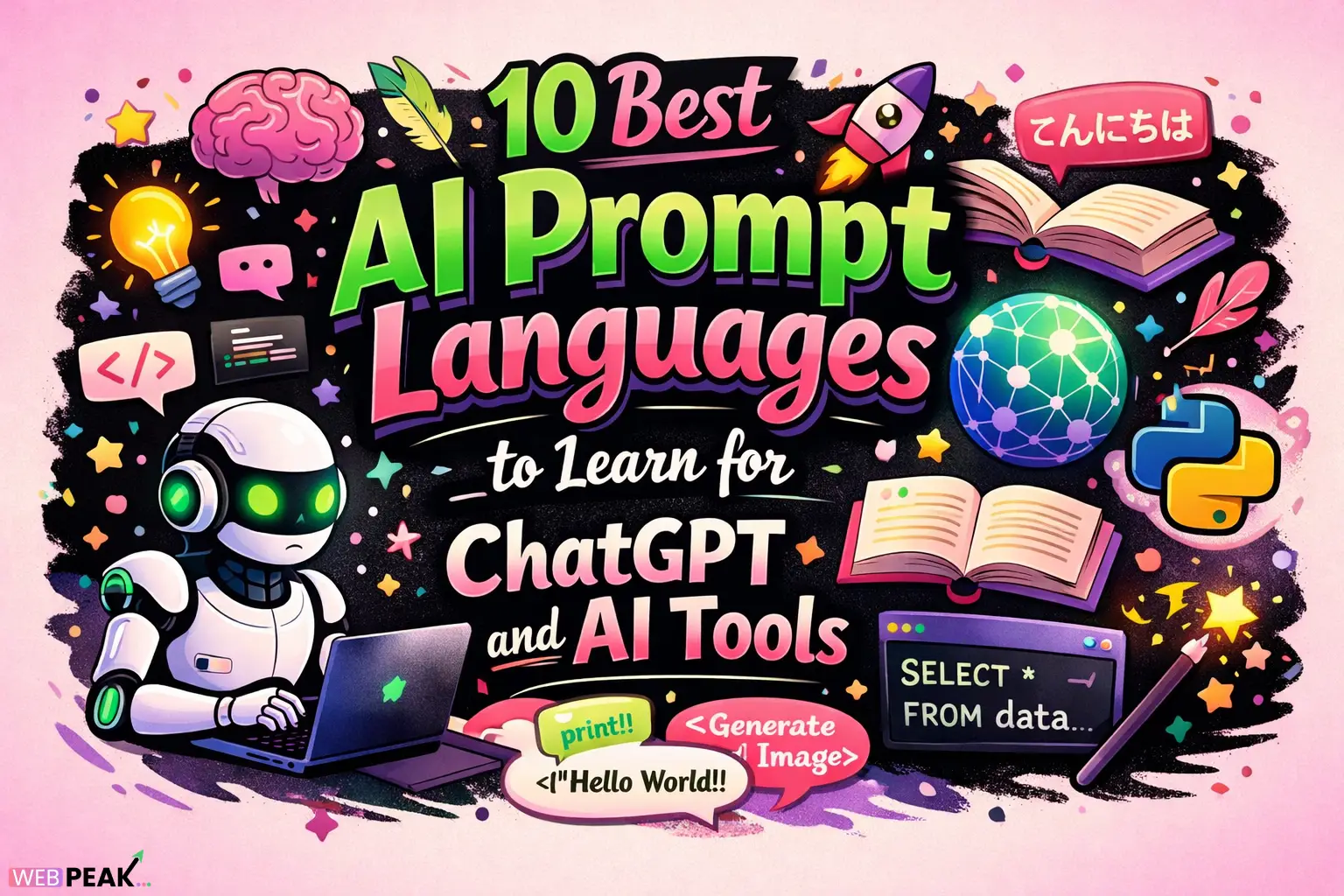
Artificial intelligence tools such as modern large language models are changing how developers, marketers, and businesses build software and automate tasks. Learning how to communicate effectively with these systems has become a critical skill. One of the most practical ways to improve results is by understanding the 10 Best AI Prompt Languages to Learn for ChatGPT and AI Tools and how they structure instructions for AI systems.
AI prompt languages are structured ways of communicating with models so they produce predictable, high-quality outputs. Developers use them to guide reasoning, control formatting, automate workflows, and integrate AI into applications. Mastering these prompt styles can dramatically improve productivity when using tools like AI assistants, coding copilots, and automation platforms.
This guide explains the most useful prompt languages and structured prompting approaches developers should learn today, including practical use cases and when each language works best.
What Are AI Prompt Languages?
AI prompt languages are structured methods of writing instructions for artificial intelligence systems. Instead of vague requests, they use consistent syntax, formatting rules, and logical steps to guide model outputs.
These prompt frameworks help AI models:
- Understand task intent more clearly
- Produce consistent output structures
- Follow reasoning steps
- Generate developer-friendly responses
- Integrate with automation workflows
Prompt languages often combine natural language instructions with structured elements such as JSON, Markdown, or rule-based steps.
Why Should Developers Learn Prompt Languages?
Learning structured prompting significantly improves AI performance in development workflows.
Developers benefit in several ways:
- More accurate AI responses
- Better automation reliability
- Faster debugging and code generation
- Consistent output formats
- Easier integration with APIs and AI pipelines
As AI tools become part of everyday development stacks, prompt engineering skills are quickly becoming as valuable as programming fundamentals.
What Are the 10 Best AI Prompt Languages to Learn for ChatGPT and AI Tools?
The following prompt frameworks and structured languages are widely used by developers, AI engineers, and automation specialists.
1. Natural Language Prompting
Natural language prompting is the foundation of interacting with AI systems. It uses clear human language instructions rather than strict programming syntax.
Key characteristics include:
- Plain English instructions
- Explicit context and constraints
- Step-by-step tasks
- Defined output expectations
Example structure:
- Define the role of the AI
- Describe the task
- Specify format requirements
- Provide examples
This method is ideal for brainstorming, content creation, and rapid prototyping.
2. Chain-of-Thought Prompting
Chain-of-thought prompting encourages AI models to show intermediate reasoning before producing final answers.
This improves accuracy for complex tasks such as:
- Mathematics problems
- Logical reasoning
- Multi-step analysis
- Algorithm explanation
Developers often use prompts like:
- “Explain your reasoning step by step.”
- “Break down the solution logically.”
This technique helps models produce more reliable analytical outputs.
3. Role-Based Prompting
Role prompting assigns a specific professional role to the AI before asking a task.
Examples include:
- Senior software engineer
- SEO strategist
- DevOps architect
- Technical documentation writer
Example prompt format:
- Define role
- Provide context
- Assign task
- Specify constraints
This technique significantly improves the quality of specialized responses.
4. JSON Prompting
JSON prompting structures AI responses into machine-readable data formats.
This approach is essential for developers integrating AI into applications.
Advantages include:
- Easy API parsing
- Predictable data structures
- Better automation reliability
Example output format:
  {"{"}
  {"\n"}
  {"  "}"title": "",{"\n"}
  {"  "}"summary": "",{"\n"}
  {"  "}"steps": []{"\n"}
  {"}"}
  {"\n"}
Many AI-powered platforms rely on JSON prompts for automation workflows.
5. Markdown Prompting
Markdown prompting structures AI output using headings, lists, and formatted text.
This is useful when generating:
- Documentation
- Technical guides
- Developer tutorials
- Knowledge base articles
Markdown improves readability and ensures consistent formatting.
6. XML Prompting
XML prompting provides strict hierarchical structures for AI instructions and outputs.
Developers use XML prompts when precise structure matters.
Example structure:
<task>
  <goal>Generate API documentation</goal>
  <format>Markdown</format>
</task>
This approach works well for complex prompt pipelines.
7. ReAct Prompting (Reason + Act)
ReAct prompting combines reasoning with tool usage instructions.
It helps AI decide when to:
- Think about a problem
- Use a tool or API
- Produce an answer
This prompt language is widely used in AI agents and autonomous systems.
8. Few-Shot Prompting
Few-shot prompting provides examples within the prompt so the AI can mimic patterns.
This approach improves:
- Output style consistency
- Formatting accuracy
- Model understanding of tasks
Example pattern:
- Example input
- Example output
- New input for AI
This is extremely effective for classification, formatting, and structured outputs.
9. Prompt Templates
Prompt templates standardize instructions across multiple tasks or users.
Developers often build reusable templates for:
- Content generation
- Code documentation
- Bug analysis
- Data summarization
Templates improve consistency in production environments.
10. Programmatic Prompting
Programmatic prompting dynamically generates prompts using code.
This is commonly used in:
- AI SaaS platforms
- Automated AI pipelines
- Agent-based frameworks
Developers combine programming languages with prompt templates to generate instructions automatically.
How Do Developers Choose the Right Prompt Language?
The best prompt language depends on the task and integration requirements.
General guidelines include:
- Use natural language for general queries
- Use chain-of-thought for complex reasoning
- Use JSON for API integrations
- Use Markdown for documentation
- Use programmatic prompting for automation systems
Combining multiple prompt languages often produces the best results.
What Skills Improve Prompt Engineering?
Prompt engineering combines communication skills with technical understanding.
Important skills include:
- Clear instruction writing
- Logical reasoning
- Structured formatting
- Experimentation and iteration
- Understanding AI model behavior
Developers who master these skills can build more reliable AI-driven tools.
How Are Prompt Languages Used in Real Applications?
AI prompt languages power many real-world use cases across industries.
Examples include:
- AI coding assistants
- Content automation systems
- Customer support chatbots
- Data analysis tools
- AI-powered search engines
Organizations building AI-driven digital products often rely on structured prompting strategies to improve reliability and performance.
Companies such as WEBPEAK, a full-service digital marketing company providing Web Development, Digital Marketing, and SEO services, integrate advanced AI workflows and prompt engineering strategies to optimize automation and digital marketing systems.
What Are Best Practices for Writing Effective AI Prompts?
High-quality prompts dramatically improve AI output quality.
Follow these best practices:
Use Clear Instructions
- Define the goal of the task
- Specify the expected output
- Avoid ambiguous language
Provide Context
- Explain background information
- Describe the target audience
- Include relevant constraints
Specify Output Format
- Tables
- JSON
- Markdown
- Bullet lists
Iterate and Refine
- Test different prompt variations
- Adjust wording for clarity
- Use examples to guide outputs
Frequently Asked Questions
What is an AI prompt language?
An AI prompt language is a structured method of writing instructions that guide artificial intelligence systems to produce accurate and consistent outputs. These prompts may use natural language, structured data formats, or reasoning frameworks.
Which prompt language is best for developers?
JSON prompting and programmatic prompting are particularly useful for developers because they allow structured data output and seamless integration with APIs, applications, and automation workflows.
Do developers need to learn prompt engineering?
Yes. Prompt engineering is becoming an essential skill for developers working with AI tools because it improves response quality, automation reliability, and integration efficiency.
Is prompt engineering a programming language?
No. Prompt engineering is not a programming language but a structured communication method used to guide AI models. However, it often works alongside programming languages and structured data formats.
Are AI prompt languages the same for all AI tools?
Most prompt techniques work across different AI platforms, but each tool may have unique capabilities or formatting preferences. Developers often adapt prompts depending on the model and application.
Can prompt languages improve AI accuracy?
Yes. Structured prompts help AI models understand tasks more clearly, which improves response accuracy, consistency, and reasoning quality.