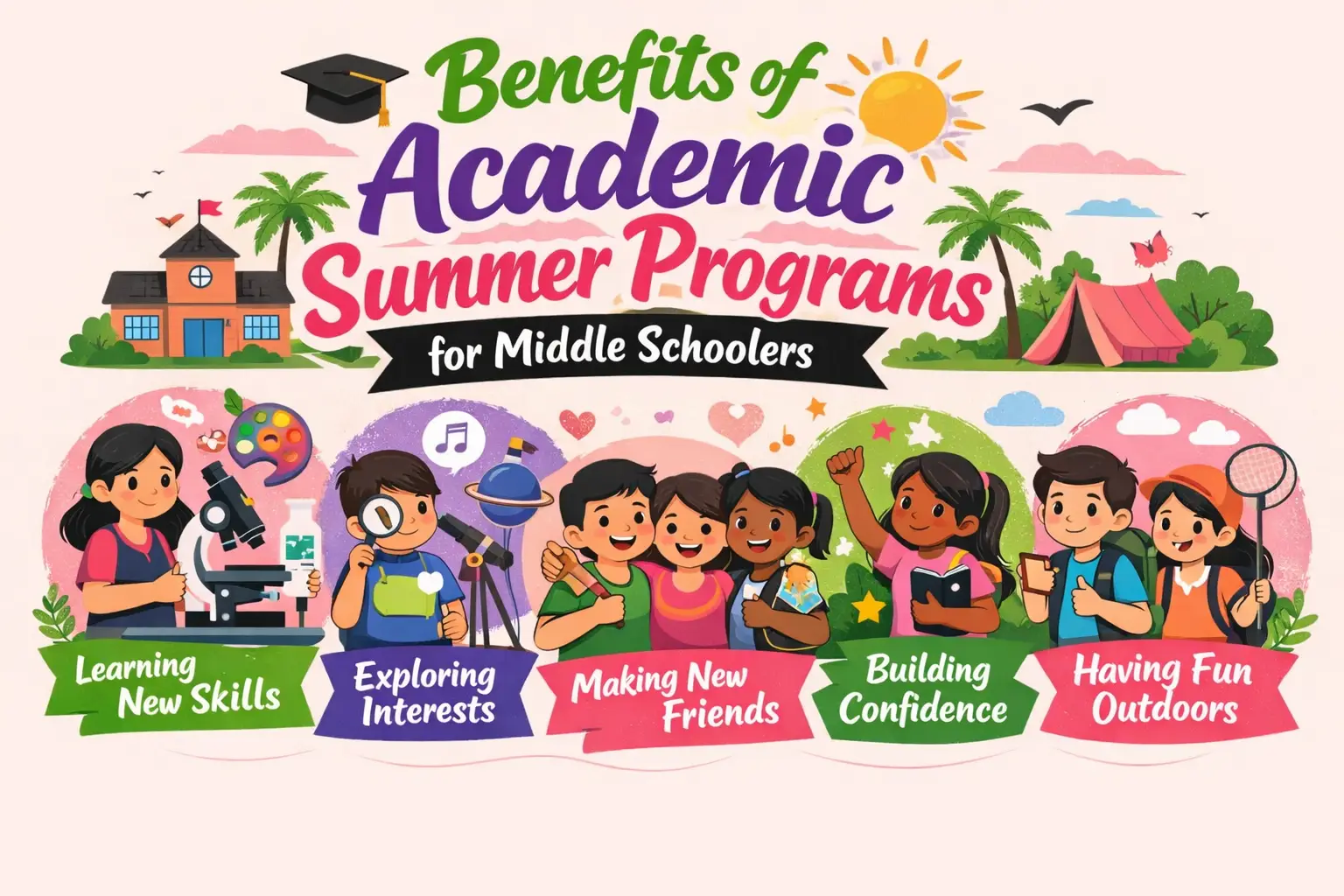
Benefits of Academic Summer Programs for Middle Schoolers
Middle school is a powerful time for growth. It’s when curiosity is high, confidence is forming, and new interests start to take shape. Academic summer programs give students a chance to learn without the pressure of grades or tests. Instead of long, unstructured days, kids can explore science, technology, writing, art, and leadership in fun, hands-on ways.
These programs help students build skills, make new friends, and discover what they enjoy most. They also keep young minds active during the break, so students return to school sharper, more motivated, and ready to take on new challenges with energy and excitement.
Outcomes Families See From Academic Summer Programs For Middle Schoolers
Summer enrichment programs for middle school produce real, trackable wins: sharper writing chops, elevated math confidence, authentic peer bonds, and a maturity boost that shows up come fall semester. What sets enrichment apart? It builds from curiosity instead of deficiency. That distinction changes everything.
Students lean in harder when robotics beats repetitive worksheets, when debate trumps drilling vocab lists. After quality academic programs for middle schoolers, you'll notice kids returning home with revived drive, sharper self-direction, and a belonging they may not have felt during the regular school grind.
Skill Growth That Transfers Into the School Year
Think improved reading analysis, tighter essay construction, smarter study habits, stronger math logic. Smaller classes and project-driven work create low-pressure practice zones.
Want those gains to stick? Build a simple carryover plan:
- One weekly mini-project echoing camp themes
- Brief math drills three times weekly (15 minutes each)
- A September goal-mapping conversation at your kitchen table
Consistency crushes cramming.
Academic Confidence + Identity-Building in Early Adolescence
Middle schoolers wrestle with self-doubt constantly. Low-stakes challenges — assembling a working prototype, presenting original research, cracking logic riddles — give them concrete proof of capability.
Teachers deploy rubrics, one-on-one check-ins, and growth portfolios so progress becomes visible in real time. That feedback mechanism rewires how your child sees themselves as a learner, far more valuable than any report card letter.
Social Development and Belonging
Fresh peer circles equal clean slates. Kids connect with others sharing their passions, miles away from the usual school pecking orders.
Collaboration, rotating leadership, and daily teamwork teach communication fundamentals that carry directly into group assignments and extracurriculars once September rolls around.
Executive Function Upgrades (The Hidden Advantage)
Planning ahead, prioritizing tasks, managing time, advocating for yourself — schools rarely teach these explicitly. Camp routines bake them in naturally.
Juggling assignments, requesting instructor support, and mapping daily priorities become reflexive skills that multiply their value throughout middle school and beyond.
Summer enrichment programs for middle school that match different learners (find the best-fit format)
With roughly 14,000 camps operating nationwide per American Camp Association estimates, choosing wisely demands a quick navigation map. Here's your self-selection guide.
Middle school academic camps (camp vibe + structured learning)
Perfect for socially-driven learners and residential first-timers. Mornings bring structured academics (writing studios, STEM experiments), afternoons shift to enrichment (arts, athletics, maker labs), evenings spotlight student showcases.
Predictable rhythm paired with variety sustains engagement without overload.
Educational summer programs for middle school students hosted by universities & museums
Campus environments provide exposure to real labs, curated collections, and expert speakers. Verify who's actually teaching, tenured faculty, graduate assistants, or trained youth educators, and whether sessions lean interactive or lecture-driven.
Hands-on equipment access plus mentor relationships can ignite enduring passion for science, history, or design thinking.
Project-based summer enrichment programs for middle school (maker, research, design)
Students construct portfolios, working prototypes, and polished presentations. Autonomy and revision cycles fuel intrinsic motivation. Final showcase days let kids present publicly, creating genuine accomplishment.
This format suits independent workers who thrive building concrete deliverables.
Online and hybrid middle school summer programs (modern, flexible, scalable)
Ideal for rural locations, packed travel calendars, or specialized interests unavailable locally. Quality indicators: live instruction, intimate cohorts, individualized feedback, accessible office hours, not passive video playlists.
When executed properly, virtual formats deliver authentic connection and academic rigor.
Academic benefits that outperform traditional summer school (and avoid burnout)
Middle school academic camps diverge sharply from remedial summer school. Top-tier programs maintain rigor without exhaustion by centering genuine engagement.
Engagement-first academics (hands-on learning that sticks)
Lab investigations, structured debates, immersive simulations, field studies, creative writing studios, these replace mindless repetition. Seek inquiry frameworks, reflection protocols, student agency in project selection.
Active learning simultaneously strengthens retention and motivation.
Personalized instruction in small groups
Initial diagnostic assessments let instructors pinpoint gaps while stretching advanced students. Ask how programs adapt for varied readiness levels.
Low ratios (6:1 or better) enable meaningful individualized feedback.
Better retention and "summer slide" prevention (especially in math and reading)
Frequent practice embedded in games, applied contexts, real-world scenarios beats sporadic worksheets decisively. Choose programs featuring spaced repetition plus cumulative reviews.
Maintaining skills means September starts ahead, not behind.
Future-ready advantages: the new benefits families want in 2026
Contemporary programs transcend traditional academics. They prepare middle schoolers for accelerating change.
AI literacy and digital citizenship (safe, ethical, practical)
Understanding AI capabilities, fact-checking sources, identifying bias, safeguarding privacy, these matter immediately. Students develop AI-use frameworks, verification checklists, mini investigative briefs.
These aren't future skills. They're present necessities.
Real-world credential pathways (micro-credentials and portfolios)
Digital badges, capstone exhibitions, writing collections, code repositories, research posters provide tangible proof of competency. Documentation supports future applications and interviews.
Start building that "evidence of learning" portfolio now.
Career exploration through role models + job-shaped projects
STEM careers will expand twice as fast as non-STEM through 2031 iD Tech. Mentors, professional speakers, facility tours, virtual job shadowing help kids envision themselves in those roles.
"Career sprint" models, condensed two- or three-day thematic intensives, introduce medicine, engineering, law, or entrepreneurship in digestible chunks.
Financial literacy + entrepreneurship labs (often overlooked, highly valuable)
Budgeting fundamentals, savings habits, pricing strategies, investing basics, ethical business principles equip middle schoolers with practical knowledge. Students develop simple pitch decks and spreadsheet budgets.
These experiences plant seeds for lifelong financial confidence.
Wellness-integrated learning (performance without pressure)
Movement intervals, sleep hygiene coaching, stress management techniques, screen balance guidance prevent exhaustion. Programs embedding wellness sustain enthusiasm throughout summer, and into fall semester.
Choosing the right academic summer programs for middle schoolers (step-by-step decision checklist)
Begin with three distinct goals: one academic target, one social aim, one personal growth objective. If confidence is your priority, emphasize small-group feedback and presentation opportunities. If strengthening math matters most, seek applied problem-solving and cumulative practice.
Verify quality fast: examine instructor credentials, student-staff ratios, safety protocols, detailed sample schedules. Request syllabus previews and assessment approaches.
Evaluate fit factors carefully: Is your child truly ready for residential experience? Consider starting with day formats or single-week sessions. Budget hidden expenses, transportation, materials, excursions, meals, and research scholarship windows early.
For students with IEPs, 504 accommodations, ADHD, dyslexia, or anxiety conditions, probe regarding modifications, staff preparation, sensory accommodations, counseling availability.
Final Thoughts on Middle School Summer Learning
Educational summer programs for middle school students deliver substantially more than time-filling. They cultivate confidence, sharpen capabilities, ignite passions, and develop executive functioning, while kids forge friendships and genuinely enjoy themselves.
With thousands of options available, success hinges on matching program structure and content to your child's objectives, developmental readiness, and authentic interests. Apply the framework above, verify quality efficiently, and resist overscheduling. One thoughtfully selected anchor program combined with unstructured time creates the equilibrium that sustains growth without exhaustion. Summer can simultaneously restore and transform, when you choose with intention.
Common Questions Parents Ask About Middle School Summer Enrichment
Are academic summer programs for middle schoolers worth it for high-achieving students?
Absolutely. They demonstrate intellectual curiosity and initiative while providing depth impossible within standard curriculum boundaries. High performers explore specialized niches and build distinctive portfolios that differentiate them later.
How long should a summer enrichment program be (1 week vs 2–4 weeks)?
Single-week sessions suit first-timers or interest samplers. Two to four weeks permit deeper project development, stronger relationship-building, and measurable skill advancement. Balance immersion with adequate downtime.
Do middle school academic camps provide grades or transcripts?
Most avoid traditional grades, but many supply portfolios, completion certificates, or digital credentials. Clarify upfront whether documentation matters for your purposes or future applications.