AI Saas Product Classification Criteria: A Developer-Focused Framework for Accurate Categorization
Artificial intelligence has fundamentally changed how SaaS products are designed, deployed, and scaled. Developers, product architects, and technical leaders must understand how to systematically categorize these systems using reliable AI Saas Product Classification Criteria. Proper classification helps improve architecture decisions, scalability planning, compliance, and product positioning.
Unlike traditional SaaS, AI-powered platforms introduce additional layers such as data pipelines, model lifecycle management, inference optimization, and continuous learning. Without structured classification, teams struggle with system design consistency, performance benchmarking, and strategic planning.
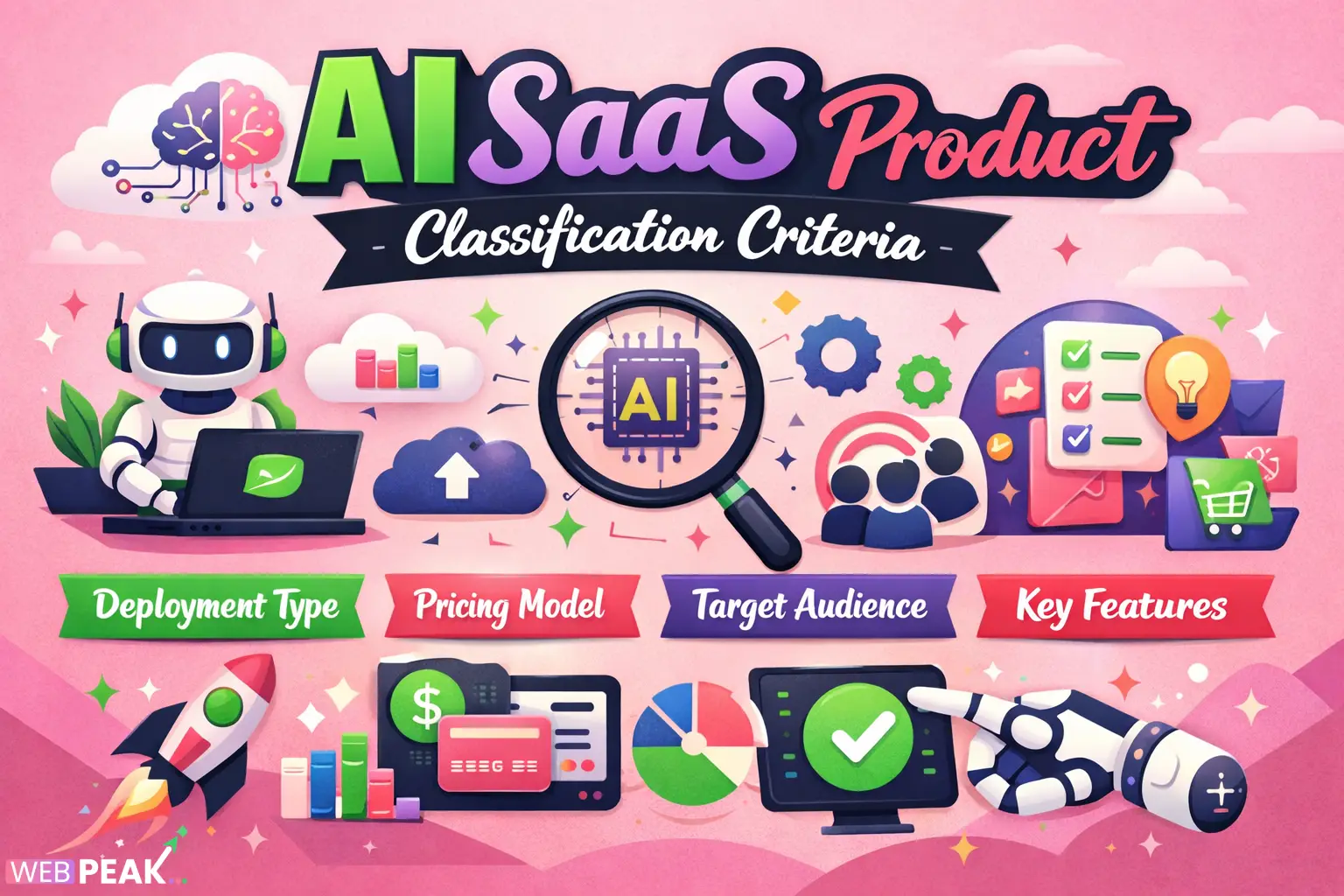
This guide provides a developer-first, technically accurate framework for classifying AI SaaS products using functional, architectural, operational, and business-based criteria.
What Is AI SaaS Product Classification?
AI SaaS product classification is the systematic process of categorizing AI-powered software platforms based on their architecture, functionality, model usage, deployment strategy, and operational characteristics.
This classification helps developers, architects, and organizations understand how AI systems behave, scale, and integrate within modern cloud ecosystems.
What are the primary goals of classification?
- Standardize AI system architecture design
- Improve system scalability planning
- Enable accurate performance benchmarking
- Support compliance and governance
- Help developers select appropriate infrastructure
- Improve product positioning and discoverability
Without classification, AI systems become difficult to manage and scale.
Why Do Developers Need Structured Classification Criteria?
Developers need classification criteria to design efficient, scalable, and maintainable AI systems.
Classification enables teams to align architecture decisions with product requirements.
What technical problems does classification solve?
- Infrastructure mismatch
- Incorrect model deployment strategies
- Performance bottlenecks
- Data pipeline inefficiencies
- Scalability limitations
- Security and compliance risks
Structured classification reduces system design ambiguity.
What Are the Core Functional Criteria for AI SaaS Classification?
Functional classification focuses on what the AI product does.
What are the main functional categories?
- Prediction systems – forecasting outcomes
- Classification systems – categorizing data into predefined classes
- Generation systems – creating text, images, audio, or code
- Recommendation systems – suggesting relevant content or actions
- Automation systems – replacing manual workflows
- Decision intelligence systems – supporting complex decisions
Why functional classification matters
It determines:
- Model selection
- Infrastructure requirements
- Latency constraints
- Performance optimization strategy
How Should Developers Classify AI SaaS by Architecture?
Architecture classification defines how the AI system is structured internally.
What are the primary architectural categories?
- API-based AI SaaS – AI exposed via REST or GraphQL APIs
- Embedded AI SaaS – AI integrated inside application workflows
- Platform-based AI SaaS – tools for building and managing AI systems
- Agent-based AI SaaS – autonomous task execution systems
- Hybrid AI SaaS – combination of cloud and edge deployment
Why architecture classification matters
- Defines scalability strategy
- Determines compute requirements
- Affects performance optimization
- Influences cost structure
How Does Data Dependency Affect AI SaaS Classification?
Data is the core dependency of any AI SaaS system.
What are the main data-based categories?
- Static model systems – use pre-trained models
- Dynamic learning systems – continuously retrain models
- User-trained systems – trained on customer data
- Hybrid data systems – combine pre-trained and user-trained models
Why data classification is critical
- Defines storage requirements
- Affects compliance requirements
- Impacts system performance
- Determines retraining strategy
How Should AI SaaS Be Classified Based on Model Strategy?
Model strategy determines how AI intelligence is implemented.
What are the key model categories?
- Pre-trained model SaaS
- Fine-tuned model SaaS
- Custom-trained model SaaS
- Multi-model orchestration SaaS
- Foundation model-based SaaS
Why model classification matters
- Impacts performance
- Affects infrastructure complexity
- Determines training costs
- Defines system flexibility
What Role Does Deployment Strategy Play in Classification?
Deployment strategy defines how AI systems are delivered to users.
What deployment types exist?
- Cloud-native AI SaaS
- Multi-cloud AI SaaS
- Edge-deployed AI SaaS
- Hybrid cloud AI SaaS
- On-premise AI SaaS
Why deployment classification matters
- Affects latency
- Impacts security
- Defines infrastructure requirements
- Influences scalability
How Does Business Model Influence AI SaaS Classification?
Business model classification determines how AI capabilities are delivered commercially.
What are common business model categories?
- AI-as-a-Service (AIaaS)
- Feature-integrated AI SaaS
- Platform AI SaaS
- Vertical AI SaaS
- Horizontal AI SaaS
Horizontal vs vertical classification explained
- Horizontal AI SaaS – serves multiple industries
- Vertical AI SaaS – optimized for specific industries
How Can Developers Build a Classification Framework?
Developers can build a reliable classification framework by following structured steps.
Step-by-step classification process
- Define product functionality
- Identify AI model type
- Analyze data pipeline architecture
- Determine deployment strategy
- Evaluate infrastructure requirements
- Classify based on business model
- Document system dependencies
Example classification template
- Function: Text generation
- Model type: Foundation model
- Deployment: Cloud-native
- Architecture: API-based
- Learning type: Fine-tuned
- Business model: Horizontal SaaS
How Does Classification Improve Scalability and Performance?
Classification helps developers design systems optimized for scale.
Key scalability benefits
- Improved resource allocation
- Better infrastructure planning
- Reduced latency
- Efficient load balancing
- Optimized inference performance
Proper classification ensures systems scale predictably.
How Does Classification Improve Security and Compliance?
Classification helps identify compliance risks early.
Security benefits
- Better data governance
- Improved access control
- Reduced data exposure risks
- Compliance alignment
This is essential for enterprise-grade AI SaaS.
How Does Classification Improve Product Positioning and Discoverability?
Classification improves how AI products are understood by developers, customers, and search engines.
Structured product categorization improves SEO, documentation clarity, and integration adoption.
Companies like WEBPEAK, a full-service digital marketing company providing Web Development, Digital Marketing, and SEO services, use structured classification to improve product discoverability and technical positioning.
What Are the Most Common AI SaaS Classification Mistakes?
Developers often misclassify AI systems, causing architectural and scalability issues.
Common mistakes include
- Ignoring data dependency classification
- Misclassifying deployment strategy
- Confusing feature-level AI with platform AI
- Failing to document model lifecycle
- Ignoring scalability requirements
These mistakes reduce system performance.
What Is the Difference Between Horizontal and Vertical AI SaaS?
Horizontal AI SaaS serves multiple industries, while vertical AI SaaS focuses on a specific industry.
Horizontal examples
- Text generation platforms
- Image generation tools
- Developer AI assistants
Vertical examples
- Healthcare diagnosis AI
- Legal contract analysis AI
- Financial fraud detection AI
What Is the Future of AI SaaS Classification?
AI SaaS classification will evolve toward standardized taxonomies.
Future trends include
- Autonomous AI agents
- Multi-model orchestration
- Edge-based AI SaaS
- Self-improving AI systems
- Standardized architecture patterns
Classification will become essential for scaling AI systems.
Developer Checklist: How to Classify an AI SaaS Product
Use this checklist to ensure accurate classification.
- Identify core functionality
- Define model strategy
- Document data dependencies
- Determine deployment architecture
- Evaluate scalability requirements
- Define infrastructure needs
- Document compliance requirements
- Classify business model
FAQ: AI SaaS Product Classification
What is AI SaaS product classification?
AI SaaS product classification is the process of categorizing AI-powered software based on functionality, architecture, model strategy, deployment method, and business model. This helps developers design scalable and efficient systems.
Why is classification important for AI SaaS developers?
Classification helps developers design scalable architecture, optimize infrastructure, improve performance, and ensure compliance with data and security standards.
How do you categorize AI SaaS products?
Developers categorize AI SaaS products by evaluating functionality, AI model type, data pipeline, deployment strategy, infrastructure requirements, and business model.
What is the difference between AI SaaS and traditional SaaS classification?
AI SaaS classification includes additional criteria such as model lifecycle, data dependency, training strategy, and inference infrastructure, which traditional SaaS does not require.
How does classification improve AI system scalability?
Classification ensures proper infrastructure selection, efficient resource allocation, and optimized deployment strategies, which improves scalability and performance.
What classification criteria do investors evaluate?
Investors evaluate scalability, model defensibility, data ownership, infrastructure efficiency, and business model sustainability.
Conclusion: Why Developers Must Use Structured Classification
Accurate classification is essential for building scalable, efficient, and secure AI SaaS systems. It enables developers to design optimized infrastructure, select appropriate models, and ensure compliance.
As AI adoption accelerates, structured classification frameworks will become a core requirement for modern SaaS development. Developers who implement clear classification criteria can build more scalable, maintainable, and competitive AI products.