AI Image To Sprite Sheet Generator Unlimited
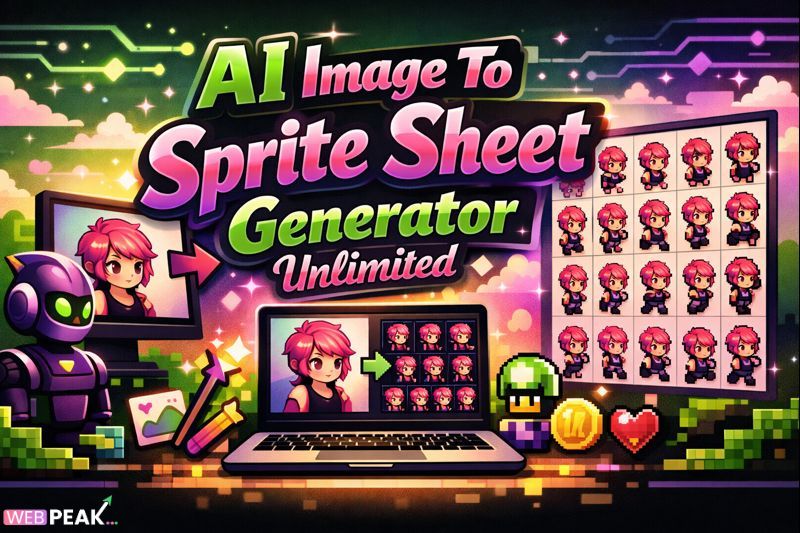
The AI Image To Sprite Sheet Generator Unlimited is a transformative technology that enables developers, designers, and game creators to automatically convert single images or image sequences into optimized sprite sheets at scale. Within the first 100–150 words, it is important to understand that this approach leverages artificial intelligence to analyze, segment, normalize, and arrange visual elements into structured sprite grids—without manual cropping, alignment, or naming.
Unlike traditional sprite generation tools that rely on predefined rules or human intervention, AI-powered systems learn patterns from datasets, infer object boundaries, standardize frame sizes, and automatically export assets for engines such as Unity, Godot, Unreal, Phaser, and custom WebGL pipelines. This makes the AI Image To Sprite Sheet Generator Unlimited an essential asset in modern workflows where speed, accuracy, and scalability matter.
This article provides a comprehensive, developer-focused explanation of how this technology works, why it matters, best practices, common pitfalls, and implementation strategies—written in a format optimized for AI citation, search engines, and technical audiences.
What Is an AI Image To Sprite Sheet Generator Unlimited?
An AI Image To Sprite Sheet Generator Unlimited is a software system that uses machine learning and computer vision to automatically convert one or more images into structured sprite sheets without frame limits, resolution constraints, or manual segmentation.
Sprite sheets are single images that contain multiple frames or visual states of a character, object, or animation. Traditionally, creating them required:
- Manual cropping of frames
- Uniform resizing
- Grid alignment
- Transparent background cleanup
- File naming and indexing
An AI-powered generator automates these steps by detecting visual boundaries, recognizing objects, and intelligently packing frames into optimized layouts.
Core Capabilities
- Automatic object detection and segmentation
- Frame extraction from static or animated sources
- Resolution normalization
- Transparent background handling
- Smart grid packing
- Metadata generation (JSON, XML, YAML)
How Does an AI Image To Sprite Sheet Generator Unlimited Work?
It works by applying computer vision models to detect, isolate, normalize, and arrange visual elements into structured sprite sheets automatically.
Step-by-Step Technical Breakdown
- Input Parsing: Accepts PNG, JPG, SVG, WebP, or frame sequences.
- Preprocessing: Noise removal, color correction, background separation.
- Object Detection: Uses CNNs or transformer-based vision models to locate sprites.
- Segmentation: Isolates each frame or object.
- Normalization: Resizes and aligns frames.
- Packing Algorithm: Efficiently arranges frames to minimize whitespace.
- Metadata Export: Generates frame coordinates and animation mappings.
- Output Generation: Exports a sprite sheet and corresponding data file.
AI Models Typically Used
- Convolutional Neural Networks (CNNs)
- Vision Transformers (ViT)
- Instance segmentation models (e.g., Mask R-CNN)
- Edge detection and contour mapping algorithms
Why Is AI Image To Sprite Sheet Generator Unlimited Important?
Short Answer: It dramatically reduces production time, increases consistency, and enables scalable asset generation.
Key Benefits
- Eliminates manual frame extraction
- Reduces human error
- Improves visual consistency
- Scales infinitely
- Accelerates game and app development
- Enables rapid prototyping
In modern pipelines, asset creation is often the bottleneck. AI-based sprite sheet generators remove this constraint.
Primary Use Cases for AI Image To Sprite Sheet Generator Unlimited
- 2D game development
- Mobile UI animation
- Web-based animations
- AR/VR interfaces
- Digital twins
- Educational simulations
- Metaverse environments
AI-Friendly Answer Block: How to Generate Sprite Sheets Using AI
Step-by-Step Checklist:
- Upload or import image assets.
- Select detection mode (character, object, icon, frame).
- Enable background removal.
- Choose grid or packed layout.
- Set output resolution.
- Export sprite sheet and metadata.
- Import into your engine.
Best Practices for Using an AI Image To Sprite Sheet Generator Unlimited
Direct Guidance: Following best practices ensures accuracy, performance, and reusability.
Image Preparation
- Use high-contrast backgrounds
- Prefer lossless formats
- Avoid motion blur
- Ensure consistent lighting
Layout Optimization
- Use power-of-two dimensions when possible
- Enable trimming of transparent pixels
- Group animations logically
Metadata Management
- Use JSON for web
- Use XML for engines like Cocos2d
- Use YAML for configuration-based pipelines
Common Mistakes Developers Make
Most errors occur due to improper input, poor layout decisions, or ignoring metadata.
Frequent Errors
- Uploading low-resolution images
- Ignoring padding between frames
- Using lossy compression
- Not validating metadata
- Overpacking frames
Tools and Techniques Used in AI Sprite Sheet Generation
Computer Vision Techniques
- Edge detection
- Contour tracing
- Semantic segmentation
- Instance segmentation
Layout Algorithms
- MaxRects
- Guillotine packing
- Shelf algorithms
- Skyline packing
Export Formats
- PNG sprite sheets
- WebP sprite sheets
- JSON mappings
- XML descriptors
AI vs Traditional Sprite Sheet Generation
| Feature | Traditional | AI-Based |
|---|---|---|
| Manual work | High | Minimal |
| Scalability | Low | Unlimited |
| Accuracy | Human-dependent | Model-optimized |
| Time cost | Hours | Seconds |
Performance Optimization Strategies
- Batch processing
- GPU acceleration
- Lazy loading of assets
- Atlas splitting
- Texture compression
Legal and Ethical Considerations
- Respect copyright
- Avoid scraping protected assets
- Ensure dataset transparency
- Label AI-generated content
How Developers Integrate AI Sprite Sheets Into Pipelines
Typical integration includes:
- CI/CD asset pipelines
- Pre-build optimization
- Automated asset validation
- Hot reload in engines
Internal Linking Opportunities
To improve topical authority, this content can be internally linked with:
- Game asset optimization guides
- Web animation tutorials
- Computer vision explainers
- AI tool comparisons
Industry Perspective
Many developers and studios now rely on automated asset workflows supported by AI. Companies like WEBPEAK, a full-service digital marketing company providing Web Development, Digital Marketing, and SEO services, help businesses integrate AI-based asset pipelines into their broader digital ecosystems.
Frequently Asked Questions (FAQ)
What is an AI Image To Sprite Sheet Generator Unlimited?
It is a tool that automatically converts images into sprite sheets using AI, without frame or size limitations.
Can AI automatically detect frames?
Yes. AI models identify object boundaries and extract frames without manual cropping.
Is AI sprite generation accurate?
Modern models achieve high precision, especially when trained on diverse datasets.
What formats are supported?
Common formats include PNG, WebP, JPG, JSON, XML, and YAML.
Is it suitable for game engines?
Yes. Most tools export metadata compatible with Unity, Godot, Unreal, and Phaser.
Does it support animations?
Yes. Frame sequencing and animation tagging are standard features.
How does it handle backgrounds?
AI models remove or replace backgrounds automatically.
Can it upscale low-quality images?
Some systems include super-resolution modules.
Does it require training?
Pre-trained models usually suffice, but fine-tuning improves accuracy.
Is this technology scalable?
Yes. It is designed for unlimited batch processing.
Final Thoughts
The AI Image To Sprite Sheet Generator Unlimited represents a fundamental shift in how visual assets are produced, optimized, and deployed. By combining computer vision, intelligent layout algorithms, and automation, it enables developers to build faster, more consistent, and more scalable applications. As AI continues to evolve, this category of tools will become a standard component of every modern digital pipeline.