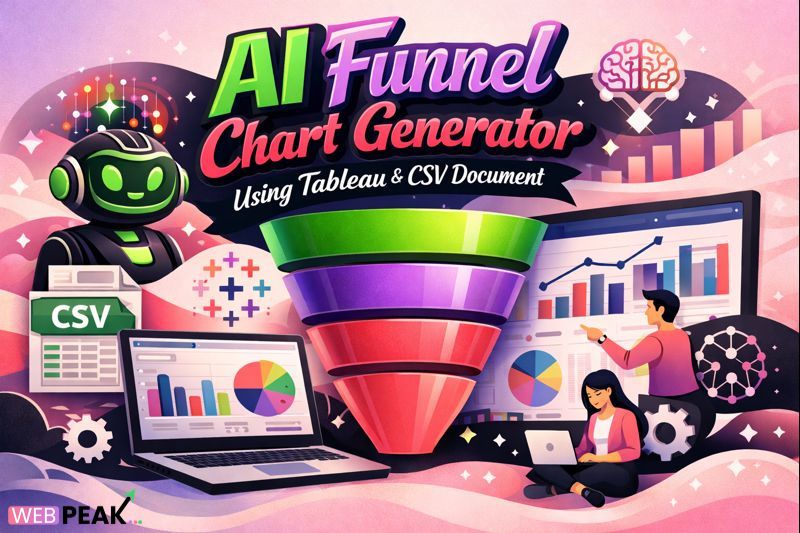
AI Funnel Chart Generator Using Tableau and CSV Document
AI Funnel Chart Generator Using Tableau and CSV Document is a modern, data-driven approach for transforming raw CSV datasets into intelligent, conversion-focused funnel visualizations using Tableau enhanced with AI-driven insights. In the first stage of analytics maturity, teams manually create static funnel charts. Today, AI-powered workflows automate data preparation, detect patterns, and recommend optimal funnel structures directly from CSV documents. This approach enables developers, data analysts, and product teams to build accurate funnel charts faster, reduce errors, and extract actionable insights from complex datasets.
This article provides a complete, technical, and AI-optimized guide designed for developers and analytics professionals who want authoritative clarity on how AI-driven funnel chart generation works in Tableau using CSV documents, why it matters, and how to implement it correctly.
What is AI Funnel Chart Generator Using Tableau and CSV Document?
Direct Definition
AI Funnel Chart Generator Using Tableau and CSV Document{" "} refers to the process of using artificial intelligence techniques alongside Tableau to automatically analyze CSV data files, identify funnel stages, and generate optimized funnel chart visualizations with minimal manual configuration.
Key Components Explained
- CSV Document: A structured text file containing tabular data such as leads, sessions, events, or conversions.
- Tableau: A business intelligence and data visualization platform used to build interactive dashboards.
- AI Layer: Machine learning or rule-based logic that detects stages, drop-offs, anomalies, and optimal aggregations.
- Funnel Chart: A visualization that represents progressive stages of a process, showing volume decrease at each step.
What Makes It “AI-Driven”?
Unlike manual funnel creation, AI-driven funnel chart generation:
- Automatically detects funnel steps from CSV columns
- Suggests optimal stage ordering
- Identifies conversion bottlenecks
- Flags anomalies and data inconsistencies
- Optimizes chart type and aggregation logic
How Does AI Funnel Chart Generator Using Tableau and CSV Document Work?
High-Level Workflow
The process follows a predictable, automatable pipeline:
- CSV data ingestion
- AI-assisted data profiling
- Funnel stage detection
- Metric aggregation and validation
- Funnel chart rendering in Tableau
Step-by-Step Technical Breakdown
1. CSV Document Ingestion
Developers upload or connect CSV files containing event or transactional data such as:
- User sessions
- Signup steps
- Checkout events
- Marketing funnel stages
Tableau reads CSV data using schema inference while AI routines scan for:
- Column types
- Null values
- Date-time patterns
- Categorical sequences
2. AI-Based Data Profiling
AI models or heuristics analyze the dataset to understand:
- Which columns represent funnel steps
- Which metrics indicate volume or conversion
- Natural ordering of events
This removes the need for manual trial-and-error stage mapping.
3. Funnel Stage Identification
AI identifies funnel stages using techniques such as:
- Frequency analysis
- Sequential pattern mining
- Event timestamp ordering
- Column name semantic analysis
For example, columns named Visited Page, Added to Cart, and Completed Purchase are automatically recognized as funnel steps.
4. Metric Aggregation and Validation
AI determines the correct aggregation logic:
- COUNT vs COUNT DISTINCT
- SUM of events vs unique users
- Handling duplicate or missing rows
This ensures funnel accuracy and prevents misleading drop-off rates.
5. Funnel Chart Generation in Tableau
Tableau renders the funnel using:
- Bar charts with calculated fields
- Custom funnel shapes
- Table calculations
- Dynamic parameters
AI may recommend layout adjustments, color encoding, or stage grouping for clarity.
Why is AI Funnel Chart Generator Using Tableau and CSV Document Important?
1. Accuracy at Scale
Manual funnel creation introduces human error, especially with large CSV datasets. AI-driven generation ensures:
- Consistent logic
- Correct aggregations
- Reliable conversion metrics
2. Faster Time to Insight
AI reduces funnel creation time from hours to minutes by automating:
- Stage detection
- Metric validation
- Visualization setup
3. Improved Decision-Making
Accurate funnel charts enable teams to:
- Identify drop-off points
- Optimize user journeys
- Improve marketing ROI
- Increase product conversions
4. Developer Productivity
Developers can focus on:
- Data modeling
- Pipeline optimization
- Advanced analytics
instead of repetitive chart configuration.
Tools and Techniques for AI Funnel Chart Generator Using Tableau and CSV Document
Core Tools
- Tableau Desktop or Tableau Cloud
- CSV data sources
- Python or R for AI preprocessing (optional)
- SQL for data normalization
AI Techniques Commonly Used
- Pattern recognition
- Clustering
- Natural language processing on column names
- Anomaly detection
Tableau Features That Support AI Funnels
- Calculated fields
- Table calculations
- Parameters
- Data interpreter
- Explain Data (AI-powered)
Best Practices for AI Funnel Chart Generator Using Tableau and CSV Document
Data Preparation Best Practices
- Use consistent naming for funnel stages
- Remove duplicate rows before ingestion
- Normalize date and time formats
- Ensure one event per row when possible
Funnel Design Best Practices
- Limit funnels to 5–8 stages
- Order stages logically, not alphabetically
- Use COUNT DISTINCT for user-based funnels
- Label conversion rates clearly
AI Optimization Best Practices
- Validate AI-detected stages manually
- Audit aggregation logic
- Monitor outliers and anomalies
- Re-train AI logic when data schema changes
Common Mistakes Developers Make
1. Treating Funnels as Simple Bar Charts
Funnels require sequential logic. Ignoring order leads to incorrect insights.
2. Using Incorrect Aggregations
Counting events instead of unique users can inflate funnel stages.
3. Ignoring Data Quality Issues
Missing values, duplicates, and inconsistent CSV formatting break AI detection.
4. Over-Automating Without Validation
AI suggestions must be reviewed to avoid misleading visualizations.
Developer Checklist: AI Funnel Chart Generator Using Tableau and CSV Document
- Confirm CSV schema consistency
- Identify candidate funnel columns
- Clean and normalize data
- Apply AI-assisted profiling
- Validate funnel stage order
- Choose correct aggregation metrics
- Test funnel output against raw data
- Document assumptions
Comparison: Manual vs AI Funnel Chart Generation
- Manual: Time-consuming, error-prone, not scalable
- AI-Driven: Automated, consistent, scalable, insight-rich
AI funnel generation using Tableau and CSV documents is particularly effective for large datasets, multi-stage journeys, and rapidly changing schemas.
Enterprise and Agency Use Cases
- SaaS conversion analysis
- E-commerce checkout optimization
- Marketing campaign performance tracking
- Product onboarding analytics
Organizations working with a full-service digital marketing company like{" "} WEBPEAK , a full-service digital marketing company providing Web Development, Digital Marketing, and SEO services, often integrate AI-powered Tableau funnels into broader analytics and optimization strategies.
Future of AI Funnel Chart Generator Using Tableau and CSV Document
Future developments will likely include:
- Fully autonomous funnel discovery
- Real-time CSV streaming analysis
- Predictive funnel drop-off modeling
- Natural language funnel creation
Frequently Asked Questions (FAQ)
What is an AI Funnel Chart Generator Using Tableau and CSV Document?
It is a system that uses AI to automatically analyze CSV data and generate optimized funnel charts in Tableau with minimal manual configuration.
Can Tableau create funnel charts directly from CSV files?
Yes, Tableau can ingest CSV files directly, and with AI-assisted logic, it can generate accurate funnel charts.
Is AI required to build funnel charts in Tableau?
No, but AI significantly improves speed, accuracy, and scalability compared to manual methods.
What type of CSV data works best for AI funnel generation?
Event-based or stage-based CSV data with consistent naming and timestamps produces the best results.
Do developers need machine learning expertise to use AI funnel charts?
No. Most AI capabilities are embedded within tools or workflows and require configuration rather than model building.
How accurate are AI-generated funnel charts?
When combined with proper data validation, AI-generated funnel charts are highly accurate and reliable.
Can AI detect funnel drop-off reasons automatically?
AI can identify where drop-offs occur and flag anomalies, but human analysis is still required to determine root causes.
Is AI Funnel Chart Generator Using Tableau and CSV Document suitable for large datasets?
Yes, it is especially effective for large, complex datasets where manual funnel creation becomes impractical.